

Christian Gadea takes stage lighting to the next level in “Volar es humano, aterrizar es divino” (Flying is Human, Landing is Divine) with Zactrack. At the Teatro Coliseo, this cutting-edge automatic tracking technology illuminates the performers with unparalleled precision, setting a new standard in Argentine stage design. Zactrack shines as the true protagonist of this extraordinary experience!
Buenos Aires is a vibrant city with an extensive history in the world of entertainment. Christian Gadea, lighting designer, embarks on an innovative project that promises to revolutionize the stage experience in the country, as part of the team of the first show in Argentina to incorporate the zactrack automated tracking system.
This is “Volar es humano, aterrizar es divino”, the one-man monologue by Enrique Pineyro, who has been captivating audiences in Buenos Aires for more than 10 years. Now, it is at the historic Teatro Coliseo where zactrack technology transforms the way lighting interacts with the artist, in a show that demands precision and dynamism.
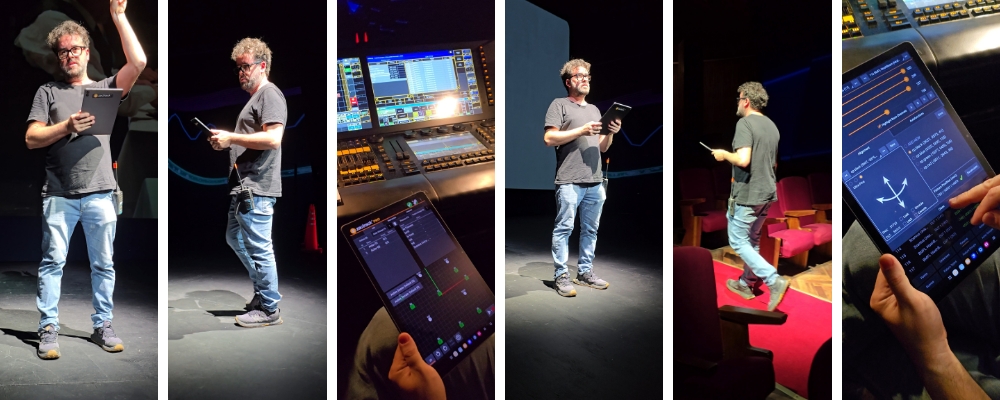
“The zactrack system allows us to make every movement of the artist come to life in a way that has never been seen here before,” says Gadea enthusiastically.
Being the first lighting designer in Argentina to implement zactrack is, for Christian Gadea, an exciting opportunity to integrate new technologies into his designs, an experience that he considers invaluable, especially when dealing with a system that until now was not available in the region.
The idea of using zactrack in “Volar es humano, aterrizar es divino” arose from the need to precisely control the video projections, led by Alfredo Cañas, which create a key immersive environment in the show. “The priority was not to contaminate the images,” he explains, “initially I had opted for manual trackers. However, given the growth of the show, the director asked to incorporate an automated system that offered greater precision and autonomy.”
When the system arrived in Christian’s hands, everything was ready for the first test in Argentina. Alejo Arce, zactrack’s sales manager for Latin America and Spain, traveled from Madrid especially to supervise the installation, accompanied by Oliver Ronshausen, a specialized technician from the brand who came from Germany. “The system arrived on the first day of assembly,” he recalls, “and the zactrack team installed and configured it from scratch.”
Behind that day there was intense preparation work: remote meetings, technical details and finalizing the logistics, making sure that all the necessary materials were available. Once in the theater, Alejo and Oliver guided Gadea through every step, from the initial configuration to the integration. “I received the necessary instructions to start my programming on the console, and from there I was able to control the system.”
For his part, Alejo Arce, a key factor in the implementation of zactrack, ensured a smooth integration of the system: “During planning, I coordinated between production, the distributor and our technical support so that everything was on time and the staff was well advised. My task was to coordinate between the technical team, production and the lighting designer, ensuring that the system was correctly implemented from Germany and locally.”
The implementation of zactrack went smoothly, thanks to the collaboration of Campe, the BALS technician responsible in the room, who took care of the technical aspects. The system, in addition to facilitating the technical process, gave the lighting design a level of precision that would be difficult to achieve manually.
Christian was convinced that the lighting in “Volar es humano, aterrizar es divino” should have a secondary, almost invisible role, to give all the prominence to the actor and the deployment of video projections. Although it may seem like a simple task, this approach required a high level of attention and control. “I was very careful to stay within that criteria,” he says. And this is where zactrack showed its true value, allowing him to focus on the actor in a stage dominated by large-scale video images, without the light contaminating the projections on the walls.
The adjustment process between the stage movements and the precision of the zactrack system took several days of work. Gadea and his team tested different configurations, including two locations for the Tags, the sensors that the actor wears hidden in his costume. “It took a few days of setting up,” says Gadea, “and we tested several technical issues.” Once this initial adjustment phase was over, the system worked without problems, with surprising precision. “Once the system is installed, you just have to turn it on, do a quick test with a light double on stage, and keep an eye on the battery charge and antenna monitoring during the daybefore the show.”
The learning curve with zactrack was a fast and intense experience for the lighting technician. And although he had had previous meetings to familiarize himself with the system, the final assembly was only two days before the premiere. “The curve was gradual and sudden at the same time. Suddenly the premiere came and the system was working and I was waiting for it.”
Regarding programming, Christian Gadea started from the base inherited from other seasons, and the integration was simple: one button activates the system and another controls the iris and zoom of the equipment assigned as followers. “We only ‘updated’ those buttons when we wanted to change parameters and offset values of zactrack,” he analyzes.
In his experience, the coherence of the lighting in each function with the system in full operation has been achieved without problems. “The actor moves through the scene within his ‘light cut’, while being projected onto the background walls and the stage entrance,” he confirms, highlighting the visual contrast between the projections and the fans. “I think that this year, with this addition, we perfectly achieved what I had imagined for this production.”
A clear example of how zactrack makes a difference in Flying is Human, Landing is Divine is during the main monologue, which takes up a large part of the show. “We follow the performer with four heads that cut him out in a visual context of video projections and when the actor leaves, the dimmer turns off following a ready cue, allowing the projections to dominate the scene without interference.”
As for the impact on the audience, he assures that zactrack maintains the visual fluidity of the show.
“zactrack allows the designer to take advantage of luminaires in different positions on the stage as required by each moment of the show, which opens up an immense creative range,” said Alejo Arce, “it facilitates the use of any luminaire on the set as a follower, without additional effort, allowing the actor to move freely around the stage without technical restrictions. Without a doubt, it is a tool that breaks creative and technical barriers, offering freedom to both the director and the performer.”
Of course, the collaboration with Enrique Piñeyro and the technical team was key to a successful implementation. “Enrique placed the tags on his shoulders as we had been advised, since the system was set for that location. He must have maximum technical comfort to be well concentrated to ensure that everything was comfortable for him, considering that his performance is long.”
On the other hand, the technical team was always willing to make small adjustments to the system, adapting to the needs of the show. Gadea highlights: “There were no major difficulties as I previously said. There is a great deal of development behind this technology.”
“The performance of zactrack has been impeccable, respecting our recommendations for configuration and positioning of antennas and trackers, which allowed the designer to use any luminaire as a tracker,” Alejo concludes, adding with satisfaction: “The installation and configuration were carried out quickly and efficiently, and any subsequent adjustments, even remotely, were simple thanks to its intuitive interface. The technical team was very satisfied with the reliability of the system, and the fact of being able to count on a solid after-sales service gives them additional confidence.”
And yes, of course, Cristian received training from both zactrack and its distributor in Argentina, Stage Tech, to ensure correct use of the system. An example of this arose when, between functions, the front heads were moved, which, although it did not alter their physical location, required recalibrating the system. “For that we had a meeting with Alejo and Oliver, who explained the calibration procedure perfectly, which did not take more than an hour.”
His experience with Alejo Arce from zactrack has been very positive. “Alejo has a great technical knowledge of the zactrack system and grandMA controllers, and that gives you a lot of confidence when it comes to needing information. It was a great contact for me, since it was a system I had never used, it was key to feel comfortable and supported, and that was the case with him. He is one of those professionals who raise the bar for the activity, so it was good for me to meet him.”
Regarding his relationship with Stage Tech, Gadea has maintained contact to access training on new releases. “They were present in the room for a few days of the installation, since they are the local support. Antonio Agra and Sebastián, a technician specialized in grandMA and now zactrack, were present, and when we had to ask about setup issues, I also contacted them and they responded perfectly.”
In summary, the experience of working on the lighting of Flying is Human, Landing is Divine was very positive for this lighting technician: “as I learned to join a dynamic that is not so common for me, since the team is very large and there are many resources available. This year, with the incorporation of zactrack, what was desired was achieved in a more precise way and the aesthetic result was as desired.”
As the first user of zactrack in Argentina, Gadea sees great potential in this technology for future productions. “I feel that it can add great possibilities to lighting setups, and obviously, in the future I am interested in learning and incorporating more possibilities, dimmer control, zoom, colors…”.
Regarding his role as a pioneer in its use, he assures that he is passionate about the technology and that he sees it as a “very interesting job opportunity, to incorporate and continue learning about its possibilities. It will be very good if it becomes common to find zactrack working in different rooms and local venues,” he comments.
Surely, after this experience, zactrack will become an indispensable tool in his future projects, because the precision and ease of operation that it offers are fundamental aspects to achieve excellent results. “I am interested in the tool being based on the aesthetic needs of the show, not the other way around. And yes, of course, it will be an integral part of my “kit” for future projects. In addition, it integrates perfectly with grandMA’s programming, which simplifies the process even more and improves the fluidity of the show.”
With zactrack already being a global success, the trend seems to indicate that, in the near future, it will be an essential tool for Lighting Designers in Argentina.
And Alejo Arce echoes these words and asserts that “The implementation of zactrack in the country marks a before and after for lighting design and other technical aspects in local theater. It is a technology that redefines how technical elements can interact in real time with actors, allowing designers from different areas – lighting, sound and video – to create more dynamic experiences. The word that is used a lot for these technologies is ‘immersive’, but I prefer to describe it as something organic, an experience that connects with the viewer in a more intimate and less passive way.”
In addition to the creative impact, Arce highlights the added value of zactrack in offering precision and freedom simultaneously: “The possibility that opens up for us now as designers is enormous. This technology helps us tell stories in a more dynamic way, connecting the audience with what happens on stage and making them complicit in the narrative.”
For his part, its most recent user, Christian Gadea, encourages professionals to actively participate in the exploration of this tool, highlighting its capacity to transform stage lighting.
Thus, the technology, which has already transformed international stages, promises to continue setting the course for lighting in Argentine theatre.


