
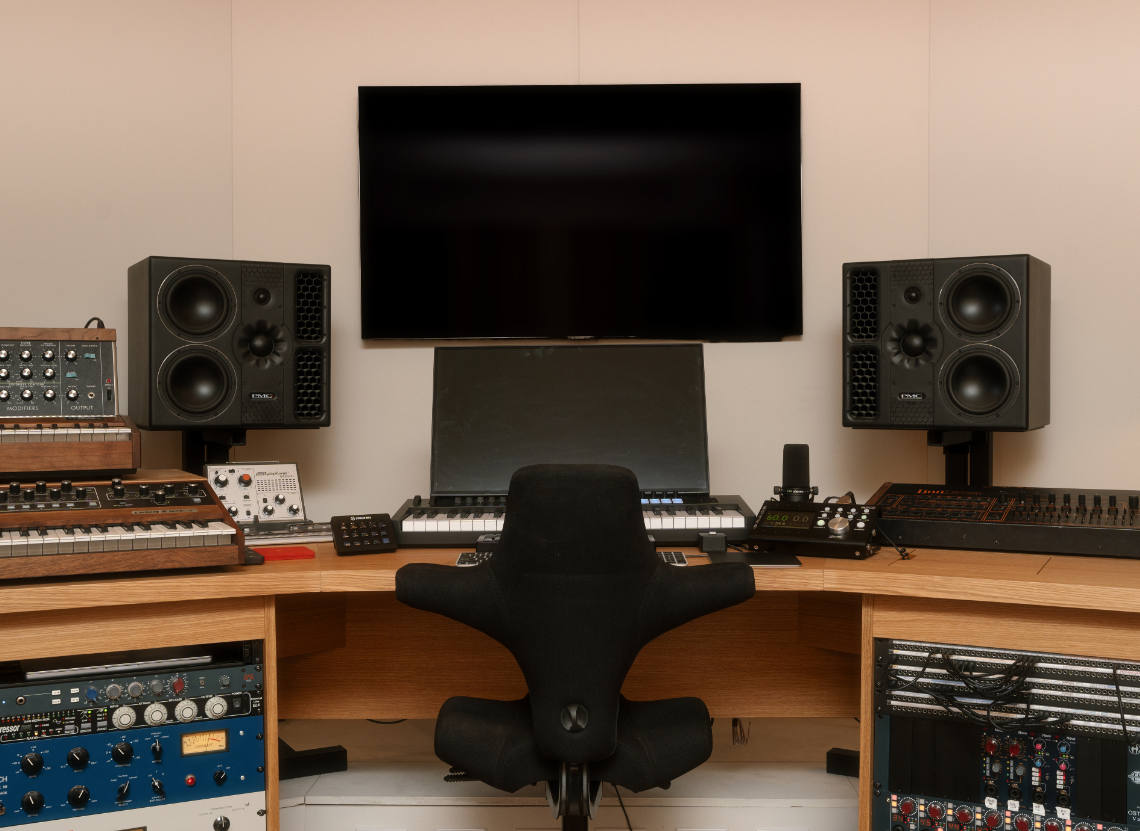
USA – WSDG has completed the acoustic and technical design of SongBoy Studios, a new professional recording facility built for music producer and songwriter Rich Tuorto in the Dumbo neighborhood of Brooklyn, New York.
Tuorto, a Cornell University-trained architect turned touring musician turned producer, first came to wider attention through a stint on American Idol before redirecting his career toward songwriting and production. After years of working from his home in Prospect Heights, the growth of his business and broader creative ambitions made a dedicated professional space a necessity. Managed by Assemble Sound, an affiliate of Atlantic Records, Tuorto is currently focused on developing artists in close collaboration with Atlantic. SongBoy Studios was conceived not only to support his own production work, but also to provide a platform for a potential publishing company, songwriter camps, and use by Atlantic Records and other labels, including the recently acquired Fader label.
WSDG Partner and Project Manager Will Brown led the design effort, delivering acoustical design, structural acoustics, room acoustics, technical interiors, and AV design as a full-package scope. The builder was Studios by Sonic, with Matt Schaefer of Full Normal serving as AV integrator.
The studio occupies approximately 1,500 square feet within a mixed-use building in Dumbo, previously held by a single tenant whose departure allowed the floor to be subdivided into smaller units. The timing proved advantageous: the project team was able to implement construction modifications before other tenants moved in, adding flexibility that would have been difficult to achieve in a more established building.
The facility is built around a large primary control room designed to function as both a high-performance mixing and production environment and a live tracking space. A separate iso booth, sized to accommodate a full drum kit, provides dedicated isolation for recording drums, vocals, and other instruments.
The design of SongBoy Studios is defined by an equal commitment to acoustic precision and livability. Tuorto was emphatic about materiality from the outset: all walls are clad in oak wood paneling, herringbone timber flooring runs throughout, and a custom-built desk serves as the centerpiece of the control room. Custom lighting, a bespoke millwork bar, and considered finish selections throughout give the space a distinctly residential quality.
“There needed to be a balance between comfortability of space, it feeling like home, and also being professional enough,” says Tuorto. “The way that it’s been built really does make it feel like home, and it’s big enough to have multiple people in there and be really serene. I was hell-bent on all the walls being this oak wood paneling, maybe in a crazy way, but it was worth it. It’s absolutely stunning in person.”
The acoustic strategy was developed with deliberate restraint, avoiding the over-treated, fabric-heavy aesthetic common in production rooms in favor of treatments that feel integrated and unobtrusive. Helmholtz resonators and carefully positioned reflectors are used in both the control room and the booth to achieve a controlled but live-feeling acoustic environment throughout.
“From our standpoint as designers, we were trying to be as efficient with the acoustic treatment as possible,” notes Brown. “We didn’t want a room that felt stuffy and overwhelmed the user with stretched fabric. Knowing how Rich intends to use this space, as a control room that also must serve as a live room at times, we had to prioritize not only playback accuracy for the mix engineer, but also the character of the room’s acoustics for the musician.”
A mid-project challenge arose when the building’s landlord confirmed that an HVAC plenum box previously thought moveable had to remain in place. The design team adapted by encapsulating it within the soffit, turning a structural constraint into an architectural feature. The space also features two clerestory windows along the rear wall, retained as a prominent design element that introduces natural light while maintaining acoustic and aesthetic integrity.
Beyond the studio itself, the space includes a kitchen, an eat-in dining area in the entry corridor, and a built-in hallway cabinet with bar, creating a hospitality zone that allows artists and collaborators to decompress without fully leaving the studio environment.
“I like that there’s a moment where you can exit the studio and still hang in the studio,” says Tuorto. “From when you walk in, it’s not like you open the door and you’re immediately in the studio. I think that’s a huge value add for the people using the space.”
The studio is built around a hybrid production workflow, with the primary workstation computer-based and supported by a comprehensive suite of analogue outboard gear for coloring and processing. Monitoring is handled by PMC loudspeakers with a Genelec subwoofer, and the room also houses a Yamaha piano. The infrastructure has been future-proofed with additional conduit runs throughout, allowing gear to be added and cabling rerouted without structural intervention.
“The space has been designed in a way that allows me to grow into it,” says Tuorto. “The extra conduit runs aren’t needed now, but if we need to add more gear later, we have the avenues to pull the cable and hook things up without ripping up the wall or the ceiling. I think the room is set up wonderfully for someone to come in and use it however they choose.”
SongBoy Studios opened in May 2026 and is already in active use for artist development sessions, songwriting camps, and productions in collaboration with Atlantic Records and associated labels.


