
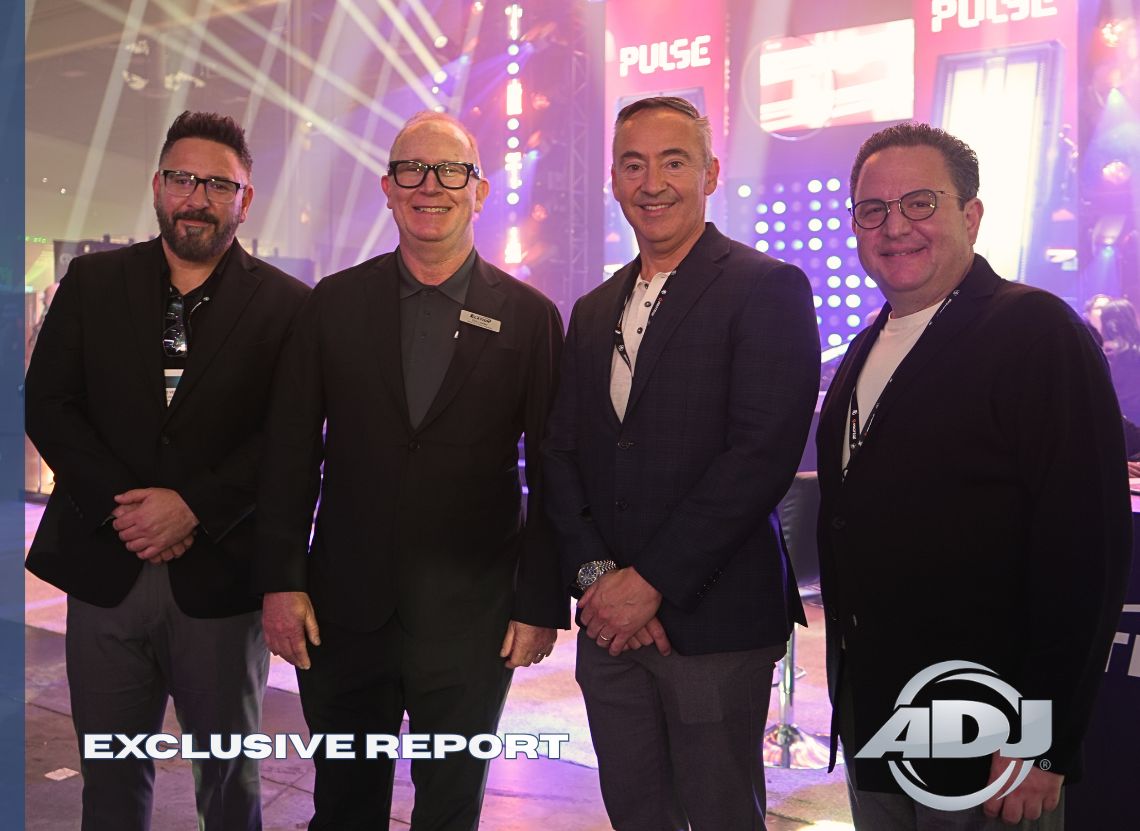
Four decades of experience in the entertainment industry and technology applied to live productions mark ADJ Group’s path into a new stage. Not from nostalgia, but from a precise reading of the present.
The evolution of the market, technological advancement, and the transformation of production models are shaping a scenario where adaptation is no longer enough: it is necessary to anticipate.
The industry is undergoing a structural change. Workflows are being redefined, execution times are becoming shorter, and the demand for more efficient, versatile, and integrated solutions continues to grow steadily.
In this context, 2026 emerges as a key year, where strategic decisions will shape the direction of the years to come.
ADJ Group responds to this scenario with a clear vision: to stop thinking in terms of individual products and start building systems that work as a whole.
Total integration: from product to ecosystem
For Toby Velázquez, CEO of ADJ Group, the key to growth lies in building complete systems, where each element makes sense within a larger structure. Innovation, he explains, must be supported by an integrated approach that combines technology, closeness to the customer, and a clear understanding of the context.
“The keys to growth will be innovation, customer focus, and the construction of integrated ecosystems that enable extraordinary results in any scenario,” he states.
This vision translates into an architecture where lighting, audio, control, effects, and structures converge into a unified proposal. ADJ, Elation Professional, Acclaim Lighting, Avante Audio, Obsidian Control Systems, Magmatic, and Global Truss are no longer independent lines but become parts of the same ecosystem.
Within this framework, differentiation is also strategic. ADJ positions itself as an accessible high-end line, versatile and oriented toward multiple applications, while Elation Professional represents the highest level of engineering, with solutions designed for the most demanding environments such as international tours, broadcast, and large-scale productions.
At the same time, technological evolution is pushing this integration to new levels. The development of AI-assisted control, process optimization, and operational reliability is combined with an increasingly strong focus on sustainability. Energy efficiency and the design of more environmentally responsible solutions are no longer a trend but are becoming a structural pillar of development.
Applied engineering and market insight: designing from reality
This strategy is built on a key principle: designing from real-world use.
For Eric Loader, Global Sales and Marketing Director of ADJ Group, the difference lies in understanding how professionals work in the field.
“We don’t develop products in a vacuum. We design solutions for designers, programmers, rental companies, and venues that operate under real-world conditions,” he explains.
This involves considering setup times, logistics, maintenance, budget, and return on investment. Fixtures like Paragon respond to this logic with a modular system that allows multiple configurations from the same technological base. Through the TruTone engine, different fixture sizes and lens options achieve a level of flexibility that directly impacts operations, allowing fleets to be standardized, inventories simplified, and profitability improved without sacrificing performance.
At the same time, solutions like Rebel reinforce the need for reliable, versatile, and easy-to-deploy fixtures that can adapt to different environments without increasing technical complexity.
Control also becomes a central element. Control systems such as ONYX and NETRON from Obsidian Control Systems allow scaling from compact setups to complex networked systems, consolidating a workflow where integration is decisive.
From a regional perspective, this evolution is clearly reflected.
For Ernesto Velázquez, International Sales Manager at ADJ, the Latin American market shows increasingly defined demand.
“There is a growing demand for high-performance LED equipment, energy-efficient solutions, and products that combine power with ease of operation,” he points out.
This is accompanied by the need for IP-rated fixtures for outdoor use, advanced color systems, creative effects, and wireless solutions that provide flexibility. At this point, the pursuit of immersive experiences becomes increasingly prominent, driving the development of technologies capable of delivering greater visual impact with fewer resources and higher operational efficiency.
However, the factor that ultimately tips the balance is support. The availability of spare parts, technical training, and proximity to the customer become decisive in brand selection. In Latin America, trust is built both through the product and the support behind it.
Latin America at the center and a future already in motion
In this scenario, Latin America ceases to be an emerging territory and positions itself as a strategic axis.
For Abraham Levit, Director of ADJ Group Mexico, growth in 2026 will be directly linked to the ability to adapt, technological innovation, and active listening to the market.
“The key differentiator will be supporting customers not only with products, but with technical advice, training, and after-sales support,” he states.
Mexico is positioned as one of the driving forces in the region, supported by the sustained recovery of live events, investment in infrastructure, and the growth of the corporate sector. However, the strategy is regional and seeks to position ADJ Group as a reference not only in volume, but in technical leadership, customer proximity, and operational excellence.
This involves strengthening distribution networks, expanding training programs, standardizing processes, and increasing presence in larger-scale projects. Building long-term relationships becomes as important as the technology itself.
Looking ahead, the direction is clear. The industry will move toward more intelligent systems, greater integration between disciplines, sustainable solutions, and increasingly complex immersive experiences.
As Toby Velázquez summarizes, the ultimate goal is not only to innovate, but to allow creators to focus on the experience, removing technical barriers and enhancing creativity.
For ADJ, 2026 is not simply a new year. It is the point where everything begins to connect. And the companies that understand—and lead—that integration will be the ones that define the future of the industry.


