
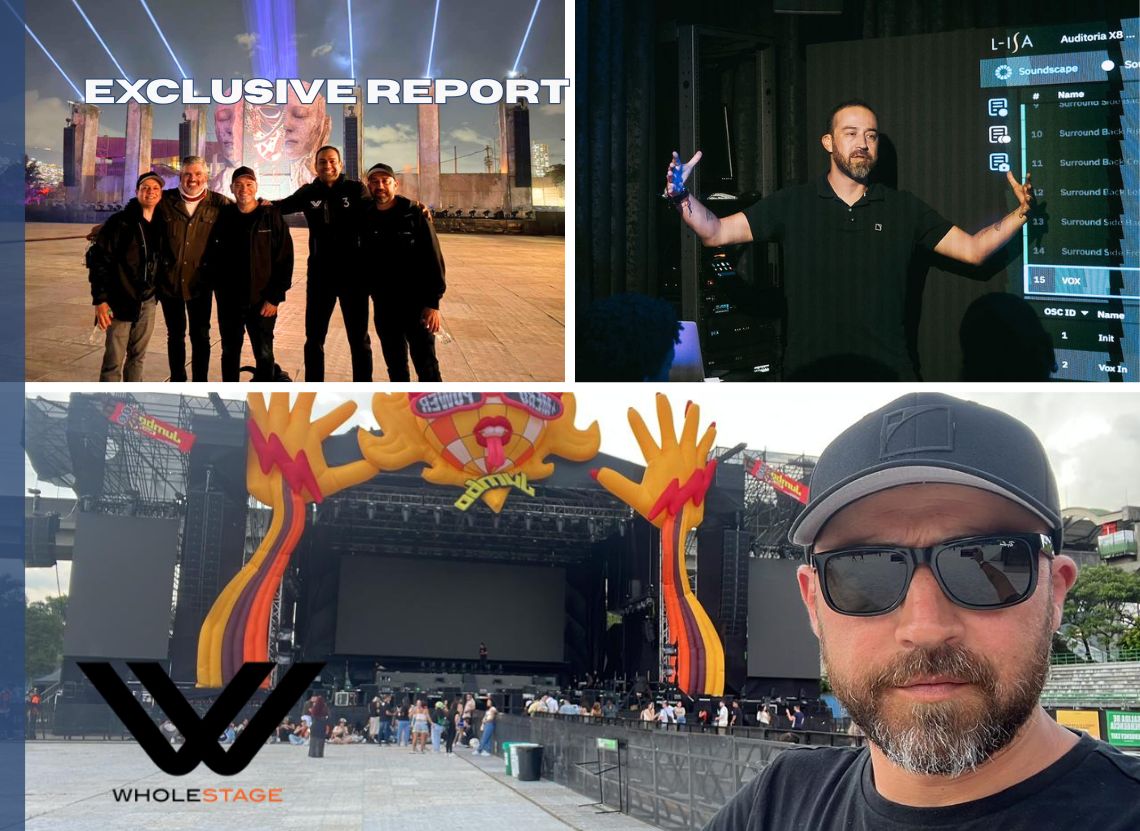
Mexico – The upcoming opening of WholeStage’s L-ISA Auditorium in Mexico marks a new step in the evolution of professional audio across the region. Through real-world experiences, hands-on training, and demonstration spaces, the company is committed to bringing immersive sound closer to Latin American engineers, producers, and artists, fostering new ways to create, mix, and experience live events.
While immersive audio has become increasingly established in theaters, auditoriums, and large-scale productions around the world, its presence in Latin America has remained much more limited.
Today, that reality is beginning to change.
With the upcoming opening of its new L-ISA Auditorium in Mexico, WholeStage aims to create a space where engineers, producers, artists, integrators, and audio professionals can experience firsthand a technology that promises to redefine the way live events are conceived.
For Marco Pineda, Audio Projects Manager at WholeStage, the challenge is not simply about showcasing a new technological platform. The real goal is to bring an experience closer to professionals who have not yet had the opportunity to explore it.
“Probably our role as WholeStage will be exactly that: to support the technology, make it known, help people lose some of the fear of facing a system like this, and show them that it is actually very simple while delivering much better results,” he says.
The Mexico facility joins the experience center the company already operates in the Dominican Republic and is part of a regional strategy aimed at creating experience hubs where the industry can interact directly with the technology.
“We already have one operating in Santo Domingo, and I believe that in the not-too-distant future we also expect to have one in Colombia,” Pineda reveals.
A new canvas for live sound
With more than 25 years of experience in the industry as a front-of-house, monitor, and system calibration engineer, Pineda avoids describing immersive audio from a purely technical perspective. He prefers to talk about possibilities.
“I believe immersive sound is basically like having an entirely new painting with which to recreate everything we want to do, where we have a gigantic canvas on which we can paint whatever we need in a much broader and freer way,” he explains.
The comparison is not accidental.
For decades, the industry built its mixes within a stereo format that, while effective, imposed certain creative limitations. Today, the ability to work with spatiality, movement, and precise positioning of sound elements opens up a completely different scenario.
“The great advantage is precisely the possibility for us, as engineers, to move away from the routine of trying to fit everything into a false stereo image and instead play with imaging, spatiality, positioning on stage, and many other elements,” he notes.
Although this technology is often associated with auditoriums or permanent installations, Pineda believes its potential extends far beyond that.
“It is no longer necessarily limited to indoor spaces or fixed installations; you can also apply it to touring productions,” he comments.
From Carlos Vives to the next generation of productions
One of the projects that most impacted the WholeStage team took place during a performance by Carlos Vives in Punta Cana, where they worked with an L-ISA system.
“The feeling among the entire band, crew, and production team was that when standing in front of the stage, everything felt enormous, much bigger, much more open, and much more complete sonically,” he recalls.
Experiences like that have reinforced the company’s belief that immersive audio can become a standard tool within the Latin American industry.
“Perhaps in Latin America we are a little behind compared to the rest of the world, but I feel it is more due to a lack of awareness than anything else. That is why the future Mexico facility was conceived as a space open to experimentation.”
The intention is for producers, artists, designers, engineers, and technical managers to be able to listen to different types of content, test configurations, and develop their own projects within an immersive environment.
“We want to bring together all members of the industry so they can experience the technology and start playing with the room,” he says.
But the WholeStage team wants the experience to go beyond a guided demonstration.
“The idea is also to do something practical—for example, having an engineer bring in a console and begin exploring firsthand just how far they can go,” he adds.
When emotion becomes part of the mix
Beyond the technology, algorithms, or speaker distribution, Pineda believes the real impact happens with the audience.
“I believe the feeling this technology leaves with the audience is a much stronger connection with the artist, and that makes you experience the concert in a much more intense and emotional way,” he says.
To illustrate the point, he recalls an experience following an immersive-audio concert he attended in the United States:
“At the end, they conducted interviews with the audience, and normally people leave a concert feeling tired. Here, you could see people still carrying that excitement. They didn’t know there was an immersive audio system, but they felt that connection with the stage and left absolutely happy. Without a doubt, immersive audio is not only perceived by professionals—it elevates the final experience of the show.”
While much of the world is already incorporating immersive audio into theaters, auditoriums, houses of worship, and touring productions, WholeStage is committed to helping Latin America stop watching that evolution from the sidelines. The opening of the new L-ISA Auditorium in Mexico represents a concrete step in that direction and an open invitation for the industry to experience firsthand where the future of live sound is heading.
Credits
Cover Photo: LATAM STAGE
Inside Photos: LATAM STAGE
The journalistic production, research, writing, editorial approach, and editing of this content are original works by LATAM STAGE and are protected by copyright.
No part of this content may be reproduced, copied, distributed, adapted, or published, in whole or in part, in any medium or format, without the prior written authorization of LATAM STAGE.


