
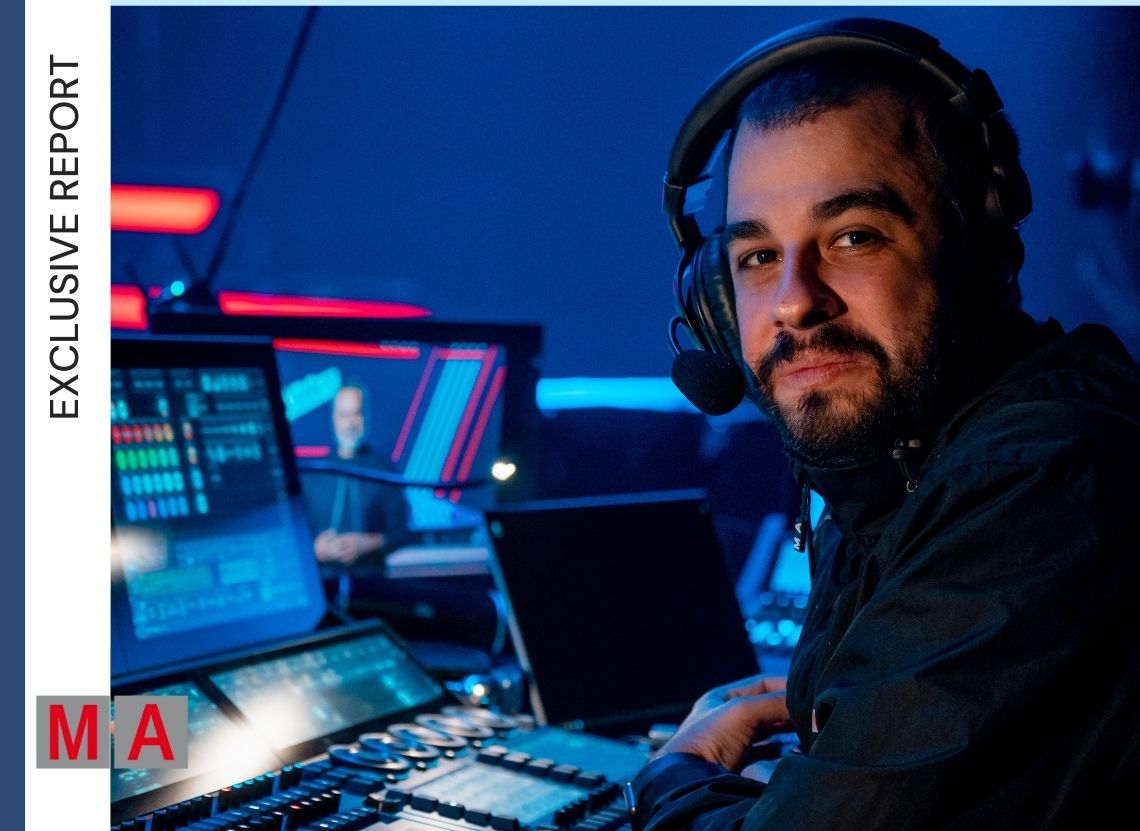
Paulinho Lebrão begins this story with a reflection on his roots in the industry: “The truth is, I can say I was born into this. Because my mother was an event producer. And she still is. She worked for many years with a large production company here in Brazil in the 1980s, which produced all the major international concerts, so I was practically born into the mix. From a young age, I was backstage, and there were few options: production, lights, or sound. And I decided on lighting.” Thus began his journey, and despite its humble beginnings, it would lead him to great achievements.
“I practically started at the end of 1997, helping out at the Municipal Theater in my city, setting up lights, etc.,” he recalls. And in 2000, he began working with a local rental company. And it was in that year that his career really began to take off: “In 2003 and 2004, I jumped at my first opportunities as a designer, where I went to work with a Brazilian reggae band. We toured the country.”
This was a turning point in his career. During this tour, Paulinho expanded his network of contacts and delved deeper into the professional market. “It was then that I started meeting more people, more people in the market, more professionals, because until then, the company I worked for installing lights was more local.” And by the end of 2006, Paulinho was already gaining visibility in the market, being in charge of Expomusic, a very famous trade show, especially in the early 2000s in Brazil, which opened new doors for his future in the lighting industry.
And as in all great stories, there’s a milestone that marks the beginning: Paulinho had problems with a team he was working with, and a friend suggested he approach MA Lighting for support. “There I met Daniel Ridano, who was coming from Argentina for training,” Paulino recalls, “and well, everything happened so naturally that I stayed at the company, working in technical support from 2008 to 2011.”
In 2011, Paulinho decided to start his own programming company, working for various designers in Brazil. It was during this time that he was introduced to the world of major festivals. It was that same year that he began working for MA at the Chilean Festival, where he met Luis Pastor. His collaboration with various designers, both in Brazil and abroad, led him to work on the 2016 Olympic Games in Brazil and, later, in 2019, on the Pan American Games in Peru.
The Challenges of Rock in Rio
Paulinho’s start at the iconic Rock in Rio festival came in 2011, when the event returned to Brazil.
He started as a technical support worker for MA Lighting, in charge of assisting the festival’s operators. “It was a big challenge for us, because at Rock in Rio, the bands don’t just present their show, but often create something exclusive for the festival,” he comments. Stage changes and the constant adaptation of high-end equipment were a fundamental part of his experience, allowing him to face unique challenges at each edition.
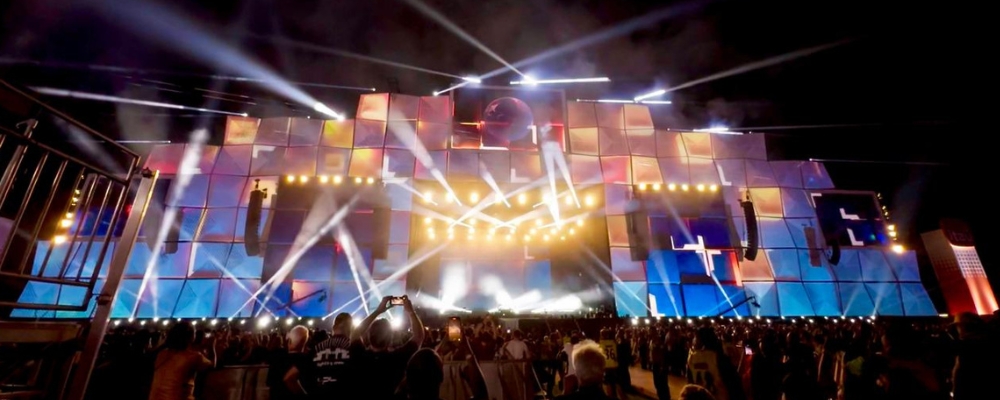
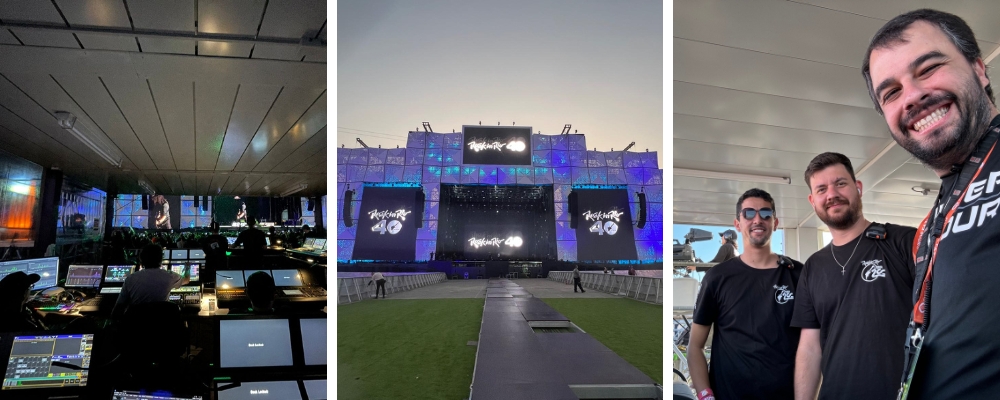
In 2015, the renowned equipment rental and production company LPL took over the organization of the festival, and Paulinho was invited to operate the FOH. Since then, he has been part of the 2015, 2017, 2019, and 2022 editions. In his account, he highlights the logistical challenges of working on an event of this magnitude: “We have four different shows per night, and each one requires a complete system reconfiguration in just one hour. The complexity of coordinating rapid changes between shows, the entry and exit of equipment, and managing more than 55 cargo trucks make this festival a unique challenge.”
But that’s not a problem when you have the right technology: “With MA, there are no barriers; it’s always up to great challenges; you simply select the effect and it’s ready. The evolution of consoles, especially the transition from MA2 to MA3, has allowed me to take on more complex technical challenges, such as merging data from different sources without losing quality or control of the show.”
In this way, Paulinho has witnessed and participated in a technological evolution that has transformed his work, giving him the ability to face the greatest challenges in global entertainment, such as those presented by Rock in Rio, adapting quickly to any change in record time.
Despite having the best backup technology, the LD remains extremely self-demanding with his work: “I’m always working on something, but I never feel like it’s enough. Every time I finish something, I can’t give myself that ‘Wow!’ of complete satisfaction. It’s as if there’s always something left behind, as if my mind is searching for more, something I can’t reach. It’s frustrating sometimes. But, in the endThat’s what keeps me going, the constant search for something better, even if I never reach that perfection.”
At Rock in Rio, Paulinho is very clear that the work is never done: “We’re never like, ‘We’ve done it, we’re here!’ No, we always have to be looking for new ways to do things; there are always different challenges every year. Each edition brings its own set of obstacles, and sometimes those challenges require quick, improvised solutions. Other times, after the event is over, you’re left thinking: ‘This solution wasn’t the best, the best would have been this other one.’ And that’s what always happens: there’s always something new to learn and always room for improvement, even on the biggest stages in the world like this one.”
This year, Rock in Rio was, for Paulinho, one of the best in terms of technical stability. “Honestly, it was a pretty good year. We had fewer problems within the system, which is a great achievement at an event of this magnitude. Of course, there were some initial issues, but once we identified the problem, it was quickly resolved. The most important thing is that there were no glitches the audience could notice, and that’s a challenge we face every year.”
Recalling last year’s edition with Coldplay, he recounts a challenging episode: “The show started off without a hitch, but suddenly, the rain in Rio started to come down hard. When it rains in Rio, it’s not a light rain, it’s a storm. The lighting crew had placed a Socapex under the stage, but the cable wasn’t long enough to reach the control panel. In the middle of the show, the power suddenly went out. But thanks to our preparation, with a UPS, we were able to continue nonstop. We switched to Power 2, then 3, and 4… all because of the water that had soaked the Socapex. It was crazy.”
The following year, after the previous incidents, Paulinho and his team made key decisions to improve the infrastructure. “We learned our lesson: we can’t have a Socapex crossing through the audience. In addition, there was another setback with a UPS that went out during the show, and the entire system was connected to it. There was no way to replace it without shutting down everything, so, at one point, everything shut down.”
That’s when they decided to implement a more robust solution: “We decided to incorporate a switching system with two power supplies. One connected directly to the power supply and the other to the UPS. If one fails, the other takes over. These solutions emerge over time, through testing and learning from each situation.”
Today, with the experience of those challenges, Paulinho has a much more secure system: “Today I can say that my system is 90% fail-safe. Everything is duplicated, everything is backed up: fiber optic cables, consoles, master, backup, everything has a backup plan.”
With everything he’s experienced, Paulinho is visibly proud of the progress he’s made: “We sometimes talk about what’s happening in Latin America, and the Americans who come to work with us are impressed by the complexity of what we manage. They see how everything flows, how we handle every detail, and they’re surprised by the ease with which we handle challenges. For me, that’s a source of great pride.”
In fact, every time he finishes an event as large as Rock in Rio, he feels like it’s all been worth it: “Seeing that we’ve completed another Rock in Rio and that everything went well fills me with satisfaction.”
Since he took on greater responsibility for design in 2018, Paulinho has witnessed a significant evolution. “When the company stopped being just a programming producer and started focusing on design as well, I saw how everything changed and how we grew,” he reflects.
MA Lighting in Brazil
The successful performance of a brand has several facets: from those who manufacture it, those who operate it, and, of course, those who distribute it to the rest of the world. In this case, HPL has played a key role in ensuring MA Lighting’s presence in the Brazilian market, providing constant support to its users and maintaining a close connection with the challenges and needs of the industry.
Andrea Nascimento, CEO of HPL, recalls how it all began: “We started working with MA1 and M2 were a long time ago, but we stepped back for a few years. However, we returned to the MA family in 2021, and since then, we’ve experienced steady sales growth, with each year bringing new surprises.” This renewed relationship with MA has been fundamental to HPL’s success, especially highlighting the company’s commitment to after-sales service, technical support, and training, which have been key to the growth and satisfaction of Brazilian users.
Regarding the professional lighting market in Brazil, Andrea notes that “Brazil has great potential, although there are many challenges. But we are confident that we are doing everything possible.”“It’s possible to overcome these barriers,” she comments optimistically.
For HPL, MA Lighting not only provides the best console on the market, but also top-notch technical support, ensuring users can get the most out of their technology. “MA is the best console, and we are happy to offer this incredible tool to the Brazilian market,” Andrea adds.
In order to maintain the quality of the services and products they offer, HPL has implemented ongoing training and support plans. “We have our own service department on-site, with a professional team led by Felipe Silva, our product specialist. We offer training to keep our team up to date and ensure we can always offer the best service possible. Additionally, users can count on constant software updates and support via WhatsApp, demonstrating HPL’s commitment to excellence in customer service.”
Through these efforts, the company continues to strengthen MA Lighting’s presence in Brazil and ensures that users always have access to the best technology and support available.
Evolution and Future
Success in lighting design, especially for large events, is the result of a combination of creativity, technical knowledge, and the use of the right tools. Paulinho Lebrão reflects on this process, emphasizing that design is always based on a blend of intuition and technique: “In the design, we create a position, a grouping, a way of using things that we already think of, to use a specific effect that will help create a situation. Familiarity with the tools and effects, especially with consoles like the grandMA 3, plays an essential role in bringing these ideas to life.”
A direct relationship with the technology’s creators is another crucial factor in professional development. According to Paulinho, “I’ve always had direct contact with the creators, and that’s the difference: drinking directly from the source.”
Close contact with console manufacturers, such as MA Lighting, allows all professionals not only access to direct training but also real-time problem-solving.
“The technology is there, and things are evolving every day. You can’t stay in your comfort zone,” he concludes.
MA Lighting has consolidated its position as the undisputed leader in the professional lighting industry, serving as a benchmark for major festivals and productions worldwide. Its success is not only due to the technological innovation of its products, but also to the strong human chain that supports each project. From the console creators to the distributors, operators, and designers, everyone plays a crucial role in the realization of major productions.
This network of highly trained professionals allows for the ability to address technical challenges in real time, driving the brand’s growth and expansion globally.
With its presence at key events and ongoing commitment to training and technical support, MA Lighting remains at the forefront, ensuring that quality standards remain consistently high and accessible to industry professionals worldwide.


