
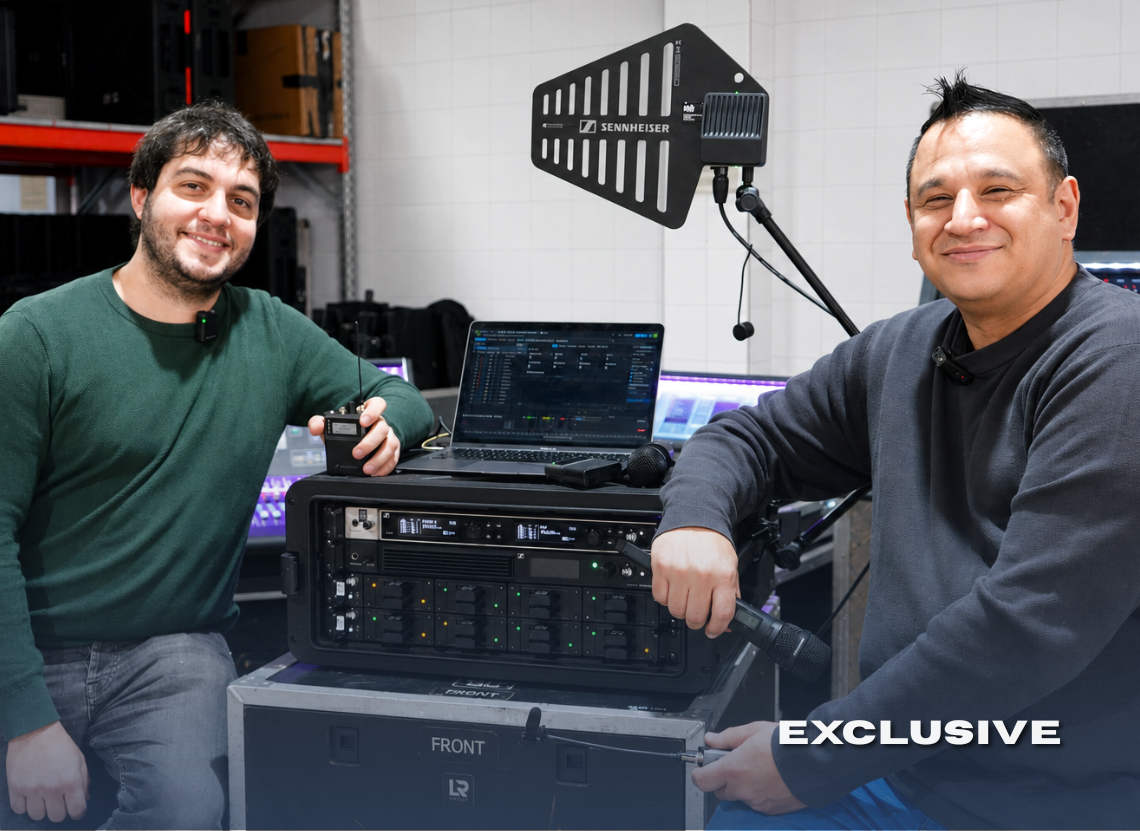
STR incorporates Sennheiser Spectera as part of a specific pursuit: bringing a more compact, flexible, and integrated wireless solution to touring. Jony Macon and Fernando Parra, the company’s directors, discuss a decision that combines bidirectional transmission, multi-zone operation, and digital audio within a platform that has already begun to be used with musicians in Argentina and that the company is strongly projecting toward its next season.
From stadiums to increasingly compact tours
In a major production, reducing space is never simply a matter of transportation. Fewer racks, fewer devices on the artist, and a system capable of concentrating different functions can change everything from preparation to operation during a tour.
For STR Rental, that pursuit proved decisive when incorporating Spectera from Sennheiser.
The decision is backed by more than a decade of experience in productions of very different scales. Led by Jony Macon and Fernando Parra, STR develops sound, video, and lighting services for shows, covering everything from small corporate events to large stadiums.
Its base is located in Ramos Mejía, Buenos Aires province, although its activity extends throughout the country. This growth was complemented by an office in Spain and a structure in Uruguay, progressively expanding its reach beyond the Argentine market.
Within that journey, one of the projects that both identify as an important milestone was María Becerra’s concert at River Plate Stadium, a production in which STR was responsible for the complete RF service and consoles.
“Basically, we handled everything from the musician to delivering the audio. The speakers weren’t ours, but the entire stage was ours,” Macon highlights. “Working at that level also forces us to constantly review how to optimize each system.”
When equipment has to accompany a tour, quality is essential, but so are portability, connectivity, and the ability to simplify an infrastructure that must be assembled, dismantled, and transported over and over again.
It was at that point that Spectera began to make sense for STR.
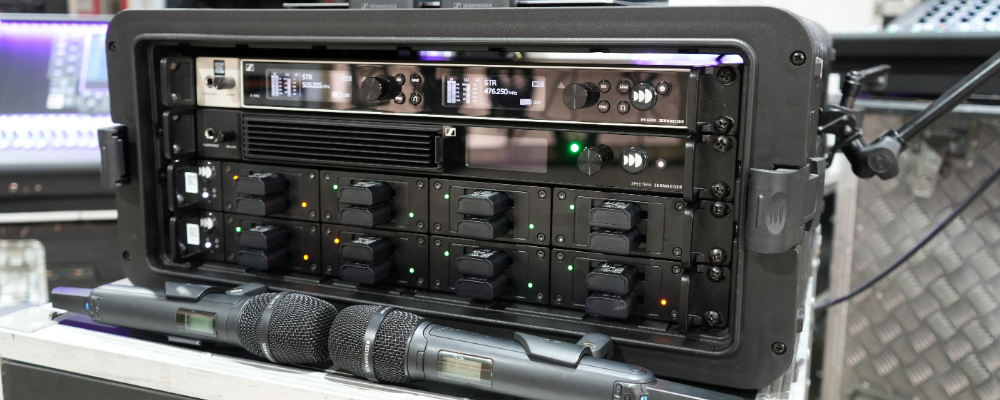
“We were looking for equipment that was compact and bidirectional. The only one that had those qualities was Spectera, with superior quality and antenna coverage that works over network cable. It benefited us in every way. I think the product is much more than we expected,” says Parra.
Macon adds another variable directly related to the company’s identity: “We needed portable equipment that was friendly with the company’s name, Tour Rental, so that artists could take something very good and small with them. That also adds to our technology integration, with the provision of consoles, digital audio protocols, and so on.”
When architecture changes the operation
Spectera proposes a different way of approaching professional wireless, and for STR, much of its appeal lies precisely in what it allows them to simplify.
“What Spectera makes easier for us is being able to work with a lot of channels in a single rack unit and take up very little space for transportation,” Macon summarizes.
Connectivity was another factor considered. The integration makes it possible to incorporate the platform into different digital audio configurations, a particularly relevant feature for a company that works with highly diverse productions and needs.
“I think the most important thing Spectera has is its connectivity. Having Dante and MADI means that we can build different network systems, and everything is very stable, with excellent quality,” Parra adds.
As the scale of a production changes, so does the complexity of RF coverage. In this area, the ability to distribute network-connected antennas and create different operating areas expands the design alternatives.
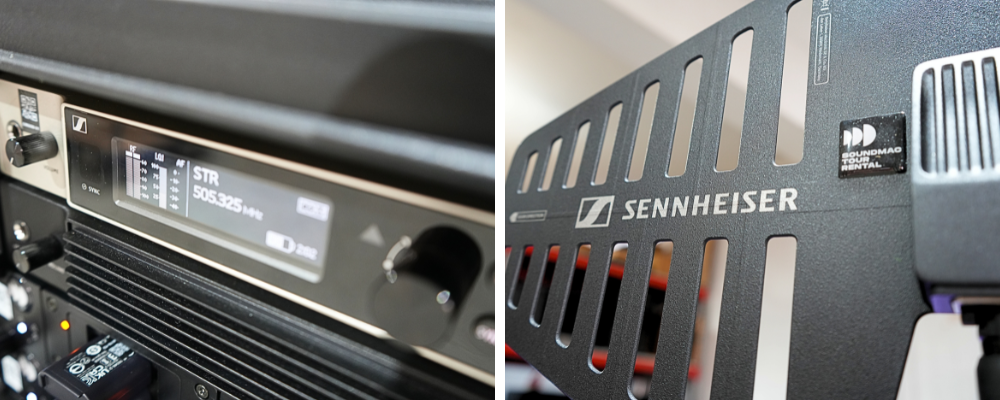
“The possibility of creating multi-zone coverage, with four antenna outputs and being able to generate up to four different coverage zones, is something very good and innovative in the market,” Macon acknowledges.
But there is one feature that both identify as particularly significant for work on stage: bidirectionality.
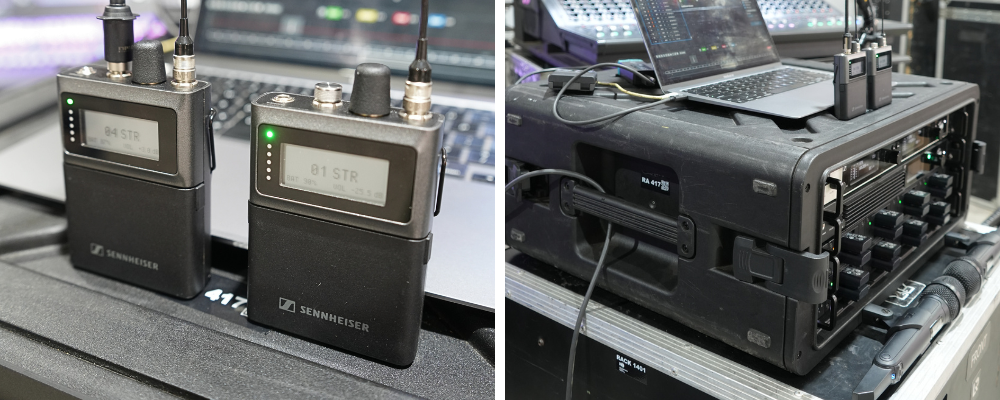
In a traditional configuration, an artist using a wireless microphone or headset who also needs in-ear monitoring requires separate devices. Spectera combines both functions.
“When an artist needs both, we normally have two bodypacks. Here we have everything in a single bodypack, and that also helps tremendously,” Parra explains.
The difference may seem small when observed from the perspective of a single musician. In a production with numerous artists, wireless channels, and monitoring systems, the equation changes: fewer devices on stage, a more concentrated infrastructure, and new possibilities for organizing the entire system.
STR’s first major step with Sennheiser
The arrival of Spectera also marks a new moment in STR’s relationship with Sennheiser. The company already had some products from the German manufacturer, although Macon defines this addition as “the first major step with the brand.”
The choice does not start from scratch either. “Sennheiser has always been one of the leading brands in RF and wireless. Now, with this new technology, we became very curious from the moment Sebastián Álvarez from Sennheiser brought it to show us and explained the applications he saw for our company.”
The possibility of concentrating different functions, working across multiple zones, and approaching transmission from a different architecture ultimately turned that initial introduction into an investment decision.
“Combining everything in a single device, the multi-zone capability, and the bandwidth consumed by the entire transmission is something that is far beyond what existed in the market,” he adds.
For STR, incorporating a platform with these characteristics is therefore not about replacing one device with another equivalent one. The interest lies in what it makes possible to rethink: how to organize a wireless system, how much equipment to transport, how to distribute coverage, and how to connect RF with the rest of a production’s digital ecosystem.
A local relationship that already had history.
The acquisition of Spectera was completed through Todomúsica / TM Pro, Sennheiser’s distributor in Argentina.
“We have many years of relationship with the company, through which we have acquired other brands, and they have always provided us with excellent commercial and technical support,” Macon states.
That support becomes especially relevant in the face of technology that introduces new ways of configuring and operating a wireless system. Product availability is one part of the process; having local technical and commercial support strengthens the relationship.
Spectera now opens a new chapter and supports the company’s commitment to increasingly concentrate more of a production’s resources in solutions capable of traveling together.
From concept to stage.
Although the specifications were enough to spark interest, the real test, however, had to take place with musicians.
The STR team has already begun conducting tests, and one of the first experiences was specifically aimed at verifying one of the differentiators that had motivated the purchase: bidirectional operation.
“The first thing we wanted to test was its bidirectional system. We did it with a brass section, using microphone and monitoring simultaneously. We used a microphone and an earpiece. The first feedback we received from the musicians was that they were all surprised by the audio from the equipment. I think that’s the important thing about all of this,” Parra says enthusiastically.
This is where the possibilities presented on paper begin to be measured against those who will ultimately use the technology on stage. And the experience is already beginning to extend beyond those initial tests.
“We are applying it with different new artists to whom we are providing an integrated solution.”
Each new application will make it possible to explore the system’s behavior under different configurations and requirements, while the company deepens its interaction with consoles and the rest of the audio solutions that form part of its operation.
The next season as the horizon.
The projected use emerges naturally for a company accustomed to designing its systems around the specific needs of touring.
“We, as a company that supports tours, believe that this is equipment that will begin to be used more firmly in the next season,” Macon anticipates.
The expectation is linked to an equation that is increasingly present in productions: concentrating capabilities, reducing infrastructure, and facilitating transportation without sacrificing the performance required by a professional system.
That is why the next step will also be to open the experience to other professionals.
“We are always very open to having staffs and operators come and test the integration of the consoles and all the audio systems we offer, so they can see the technical solution, the size, and the digital audio flow. Our idea is for them to take everything from here and be able to have the most compact tour possible.”
For a company accustomed to supporting productions from the musician through to final audio delivery, this pursuit is beginning to establish a different equation: Sennheiser Spectera is already part of the ecosystem.
Now it will be the tours, the musicians, and those who work with these systems every day who will ultimately show how far this change can go.
Credits
Cover Photo: LATAM STAGE
Inside Photos: LATAM STAGE
The journalistic production, research, writing, editorial approach, and editing of this content are original works by LATAM STAGE and are protected by copyright.
No part of this content may be reproduced, copied, distributed, adapted, or published, in whole or in part, in any medium or format, without the prior written authorization of LATAM STAGE.


