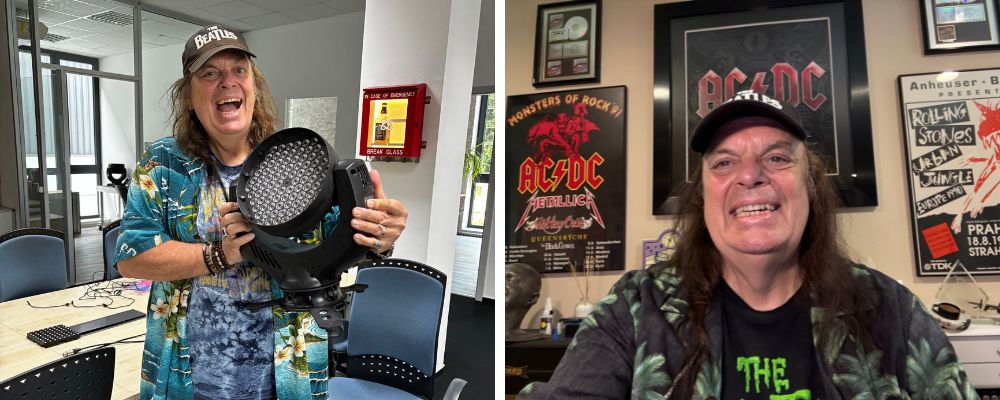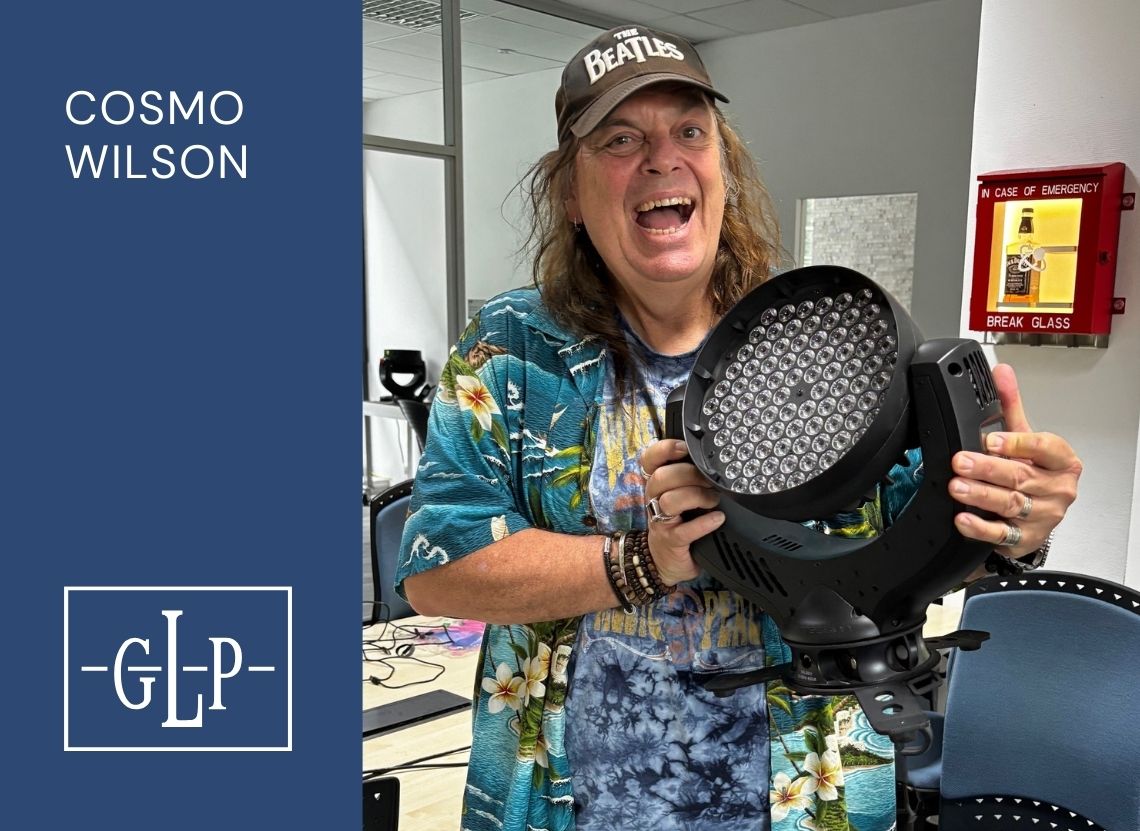
Charles “Cosmo” Wilson says it bluntly: “I am an artist, I always was.” His story has been marked by art from the very beginning. He grew up in a creative family, with an architect father and an artist sister. That sensitivity always accompanied him, but it found its definitive form when he stepped onto a stage. From then on, light became his language, and rock, his natural territory.

The story of Charles “Cosmo” Wilson did not begin with lights, but with dreams of being a rockstar. In 1976, when he was only 15 years old, he saw KISS live. “Everything impressed me: the lights, the sound, the pyrotechnics, the costumes… it was a show. At that moment, I wasn’t thinking about lighting. I just thought it was incredible.” That night he didn’t switch on a console, but he lit something much deeper: a vocation.
The following years were a search. He started as a drum and guitar technician in New York until he moved to Florida and found his first real contact with the stage. “The lighting guys were always the first to start. I didn’t want to push boxes all day, so I started moving where I knew they would need help,” he recalls. “I gave my number to all the lighting guys. And when I finally hit the road in 1986, I was 25 years old.” The curious thing, or perhaps the inevitable, was that three years earlier he had already been with KISS, but this time as part of the crew. “I first worked with them in 1983, on the same stage where I saw them for the first time: the Civic Center in Lakeland, Florida.” The circle had closed, and the tour was just beginning. From then on, the road became his natural habitat.
The Boy Who Would Become Cosmo
Charles B. “Cosmo” Wilson, born February 18, 1961, in Orlando, Florida, went from clubs to stadiums, and from stadiums to rock history.
Since 1986, his name has been associated with more than 40 legendary bands: AC/DC, Aerosmith, The Rolling Stones, Iron Maiden, Judas Priest, Def Leppard, Scorpions, and many more.
The nickname “Cosmo” came out of practical necessity and became part of his identity. It was during a tour with Genesis in the 1980s when someone had to distinguish him from the other “Charlies” on the lighting crew. They chose that name almost at random… but the universe seemed to approve.
The true turning point came with the Rolling Stones. In 1989 he took on the role of lighting director for the “Steel Wheels” tour and, the following year, was already leading the design for the Japanese and European dates of “Urban Jungle.”
His relationship with AC/DC, on the other hand, was more than professional: it was almost a vow. Since 1990 he has designed and operated more than 700 shows with the band, including the iconic performance in Moscow during the 1991 Monsters of Rock. More than 1.6 million people gathered in front of a stage. A record. A symbol. The first free Western mega-concert in the Soviet Union.
The recognitions soon arrived: Parnelli Awards, TourLink Top Dog, Pinnacle Awards. But what defines Cosmo is not the trophy case, but his way of inhabiting the show. He doesn’t “do lights,” he illuminates from emotion. Every concert, he says, is conceived as a “big club act,” even if it’s in front of thousands: intensity, spontaneity, and connection. That’s how he understands lighting. That’s how he ignites rock.
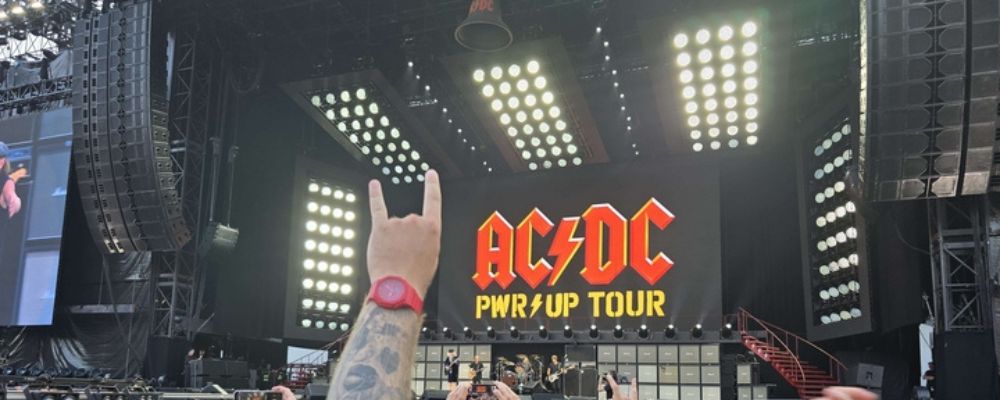
Rock That Doesn’t Break: Three Decades Lighting AC/DC
In a world where lighting advances by leaps and bounds, he chooses to keep the soul of the show intact. “Obviously technology improves, you can use a circle of a thousand lights, but I still do it the old-fashioned way. When I design, I try to make it look like a classic rock show. Like in the old days, with Par Cans and ACLs.” And yes, he is referring to those fixtures that defined the live rock aesthetic: the Par Cans, with their intense and direct light that bathed the stage in solid colors, and the ACLs, lights originally designed for airplanes, that created beams as narrow and parallel as they were powerful and dramatic.
Cosmo doesn’t just mention them: he vindicates them as an essential part of the visual identity of an era.
And if there is something that defines AC/DC, it is coherence. “As they say, if it ain’t broke, don’t fix it. That’s the formula of AC/DC. They don’t change their style. Every album is similar,” he explains with admiration.
That spirit also connects him with other legends. Rolling Stones, Aerosmith, Scorpions… the list goes on. Each has its character, its weight, its history, but Cosmo prefers not to choose. “They’re all special. It’s like food: chicken, lobster, sushi… I have favorites, yes, but I like them all,” he says, laughing.
What unites them, according to him, is something deeper. “Those bands from the ’70s invented classic rock and roll. Their songs are the soundtrack of many people’s lives. Some make you happy, others break your heart, but they all connect with people.”
And although AC/DC doesn’t sing about heartbreak, they have their own thing: “They write about having a good time, and that matters too.” For Cosmo, that DNA of the classic bands —guitar, bass, drums, singer— doesn’t need new formulas, only intensity, truth, and a lighting design that adds to the ritual.
“I was lucky enough to work with the bands I loved when I was young. I know their music, I enjoyed it from the first day. And now, being able to light up those songs is a privilege. I’m very fortunate.”
Light for Memory, Light for the Future
Cosmo Wilson doesn’t just light shows; he lights memories. And he does so thinking both of those who grew up with AC/DC and those who are just discovering them.
“When I take a band I’ve worked with for a while, I try to do something similar to the last tour. I don’t copy it, but I use the same colors. Obviously, colors evoke emotions, so I change them… but carefully.”
And this criterion has a deeper intention behind it. For him, every show is also a time machine. “Someone who saw AC/DC 20, 25, or 30 years ago, I want them to feel like they are going back in time.” And that implies more than lights: it implies an emotional atmosphere that activates memories, gestures, and sensations.
The music still sounds the same. Angus Young is still running across the stage with the same energy. And Cosmo supports that continuity with a coherent aesthetic: “I always use white between songs. Basically, people can’t remember what color I used in a song, but they remember it inherently because they were there, when they were young.”
But he also thinks of those who arrive for the first time to that ritual: “I try to make it look like in the old days for the younger ones, so they can experience not only the music, but also a light similar to what the band had at the beginning.” Although technology has changed, he uses it to revive the past, not to leave it behind. Because when rock is eternal, light must be eternal too.
GLP: New Technology, Old-School Vision
Cosmo Wilson’s quest was never about the most modern fixture. His true goal was always another: to recreate the spirit of classic rock with the tools of the present. And when he found in GLP an aesthetic ally, everything made sense.
“On the Black Ice tour with AC/DC we had already used GLP,” he recalls. “They were the original LED PAR, and I used them in the lighting truss because they didn’t have a support ring yet. They were still in development, but they were already so bright and saturated that they impressed me from the start.”
Years later, in the middle of a tour with Aerosmith in 2015, the moment came to take a definitive leap. “I was in South America using old PARs, and it was crazy. They were burning because they hadn’t been used for years. It was all local lighting, and I said: I can’t keep using this. There are too many problems.”
That was the turning point: Cosmo decided to replace conventionals with moving heads, but without losing the look he had defined. “That’s when I had the vision, I’m going to try to use new technology in an old way.”
Inspired by the classic 8-foot bars with 12 PARs, two lines of six, Cosmo redesigned the concept. “One of my old photos showed two rows of four PARs, and in the end I added a profile light. So I called John Huddleston, from Upstaging, and said: can you build me something similar with four X4 per row, like it was an old bar?”
The result was explosive. “It looked like an old structure, but with all the versatility of GLP. That’s when I decided to move from conventionals to intelligent moving heads. And I never looked back.”
The decision was bold: for that tour with Aerosmith, he ordered 272 units of GLP’s impression X4. “They told me: are you crazy? That’s way too many fixtures. But then they saw it… and they understood.” And what for many could be replaced with a single LED source, for Cosmo was a matter of visual narrative: “It’s not about changing color. For me, it’s about intensity and movement. That’s what creates impact.”
X5: Bigger, Brighter, More Rock
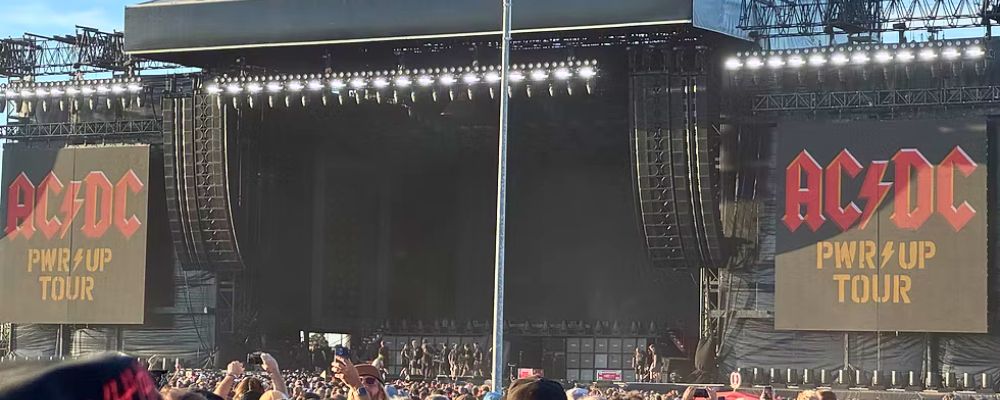
The present is written with memory. And Cosmo knows it better than anyone. Today, as he travels the world once again with AC/DC, the spirit of the ’90s remains alive, although with a new fixture at the forefront: the impression X5 Maxx.
But if there’s something Cosmo enjoys, it’s recalling the road he has traveled: “Let’s go back to 1990, my first tour with AC/DC. We had these big pods that we called MegaMag,” remembers Cosmo Wilson, laughing. “It wasn’t a specific piece of gear, it was what we called those huge structures hanging from the ceiling, full of color changers. They literally flew color gels: they used motors to move physical filters in front of the lights to achieve different tones. And behind all that, we had 48 PAR cans. Forty-eight!”
A visual beast made of analog technology and rock spirit, in times when color mixing was still done with gels and artisanal precision.
The concept was clear: visual power in service of the show. “When this new tour came up, once again we wanted that old-school look,” says Cosmo. In that creative process, three key names came together: Terry Cook, the tour’s production director; Patrick Woodroffe, legendary lighting designer and long-time AC/DC collaborator; and Cosmo himself. “The three of us said: let’s make it look old school. And it was Terry who suggested using the X5, because it’s even bigger, larger than life, and we mounted it in pods.”
Thus, the team recreated that iconic ’90s design, but with GLP’s current technology. “Basically, we did a total throwback. Big pods. And even bigger PAR cans.”
For Cosmo, GLP’s X5 is a high-level creative tool: “It’s not just a point of light. The number of things you can do with it makes the show look even better. I’m always excited about everything we can do with it. It’s so much fun.”
Karlsruhe on the Rock Map
With a busy schedule ahead, Cosmo is preparing for a series of shows that will keep him occupied for the next two months. Among all the stops, one stands out for personal and professional reasons: Karlsruhe, Germany.
It’s not just another city on the itinerary. It’s the home of GLP, the brand that transformed his way of lighting. “Yes, we’re going to do a show in Karlsruhe and I’m really excited about it,” he confirms. And it goes beyond the stage. “For each show we have three days in between. Usually the first day is travel and the second, rest… So I’m going to see if I can take the tour crew to the GLP headquarters. I’m very excited. I always like to see where things come from.”
But beyond technology, what drives him is the human encounter. “The people, especially. I love meeting those behind the products and telling them how much I enjoy using them. For me, that’s more important than anything.”
Cosmo’s relationship with GLP goes back to 2008. Since then, he has not only consolidated a technical alliance, but also a genuine bond. “Yes, I know Udo Künzler, the soul of the brand. And Mark Ravenhill… we’re good friends. I enjoy it a lot. He’s a great guy. They always provide support, friendship… and, of course, my favorite products.”
Cosmo is not one to stay stuck in the past, even if he loves the vintage spirit. In fact, every year he takes the time to attend the LDI show in Las Vegas to see what’s new on the horizon. “I go almost every year, and every time a new product appears that is wonderful.”
But he’s also clear that not everything new is useful for everyone. “There’s a lot of equipment. Many companies make the same fixtures. Some try to cover all segments… And that’s fine. There are many things I’ll never use, but that doesn’t mean others won’t.”
What he truly values about GLP is its development focus. “What I really enjoy is how much they’ve worked on developing LED PAR. That particular look is very rock and roll. The X4 was the first fixture that really evoked the feeling of a PAR can: that long beam, that glow cutting through the air to the stage. That’s what I like to see, what I love about GLP is that they keep improving, keep growing, and in some cases, making things even bigger.”
Cosmo smiles as he remembers his first impression of the Mad Maxx, GLP’s new mega fixture. “I saw it at LDI last year and I laughed… I said: ‘Ok, now we have to find a giant PAR to put it as my main PAR,’ and everyone laughed. That’s the spirit.” In the AC/DC universe, everything has to be colossal. “That’s what I love about that light: it’s bigger than the light itself. Just look at it.”
And although the exaggeration may seem like a joke among colleagues, it’s not so much. “Can you imagine having 272 of those?” he says with a mischievous laugh. The final comment says it all: “You could even call Batman with that.” Because if rock is a spectacle, Cosmo Wilson lights it up with the power of a superhero.
Lighting Up the Audience: The Real Reason Behind the Show
Lighting a stadium can be a technical feat. Lighting the audience, an emotional matter.
For Cosmo, there is no real distinction between the two. “A band on stage feeds off the audience. They play, the audience screams, and that makes them play harder,” he admits. “And the same thing happens with me, with the light.”
The connection with the audience is, for him, the soul of design. “Obviously, you want to light up the audience. When you’re down there and the light hits you, you feel like the band is looking at you. I want to make sure that happens.”
That intention also runs through technical decisions: “A long time ago, Malcolm from AC/DC told me: ‘Sometimes the audience makes noise, but I can’t see them.’ And he wasn’t just talking about front light: he wanted to see them. So what I did was put some textures in the first 20 steps, which were always on. It felt like part of the show, but it kept the audience visible all the time.”
And within that connection there are moments that marked him. One, especially, he tells us: “With the Rolling Stones, at the Olympic Stadium in Berlin. They were playing You Can’t Always Get What You Want, and I lit the audience. People were singing, smiling, and at that moment I thought: ‘My God, how lucky I am to be part of this, to make people happy.’”
And when that happiness is ignited from the stage, the energy multiplies. “The oohs and aahs from the crowd… that gives you adrenaline, it gives you drive. I love it. That’s the reason I do what I do.”
That intimate bond between band and audience, for Cosmo, is what makes the difference between just another concert and a memorable experience. “Lighting them up in color, making them feel part of the show… not just watching it. Being part of it. Participating. AC/DC does that. You see them live and the people are part of the show. And the classic bands know how to do it better than anyone, no doubt. Because they started in clubs, in small places. They were literally in the audience. And they never lost that connection.”
And as in every live event, there are moments when the technology fails, but the spirit of the show prevails. And Cosmo experienced it firsthand: “I was working with Barbara Mandrell, a country singer, many years ago. The transformer blew and took out all the power on the block where we were. The whole show. Only the emergency lights stayed on.”
With no sound system, it seemed impossible to continue. But Barbara had another idea. “She went on stage with a guitarist and an acoustic guitar, and sang a cappella. People lit her with flashlights. And that’s how the show ended.”
That is the kind of spirit that, for Cosmo, defines great artists and great moments. “Without a doubt, we are part of a generation that always finds a way to move forward and make the show go on.”
And when the stage is the world, anecdotes turn into history. “We did a show with AC/DC in 1991, in Moscow. It was at an airport, Tushino Airfield. There were 1.6 million people. An incredible, incredible show,” he recalls. “Especially for the Russian audience, who at that time… couldn’t even listen to that music. They had never seen AC/DC.”
That day, they also shared the bill with Metallica, Pantera, The Black Crowes, and Queensrÿche. “It was an unforgettable experience. Those are the moments when you look around and say: wow, I’m here. It was a historic moment.”
A Life Destined to Illuminate
And if he hadn’t been a lighting designer? Where would Cosmo Wilson be today? The answer, far from being definitive, reveals lesser-known facets of his personal history. “The main thing I wanted to be when I was young was a pilot. A jet pilot,” he confesses with a smile. “I wanted to join the Air Force, but instead I got interested in music.”
His artistic vocation wasn’t built overnight: it was drawn between blueprints, light, and stages. “My father was an architect and interior designer. I grew up in that environment, surrounded by structures, shapes, design,” Cosmo recalls.
But it was light that ultimately marked his path, even beyond entertainment. One of the most significant moments of his professional life happened far from rock: “I was part of the team that installed the lights for the 9/11 memorial, the Tribute in Light, designed by Paul Marantz, who passed away this year and was a legendary figure in architectural lighting, an inspiration for me.”
There’s something in the way Cosmo Wilson speaks that reveals more than his résumé: it reveals a life lived in the front row, yet with his feet on the ground and his gaze always upwards.
He is not just a lighting designer. He is a privileged witness of time, of rock, of changes, and of what endures.
Because while the world runs after novelty, he continues to believe in the magic of simplicity. In a well-placed light. In a red that burns like Highway to Hell. In a blue that chills like Cold as Ice. In that alchemy between music and emotion that needs nothing more than sensitivity, a fine ear, and a steady hand.
His work is not nostalgia: it is fidelity. To a way of doing. To a way of feeling. To an ethic of the craft that does not trade inspiration for spectacle.
And perhaps that is why his story resonates so much: because no matter how many tours, brands, or stages go by, there is always a light, a song, and a moment that takes him back to the origin. And he simply presses go.