
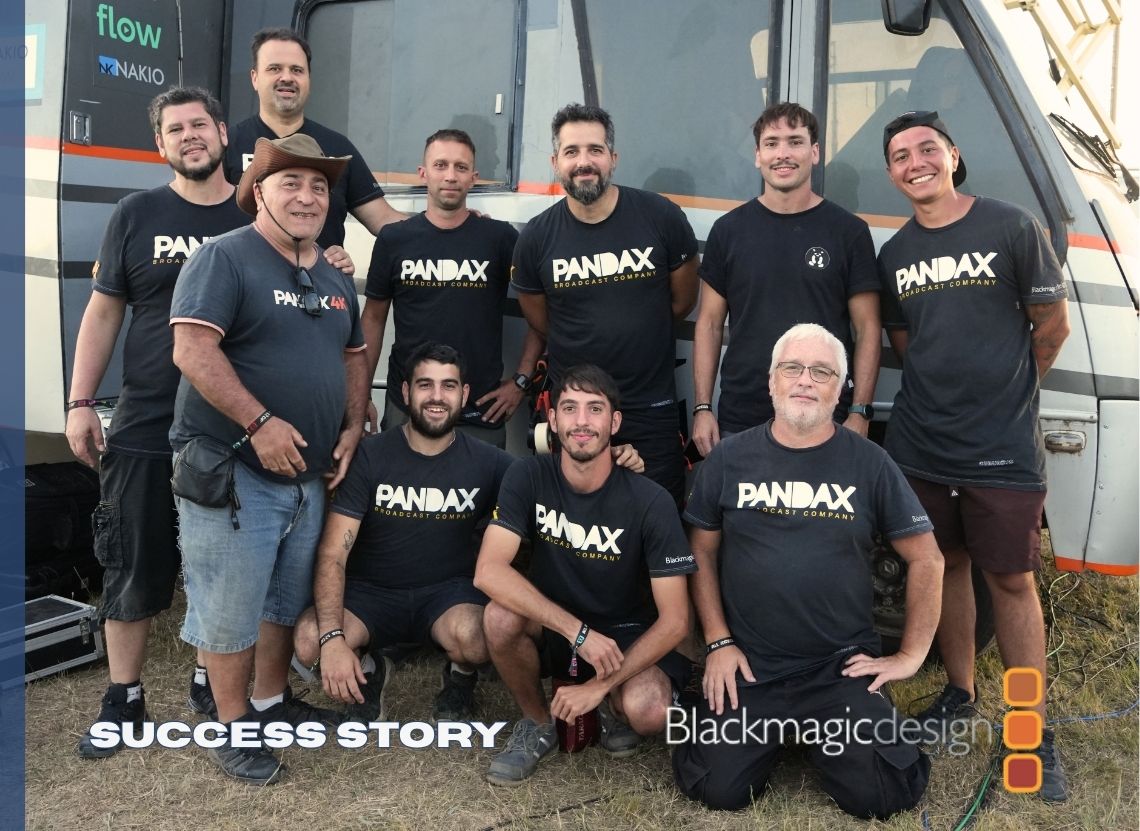
Before talking about Imagine Dragons, Blackmagic Design or large-scale transmissions, there is a story to tell. A story about vision, projects and technical decisions made before the market was ready.
“We are Pandax. And we added 4K at the end as a statement,” says Marcos Núñez, partner at the company, at the very start of the conversation. And that clarification is not minor. “We were pioneers in 4K. Back in 2017 we were already working with 4K recording and switching, when in Argentina the industry was still discussing HD. So that addition reflects that we had technology that no one else had at the time.”
The company was officially founded in 2015, but the partnership between Marcos Núñez and Demián Lammer goes much further back. “We started when we were 19 and now we’re 50. Names and team members changed, but the mindset remains the same,” he recalls.
The definitive consolidation came with a project that would shape the team’s technical DNA: building the TV channel for the University of La Plata. “That project brought together the group of people who today form the technical core of Pandax.” Damián Petruccelli, now part of the leadership team, joined later. “I started in 2015 as a cameraman and stayed!” he says.
That foundation—built in television, with real broadcast logic rather than improvisation—would later allow them to take on challenges such as broadcasting Imagine Dragons for Flow, supported by a Blackmagic Design infrastructure designed to operate at the limit, with no margin for error.
From full-service production to a reference in large-scale shows
Pandax’s growth has not been linear or confined to a single segment. From the beginning, the company moved with a clear objective: not to be limited by the type of project, but by its technical capacity.
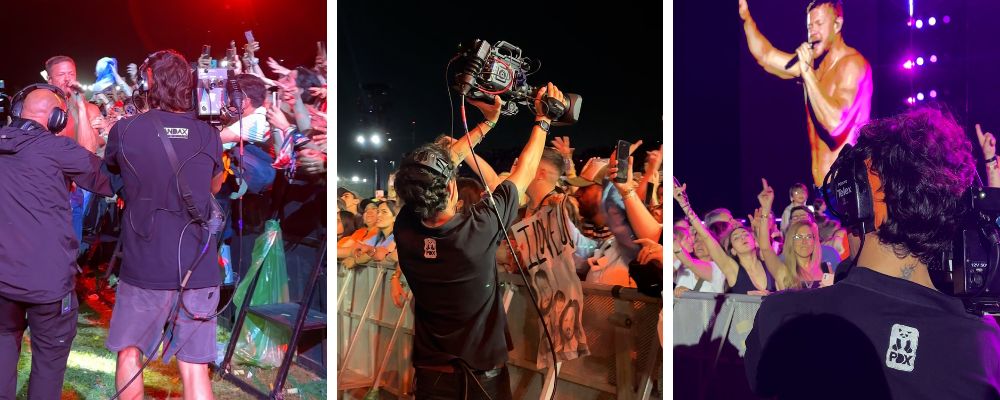
“We actually do many things, we’re not segmented,” explains Marcos. “Today we mostly handle large-scale shows, massive productions, because we have the capability and the tools to do so.”
However, their specialization in live music came as a natural result of that technical evolution. “We’re not limited to one field. We are more specialized today in music projects, but we’ve done everything. Wherever we’re hired, we go,” he says with a laugh. “Along the way there were sports, corporate events, television and industry awards. We produced the Martín Fierro cable awards, corporate shows, TV…” he lists.
That versatility shaped a hybrid profile: a production company with broadcast DNA and the technical strength to operate on large stages.
When it comes to milestones, the team quickly identifies key turning points. Damián highlights one in particular: “What we did with Imagine Dragons for Flow was a turning point. It showed our capability to handle shows at that level. It was truly perfect. Marcos directed it and we received very strong feedback.”
But Marcos goes further back to another defining moment: the Fiesta del Sol in San Juan. “That project shaped us as a professional team,” he says. “What started as a standard coverage turned into an extreme test of adaptability. We began with four cameras and ended up deploying twenty per day. We had Bizarrap, Los Ángeles Azules, María Becerra… each artist required different setups. We moved the entire camera system, control, everything, often 200 meters away. One day we used a crane, the next a steadycam we had to source near Mendoza. It was real-time problem solving. Crazy, but it gave us massive experience.”
Damián also recalls the Villa María Festival as a “prequel” to that leap. “It was the last big edition, with Alejandro Sanz, with Fonsi during ‘Despacito’. That’s where we truly understood festival dynamics and how technically exciting those challenges are.”
Imagine Dragons for Flow: full integration with Blackmagic Design
If there was one project that confirmed Pandax’s technical maturity in large-scale music broadcast, it was the Imagine Dragons show for Flow. Not only because of its scale, but because of the complexity of integrating the artist’s system with their own transmission setup.
Marcos explains the process: “In the case of Imagine Dragons, the CCTV was handled by the event production with a local provider. Our first step is to analyze that setup and see how to integrate it into the broadcast.”
The challenge was particularly interesting because the system was also Blackmagic Design. “The Imagine Dragons setup used URSA Broadcast G2 cameras. So we took the CCTV as a base and added our dedicated broadcast system.”
The approach was clear: avoid duplication and enhance what was already there. “The positions used by the artist for LED screens—close-ups, front shots—are extremely valuable for broadcast. So we integrate those cameras into our workflow.”
But broadcast needs more than close-ups. That’s where Pandax adds value. “Transmission cameras often include elements not needed for CCTV,” says Damián. “Cranes, beauty shots, wide shots, drones… those provide context.”
The combination resulted in a significantly expanded system. “We had 17 or 18 cameras in total,” confirms Marcos.
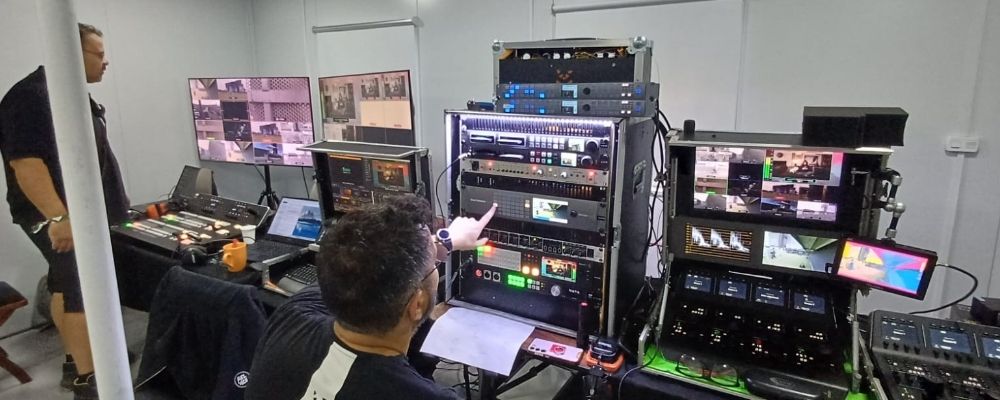
The workflow was built around Blackmagic Design infrastructure, using ATEM switchers for main switching, Videohub for signal routing, and HyperDeck HD Pro and HyperDeck Extreme 8K HDR for recording and backup. The key was not just the equipment, but how both systems were integrated without interfering with the live show.
“The challenge is always to ensure the broadcast does not affect the CCTV operation,” Marcos explains. “We integrate, add our cameras, but the show must run exactly as designed.”
This architecture allowed parallel workflows: the artist maintained their visual narrative for LED screens, while Pandax built a dedicated broadcast narrative for Flow’s remote audience.
Two technical universes coexisting in real time.
The result was not about imposing one system over another, but designing a hybrid workflow that respected the artist’s vision while delivering a broadcast with its own identity.
HyperDeck Extreme 8K HDR and real-time content engineering
In a show like Imagine Dragons for Flow, live transmission is only half the work. The other half happens in parallel: intelligent content recording.
“In Flow’s live broadcast, there are two outputs,” explains Marcos. “One is the direct broadcast. The other is the on-demand version. If something goes wrong, we need material to fix it before publication.”
For this, Pandax relied on the HyperDeck Extreme 8K HDR.
“We don’t record in 8K,” Marcos clarifies. “We use it because it can record up to four 4K signals simultaneously.”
With 17 or 18 cameras, recording everything is possible, but strategy matters. “We record key cameras: cranes, wide shots, critical angles. We also have backup recordings of the final program. Redundancy is non-negotiable.”
Damián adds another layer: “We often record clean feeds without graphics and also final versions with graphics, because digital platforms require different formats.”
The workflow even included dedicated recording for social media, with interchangeable drives enabling continuous capture and fast delivery.
What appears as a simple broadcast is actually a multi-layered system, fully integrated within the Blackmagic Design ecosystem.
Blackmagic Design as an ecosystem: integration, simplicity and evolution
For Pandax, Blackmagic Design is not just a technical choice, but a structural one.
“We work almost entirely within Blackmagic,” says Marcos. “Cameras, switching, routing, recording—it’s all connected.”
“It’s easy to work this way,” adds Damián. “The menus are simple, the logic is consistent. You understand one device and you understand them all. That makes a huge difference in live environments.”
For Marcos, the key is performance under pressure. “In live shows, there’s no time for manuals. Everything is where it should be. That gives you speed and confidence.”
Another critical factor is continuous evolution through firmware updates.
“We recently received an update for the URSA Broadcast G2 adding two more audio channels,” Marcos explains. “That changes workflows without changing hardware.”
The same applies to the ATEM Constellation. “With updates like Bus Mapping, the system evolves as if it were new equipment.”
This approach directly impacts production quality. “We bought the switcher three years ago and today it’s better than when we got it.”
Support, openness and reliability
Pandax’s relationship with Blackmagic Design goes beyond hardware.
“We constantly use technical support,” says Marcos. “I write often. When something improves, I feel heard.”
There is no exclusive contact—just a system that works.
For Pandax, what stands out is the combination of accessible support, evolving firmware, open integration and stability in critical live environments.

What’s next: mobile unit and continued growth
If Imagine Dragons marked consolidation, the next step is expansion.
“Our mobile unit is ready and will make its debut at Lollapalooza Buenos Aires,” Marcos reveals. A fully equipped broadcast truck designed for large-scale productions.
And yes, built entirely within the Blackmagic ecosystem.
With proven experience, strong technical structure and growing ambitions, Pandax is positioning itself as one of Argentina’s leading companies in music broadcast.
Because for them, technology is not the goal—it is the tool that ensures the show flows, the signal remains stable and the story reaches the audience in real time, without margin for error.


