
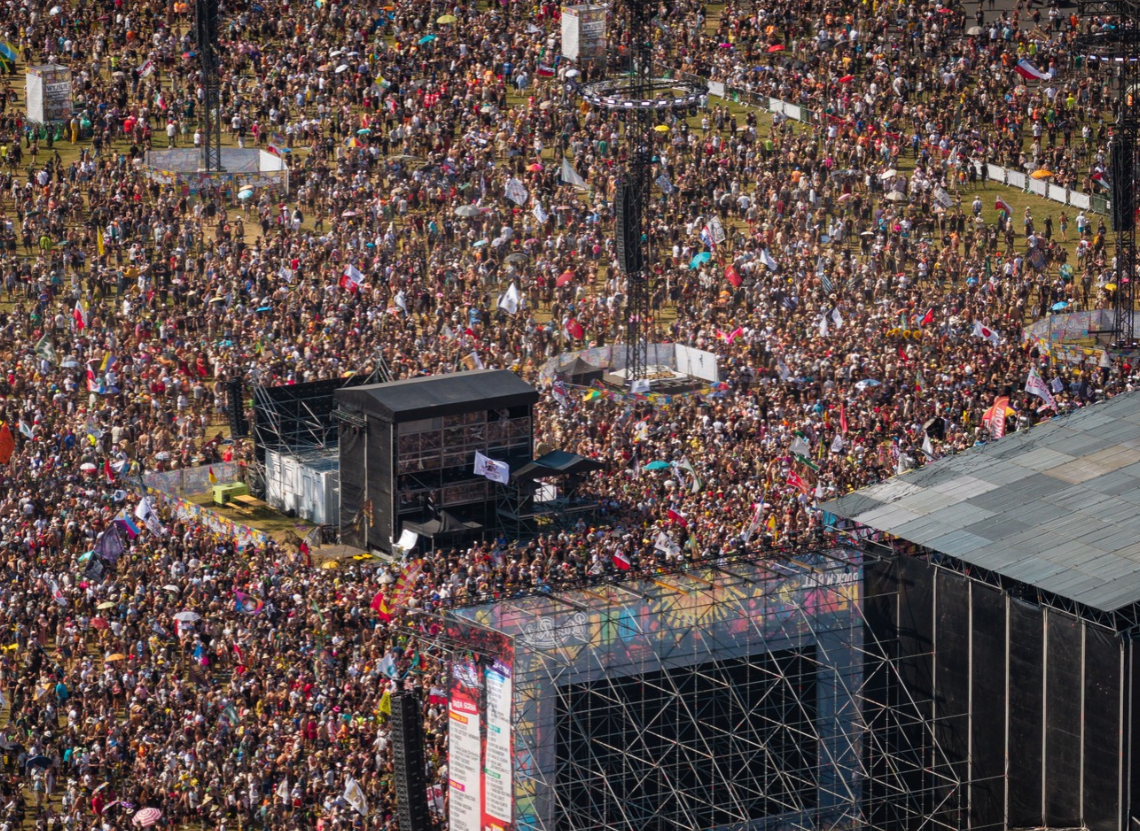
Poland – There are festivals that sell tickets, and then there is Pol’and’Rock. Created in 1995 by Jurek Owsiak as a thank-you to the volunteers of the Great Orchestra of Christmas Charity (WOŚP), the festival that calls itself ‘the Most Beautiful Festival in the World’ has never charged for admission, and is built on the three words that have been its motto for three decades – Love, Friendship, Music.
The 32nd edition ran from 30 July to 1 August 2026 on the former military airfield at Broczyno, in Western Pomerania, with the ASP Stage opening a day earlier. The crowd was put at 700,000 and more – a figure already circulating on the opening day.
The bill offered no shelter to a system with tastes of its own: Dropkick Murphys, Godsmack, Orbit Culture and Vended alongside Alborosie, Kosheen, Eagle-Eye Cherry and Atmosphere, and Polish institutions such as Dżem, Myslovitz, Happysad and Nocny Kochanek – metal, reggae, hip-hop, folk and stadium rock, one act after another, on the same rig.
Once again, that responsibility fell to GigantSound – Letus, one of Poland’s foremost rental companies and Europe’s largest holder of Outline GTO inventory. Jurek ‘Gigant’ Taborowski and his technical team covered both the Main Stage and the ASP Stage, deploying 350 loudspeaker elements in total – fifty more than the previous year, following the purchase of further GTO modules and flown GTO-SUB cabinets. Additional minor support was provided by Gondek Sound and Target Sound, as well as by Commercial Audio as a gesture of friendly assistance.
The complement across the two stages comprised 72 GTO line-array modules with 8 GTO-DF downfill units, 56 GTO C-12 enclosures, 64 Superfly compact line-array modules, 50 Mantas cabinets and 100 sub-bass elements, GTO-SUB and DBS 18-2. At the heart of the audio chain was Outline’s patented Newton, the FPGA-based signal processor that anchors the company’s technology portfolio, together with its equally patented WFIR (Warped Finite Impulse Response) zero-latency filtering. The design logic was continuity: one sonic signature carried unbroken from the stage to the far field, so that a listener four hundred metres back hears the same show as the one pressed against it.
The site itself sets conditions few productions ever have to meet. Jurek ‘Gigant’ Taborowski explains: “This festival takes place in the open space of an airfield, where there is always a great deal of wind, and that is precisely why the Outline system works so well here: it is considerably more resistant to gusts. There are also no barriers in front of the stage, because the stage front has to be a single unbroken wall – so the sub-bass cabinets are hidden beneath it and, across a stage some 80 metres wide, you end up with a continuous line of single subs that is almost impossible to control. An electronic arc was essential. Our system engineers dealt with it: the lowest frequencies, at very high power, stayed coherent in tone and even in dynamics across the entire site.
“The sound crews on both stages – in much the same line-up as last year, with technical chiefs Marcin Szafrański ‘Zapas’ on the Main Stage and Łukasz Rozmiarek ‘Rozi’ on the ASP Stage – did their job superbly in difficult conditions: punishing heat on most days and torrential rain on the last. The whole team deserves congratulations and thanks, including those that reached me from the bands who played.”
System design and tuning on the Main Stage were led by Jakub Mikołajczak, chief system engineer and FOH engineer: “The challenge is to design and tune the rig so that, across an enormous festival site, it sounds like one coherent system – full bandwidth, high dynamics and intelligibility at every point of the planned area. Carrying the energy of the music hundreds and hundreds of metres: that is exactly what this is about.
“We prepared a largely homogeneous large-format full-range system, deployed from ten positions in a MAIN (L/R) plus OUTFILL (L/R) configuration with two delay zones, reinforced with frontfill, infill and FOH delay, and underpinned by low-frequency cabinets in a cardioid configuration: a line 80 metres long. It all worked superbly, and the engineers of the headline acts made no secret of their enthusiasm, thanking us for a system so well prepared and so well tuned.”
Marek Frankiewicz, system engineer on the Main Stage, describes the signal infrastructure: “Signal distribution ran over a Dante network using two Outline Newton processors, one on stage and one at the FOH position. They took the feeds from the bands’ consoles at both locations and acted as the main matrix, distributing signal to the individual clusters. The link between the two processors ran over fibre using Dante, with analogue redundancy.”
For the festival’s founder, the result was audible far beyond the stage areas. Jurek Owsiak comments: “This year’s Pol’and’Rock Festival 2026 gathered an enormous, record-breaking crowd of festivalgoers and music lovers, and the sound system had to meet the expectations that came with it. As last year, it was supplied by GigantSound – Letus.
“We already knew the merits of the Outline system and had spoken of them before; this year, during the concerts, they were confirmed with redoubled force – judging by the outstanding comments and opinions that reached us from the audience and from the bands performing. The system’s reach and tonal precision gave us a further pleasant surprise during the local radio broadcast relayed through the delay lines across the vast camping grounds, in spite of a very strong headwind.”
Wojtek Cichocki, a highly experienced engineer now at FOH for Nocny Kochanek – winners of the audience’s top awards at recent editions of the festival – knows the rig well: “Working on the Outline GTO system prepared by GigantSound – Letus has always been a great pleasure and a real satisfaction. The system is extremely effective and accurate in every respect, although it also demands conscious, considered decisions when building the mix. It forgives only small mistakes – but it gives back dynamics and expression with interest.”
At 21:00 on that final Saturday, with the rain still falling and queues forming at the exits, British act Kosheen took the Main Stage. At the console was Max Burditt – FOH Engineer, music producer and educator, responsible for the band’s live sound and ensuring the best possible audio experience at Kosheen’s show. It was his first encounter with an Outline system; the crowd figure below is his own estimate from the FOH position: “Honestly, I had such a fun time with the GTO system; the guys at the festival did an amazing job deploying it. It was my first time working with Outline, but when I pulled up my showfile at soundcheck, the band all reacted with huge smiles on their faces, and when showtime came, that energy translated to the 150,000+ people in the crowd in a really emotional way. It felt like it was voiced with my taste in mind, with headroom, tight low, and mix depth for days. Like a giant pair of studio monitors, when can I have a go again?”
The system worked across both stages for the entire run of the festival, from the days of intense heat to the rain of the final night. For Outline, Pol’and’Rock is a full-scale annual test of what large-format systems have to do in the open air: very long throws, changeable weather and an audience of exceptional size.


