
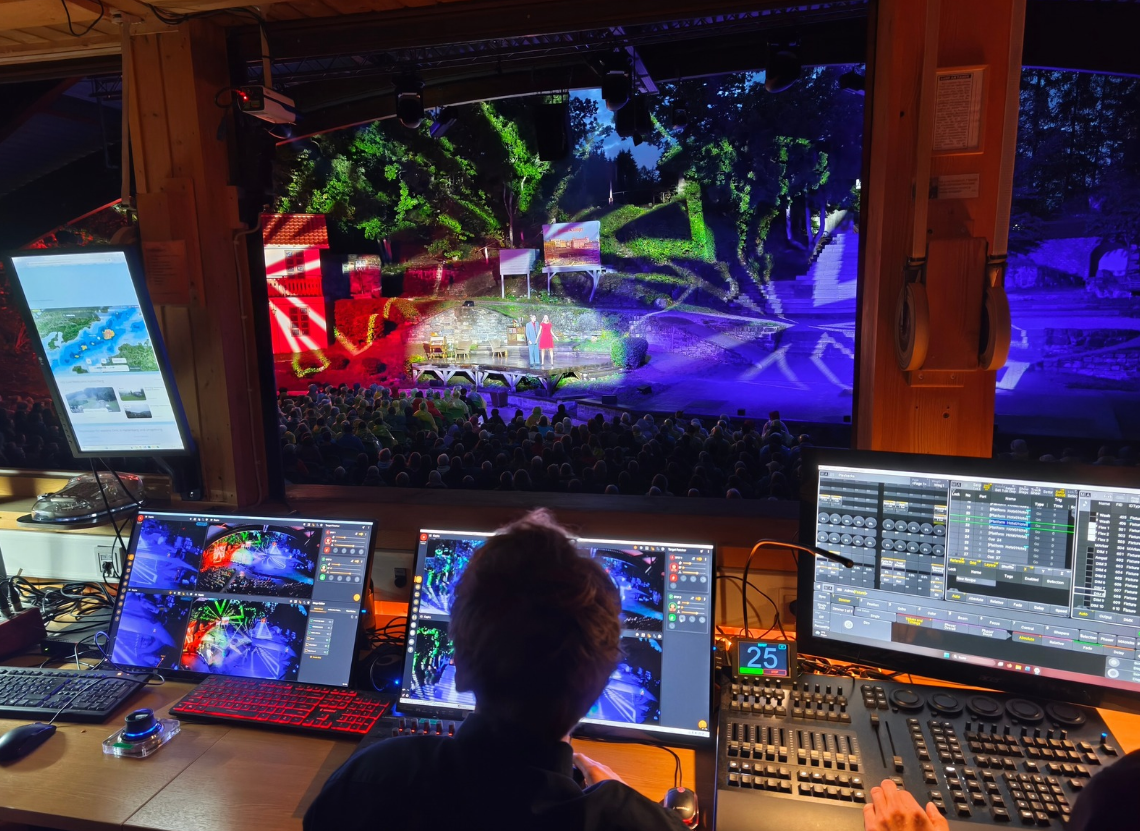
France– Freilichtbühne Hallenberg e.V. has staged more than 100 productions since 1946 and drawn over 1.1 million visitors, and all of it is run by volunteers. Around 140 people take part each year, building the sets themselves across roughly 1,000 working hours from February onwards. For the 2026 adult production of the musical Das Wunder von Bern, the association’s technical team deployed Naostage’s K SYSTEM Flow, choosing it because the system outputs tracking data rather than controlling fixtures directly, which meant any moving light in the rig could become a followspot.
Das Wunder von Bern tells the story of West Germany’s unexpected victory at the 1954 World Cup in Bern and what it meant to a country still recovering from war, following eleven-year-old Matthias Lubanski and his father Richard, a miner who returns home that summer after 12 years as a prisoner of war to find nothing as he left it. Staged from the screenplay by Sönke Wortmann and directed by Stefan Wurz, the Hallenberg production put around 70 performers on stage across 16 shows over the summer.
The venue itself set the terms. The performance area runs roughly 40 metres wide and 25 metres deep with an elevation change of around 15 metres across it, entirely outdoors, which means the system has to work through daylight, dusk and full darkness within a single performance.
“One of the main challenges for the tracking system was the significant difference in elevation across the stage,” says Valentin Eppner, technical director, Freilichtbühne Hallenberg e.V. “Other 2D tracking systems cannot determine or accurately measure the height of a performer, which made true 3D tracking important for our setup.”
That topography created a second problem before the system could be used at all. Calibrating a tracking system normally depends on identifying reliable level reference points, and a hillside stage built into a natural setting offers almost none. Naostage addressed it with a new free calibration mode developed during the period the Hallenberg system was being commissioned.
The deployment itself is deliberately light. Two Naostage KAM cameras cover the site, one mounted at the front edge of the stage roof giving a top-down view of the central playing area, and the second positioned back in the audience to provide a wide frontal view of the whole stage. Installation was completed within a single working day, with further time spent on calibration and on aligning fixtures precisely within the control system’s 3D environment.
From there, the system sends PSN tracking data across the network to a grandMA3 onPC system, where it drives two tracking markers. Any fixture in the rig can then be assigned to a marker, with the Hallenberg team currently using Chauvet Professional and Claypaky moving lights for tracked duties. Nothing has to be permanently dedicated to followspot work.
“The system only provides PSN tracking data and does not control the fixtures directly, which gives us a great deal of flexibility,” says Eppner. “In practice, almost any fixture in our rig can be used as a followspot whenever needed. We do not have to dedicate specific fixtures permanently to followspot duties, which is particularly valuable for a production environment like ours.”
K SYSTEM Flow is a manual tracking system, but it removes one axis from the operator’s workload. With Auto Z, the operator follows the performer in X and Y on a two-dimensional screen while the software maps that view against a 3D model of the venue and derives the height in real time.
“For the operators, not having to control the Z-axis manually makes a significant difference,” says Eppner. “Especially on our stage, with a big elevation difference, having the height calculated automatically allows the operator to concentrate entirely on following the performer across the 2D surface instead of having to manage three axes at the same time.”
That reduction matters more in a volunteer company than it would in a professional house. Hallenberg’s technical team numbers twelve people, and the operators running tracking are not full-time followspot operators.
“The system itself is very easy to learn because the user interface is intuitive and straightforward. Even for volunteer operators, the basic workflow can be understood very quickly,” says Eppner. “The part that requires more practice is the manual tracking itself using the joystick. Operators need some time to become familiar with the response of both the joystick and the fixture, and they benefit from knowing the performers’ movements and blocking in advance.”
Before the installation, the theatre worked with a conventional manually operated followspot from a single fixed position. On a stage of this width, that was a real constraint. Most of the venue’s lighting had to come from the front, and one followspot position could not light performers consistently across the full span.
“With the tracking system, we are no longer tied to a single followspot position. We can select whichever fixture in the rig provides the best angle for a particular area of the stage,” says Eppner. “It has also opened up new creative possibilities. Because the followspot can now be any moving light in the rig, we are no longer limited to the traditional functions of a conventional followspot. We can make use of all the features the fixture itself provides, including gobos, colour effects and beam effects. The tracked light can become an active part of the lighting design rather than simply serving as a white followspot.”
The production is also understood to have used the Naostage system to track a non-human subject, following a car during one scene, which is the first time Naostage tracking has been applied to an object rather than a performer.
The Hallenberg installation went in at a relatively early stage in the system’s development, and the theatre’s feedback fed back into it. Functions including tracking with a Z-offset and a dedicated 2D mode were both developed to suit the venue’s requirements. The system reached the theatre through Patrick Slots at So-light, Naostage’s distributor.
“Naostage gave us the opportunity not only to introduce tracking into our venue, but also to actively contribute to the development of a system that has become a flexible tool for our productions,” says Eppner.
Photo © Manuela Senger.


