
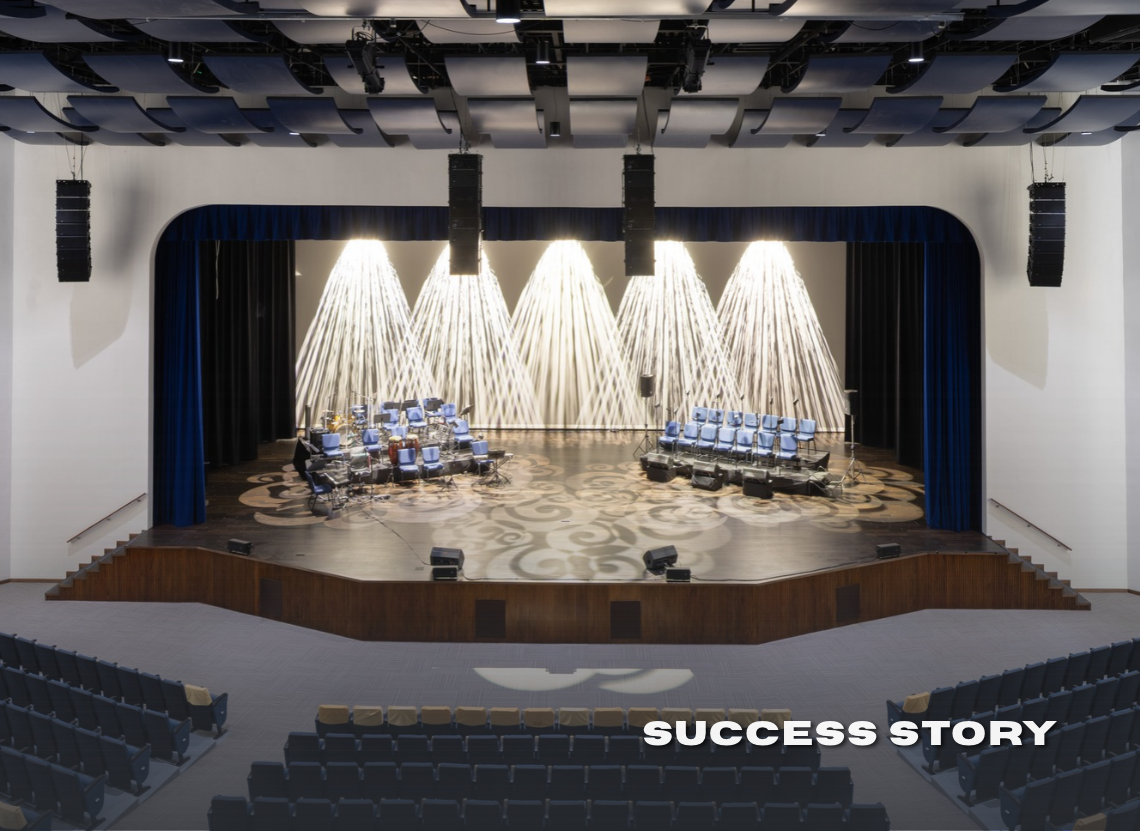
With an activity where music plays as important a role as the spoken word, the new auditorium at Más que Vencedores church required a solution capable of responding with clarity, dynamics, and precision to very different scenarios.
MusiTempo supported the project from its earliest stages and found in Meyer Sound the platform to build a system designed together with the space and prepared for a community where preaching, choir, a large-format band, and top-level musicians coexist.
At Más que Vencedores, music does not function as a complement to preaching. It occupies a large part of each service, with a large-format band, choir, and a dynamic that can move from rock to merengue or salsa before returning to the spoken word. That musical identity shaped the conception of the church’s new auditorium in the Dominican Republic from the very beginning, as well as the way its sound system needed to be designed.
The audio began to be defined while the building was still under construction, making it possible to work in parallel on architecture, acoustic treatment, and coverage. MusiTempo was involved from those early stages alongside the technical team, with an objective that would run throughout the entire project: achieving the clarity required for preaching without sacrificing the dynamics and energy demanded by live music.
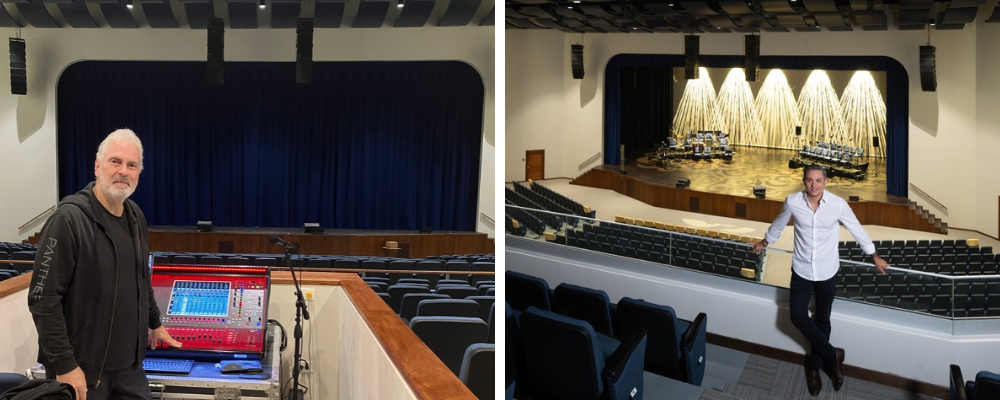
Allan Leschhorn, a Latin Grammy-winning sound engineer and producer and Juan Luis Guerra’s sound engineer, who, in addition to participating in the project, serves as the church’s FOH engineer, explains: “The usual dynamic is divided approximately into 60% music and 40% preaching. The stage can bring together six horn players, drums, several percussion stations, two guitarists, two pianists, and a choir that currently has around 20 professional voices and continues to grow.”
Adding to this reality is another particularity: Juan Luis Guerra is part of the community, participates musically, directs the band, and on certain occasions also preaches. The music therefore had to meet those expectations without compromising the naturalness and intelligibility required when the service shifted toward the spoken word.
A project that began before the auditorium
MusiTempo had the unusual opportunity to become involved when the new space still existed primarily on plans.
The Dominican company has 30 years of formal experience —and around 37 years since its beginnings— and currently operates across different professional, commercial, and residential audio segments, while also supporting integrators and professionals in the design, consulting, and execution of projects.
For Fernando Hernandez Voigt, CTO of MusiTempo, the opportunity to become involved at such an early stage was decisive. They recall that the first evaluations began while the construction was still “in the rough.” They even held a test service inside the unfinished building, using very little equipment, to begin understanding how the space would respond.
“Everything was developed together. It wasn’t a case of finishing the construction and then asking what we were going to do. Everything moved forward together. There were many emails, many decisions, many conversations, but there was a clear direction, and that direction was excellence,” says Francisco H. Voigt, General Manager of MusiTempo.
That integration also extended to the acoustic treatment. Engineer Guillermo Sánchez worked on the design and predictions for the space, while civil engineer Jaime Jiménez, responsible for the construction, facilitated coordination between the technical requirements and the building process. The process made it possible to analyze different configurations and predict the system’s behavior before moving forward with its final implementation.
For Fernando, having participated from that point completely changed the nature of the work:
“We had the privilege of contributing to the development and the entire execution from zero to one hundred. We almost always enter projects when they are already very advanced or practically finished. Here, there was a clear intention for the development and construction to be based on the experience we were going to have inside.”
Between the spoken word and the energy of a live band
Más que Vencedores needed to address two different demands within the same space.
On one hand, spoken voice had to maintain definition and naturalness throughout the auditorium. On the other, a musical ensemble capable of generating the levels, dynamics, and sonic density of a concert.
“Finding a balance between both was the real challenge,” Fernando explains. “The idea was to have enough clarity and intelligibility for preaching, while at the same time maintaining the energy for users such as Allan, Juan Luis, and the band, so that it could have that magic they look for in their music.”
Allan knows this coexistence particularly well. His daily work does not consist solely of mixing songs and then handing the system over to another operator when the preaching begins. During the same service, he may move from rock to merengue or salsa and, just a few minutes later, accompany a spoken segment. Juan Luis Guerra may even begin singing while he is preaching.
“When we do a concert, we know what we’re going into; it’s something we’ve done thousands of times. But in our case, ours is a very musical service. Maintaining that flow is something we’ve been working on Sunday after Sunday.”
And the PA had to make precisely that possible.
Meyer Sound as a meeting point
Meyer Sound was already part of the professional world of those involved in the project. For Allan and Juan Luis Guerra, it was a familiar and valued platform based on their experience in music productions, while MusiTempo had been in discussions with the company for years before formally beginning its representation in the Dominican Republic a little over three years ago.
In the case of Francisco H. Voigt, that connection with sound quality is linked even to his own professional history. Before entering the audio industry, he was a classical violinist, a background that still shapes the way he listens to and evaluates a system. A visit to the Meyer Sound factory ultimately confirmed that impression: “We realized that with Meyer we really hadn’t made a mistake. You can clearly perceive the transparency and sparkle of a Stradivarius, as well as the depth and the round, powerful sound of a Guarneri del Gesù,” he recalls.
Más que Vencedores thus became an opportunity to bring that relationship into a particularly representative project in the Dominican Republic, with Juan Carlos Yepes providing support from Meyer Sound.
LEOPARD at the front of the system
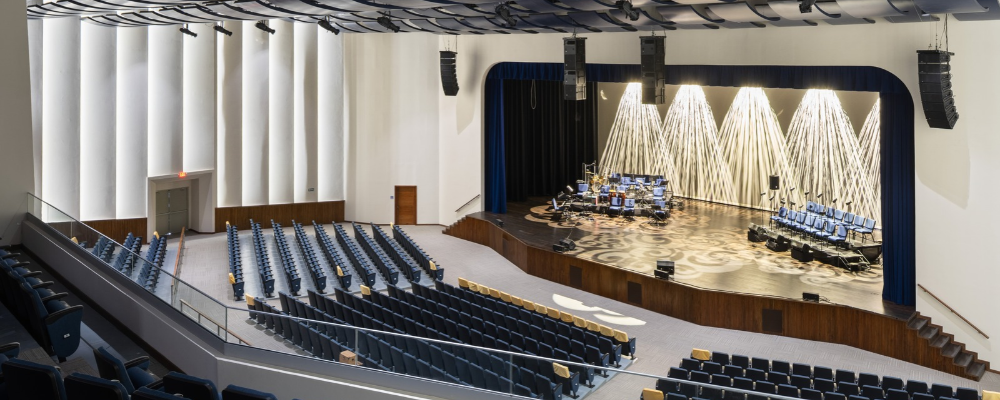
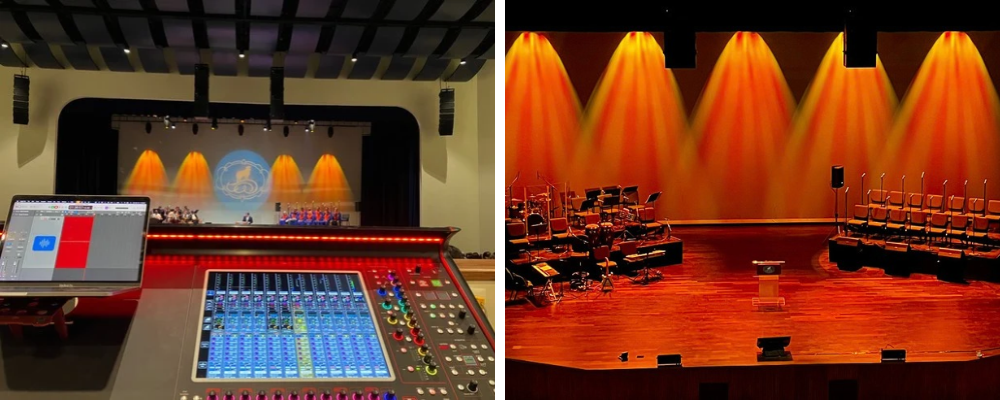
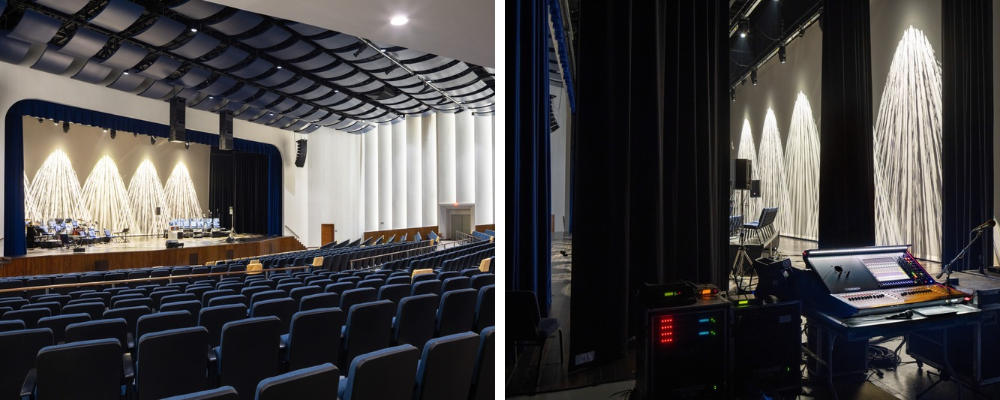
The auditorium’s main configuration is based on Meyer Sound’s LEOPARD system, with eight loudspeakers per side providing the primary coverage for the space.
For low frequencies, the system incorporates 900-LFC units arranged in a cardioid configuration of two central arrays. Coverage for the first rows is completed by four ULTRA-X20 units as frontfill, while four USW-112 units integrated into the stage provide additional low-frequency reinforcement.
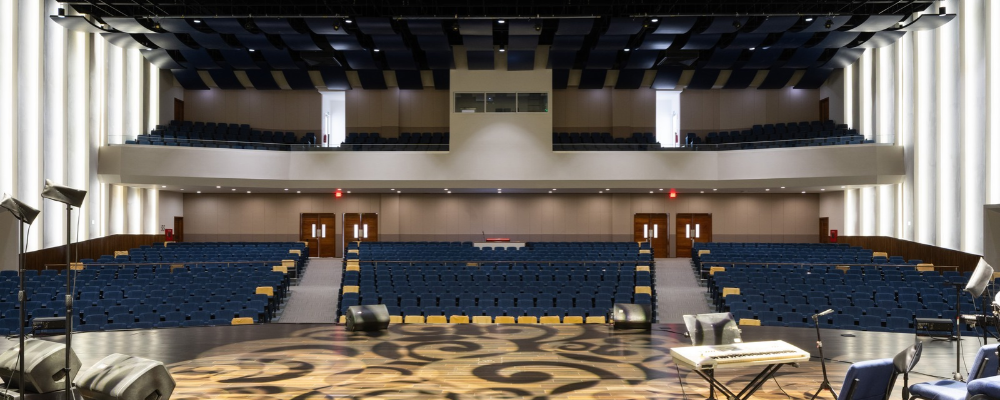
The selection and placement of each component formed part of the predictions carried out during development. This was especially important in an auditorium with an approximate capacity of between 1,200 and 1,400 people, which also incorporates an upper balcony and side sections where coverage needed to be maintained.
The installation, therefore, was not designed solely around the available sound pressure level. It was necessary to ensure that someone seated in the upper section could receive an experience consistent with that of someone in the stalls, while at the same time addressing the first rows with dedicated coverage.
Allan describes the result in a much more graphic way: “With the two speakers up there, it’s like you’re in your living room.”
The phrase summarizes one of the objectives established from the first simulations: that the scale of the venue should not translate into sonic distance.
From prediction to hearing the room
After several months of working with the system, one of the aspects Allan highlights most is how closely what they anticipated during the design matched what they ultimately experienced when listening to the completed auditorium.
“Very few system predictions reach this level of accuracy. Experiencing what had been planned and then hearing it live was wow. After that, what you need are the basic adjustments: when there are more people, when there are fewer people, when the band is playing louder.”
For the engineer, the overall sound was balanced from the moment the system was commissioned. The final stage also included direct participation from Meyer Sound through Oscar Barrientos, who was responsible for optimizing, calibrating, and aligning the system. His work concluded with the handover alongside the band during soundcheck, making it possible to verify the system’s response under the real conditions for which it had been designed.
For Allan, that work ultimately connected the predictions made during development with the auditorium’s final behavior: “The overall sound of the theater ended up very, very balanced. A big round of applause for Oscar there, because he did all the alignment.”
When the PA leaves room to mix
There is an important difference between a system being able to reproduce a band correctly and allowing the engineer to stop constantly thinking about correcting its behavior.
For Allan, that is one of the main results of working with the Meyer Sound system every day: “One of the things that helps me the most is that when you turn up that volume, there’s very little you need to do. So it lets you focus on the music, it lets you focus on the dynamics of the music. You’re not thinking, ‘Wait, let me EQ this here, let me see if the PA…’ No. It’s sounding perfect and nicely balanced.”
With an ensemble the size of the one used at Más que Vencedores, having that foundation becomes particularly important. It is neither a static lineup nor a repertoire that remains predictable from beginning to end: “Our setlist varies a lot. We can do rock and then merengue and then salsa. Sometimes I work with snapshots, but sometimes I don’t even have time, and I prefer to go straight to the mix.”
Another dimension of the system appears here: providing a sufficiently stable foundation so the operator can follow what is happening on stage without constantly having to correct the PA.
An auditorium that continues to be adjusted every Sunday
The installation has been operating in its complete configuration for approximately five or six months, and for Allan, that does not mean the work is finished.
A Sunday with a full auditorium does not behave exactly the same as another with lower attendance. Nor do all preachers use the same vocal level, and not every song generates the same energy. “It’s alive; this has a life of its own,” he summarizes.
The day-to-day adjustment even extended to certain sections usually occupied by older people. There, Allan established independent control that allows him to manage the level more precisely while maintaining sufficient coverage in more complex side areas.
Feedback from people distributed throughout the auditorium thus became an additional tool. On some Sundays, he directly asks members of the church seated in those areas how the system is reaching them and makes small adjustments from his position.
That continuous learning complements the work carried out during the design phase. The predictions made it possible to build the foundation, and the experience accumulated during each service continues refining it in front of a real audience.
MusiTempo and a relationship built around the project
For MusiTempo, Más que Vencedores also holds particular significance within its history with Meyer Sound. The previous relationship among those involved helped, but it also raised the level of responsibility. Francisco and Fernando have known Allan for more than 30 years and share long-standing professional and personal relationships with several of the people involved.
Fernando acknowledges that this closeness made expectations even higher: “There was a double commitment here. A corporate commitment, but also a very deep moral and spiritual commitment that carries much more weight than the commercial one.”
From Meyer Sound, Juan Carlos Yepes describes the project from a similar perspective: “For me, it was a joy to work with people you appreciate, admire, and truly consider leaders in what is being done in our markets. It is a source of pride to be part of this and to have at least a small piece of a project like this.”
Más que Vencedores thus became a meeting point between a professional relationship built over many years and an installation that finally made it possible to bring that relationship into a concrete project in the Dominican Republic.
A level of demand that goes beyond Sunday
Más que Vencedores was conceived as the permanent home of a community that had spent decades moving through different spaces. The new auditorium finally made it possible to think of infrastructure, acoustics, and technology as parts of the same experience. And the level of demand it faces each week can hardly be separated from the people who use it.
Juan Luis Guerra himself actively participates in that dynamic. He provides musical direction, performs with the band, and may also take on moments of preaching. Around him is a team with extensive professional experience. Allan Leschhorn brings decades of studio and live sound work to the auditorium, while other musicians associated with La 440 also participate in the services.
This makes the installed system more than a solution used occasionally for a special production.
After several months of operation, the real result begins precisely there: when the predictions, the decisions made on plans, and the hours of adjustment stop being theory and begin facing a full space every week.
At Más que Vencedores, the clarity of a sermon and the energy of a band are part of the same sonic experience, and the Meyer Sound system was conceived to respond to both with the same precision.
Credits
Cover Photo: MUSITEMPO
Inside Photos: MUSITEMPO
The journalistic production, research, writing, editorial approach, and editing of this content are original works by LATAM STAGE and are protected by copyright.
No part of this content may be reproduced, copied, distributed, adapted, or published, in whole or in part, in any medium or format, without the prior written authorization of LATAM STAGE.


