
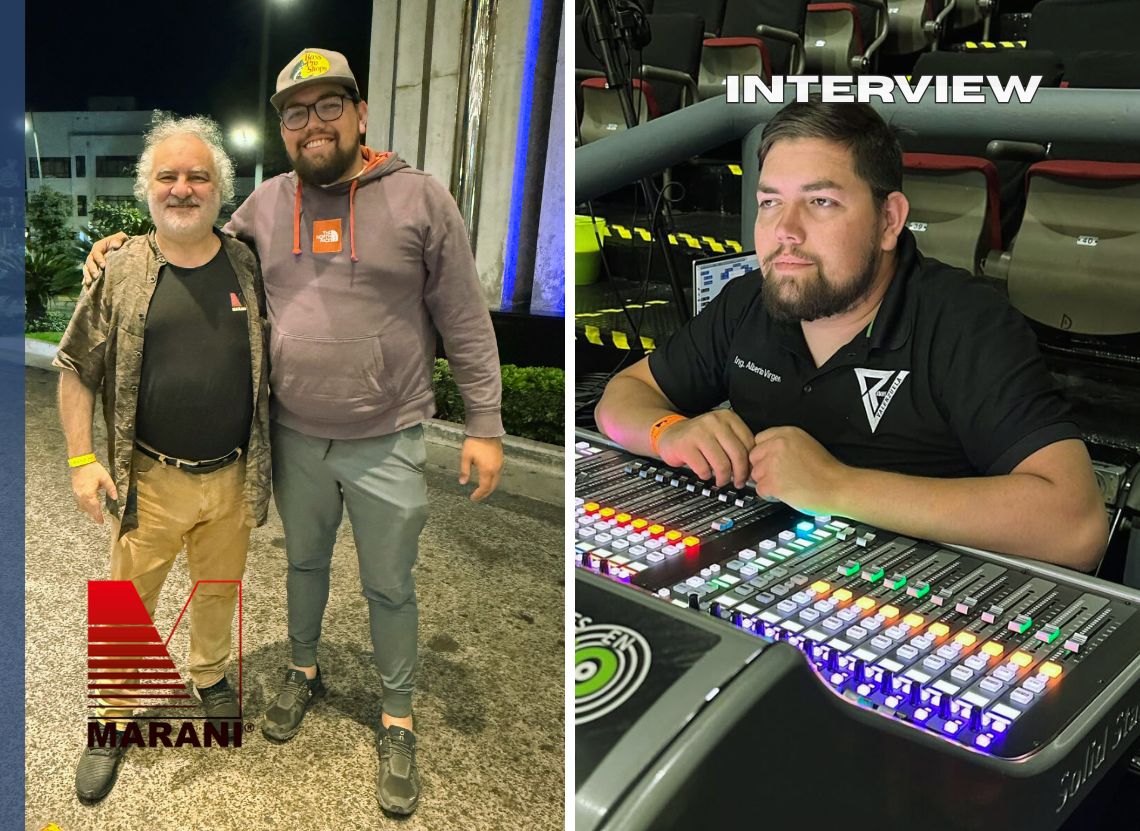
Carlos Alberto Álvarez Virgen lives audio firsthand. He tours, adjusts, tests, proposes, and improves. His relationship with MARANI did not begin in a showroom; it started in the trenches, solving real-world problems. Today, as technical support for Latin America and a direct advisor to Michele Marani, he combines field experience with product development.
Sometimes a vocation appears even before you understand what it is called. For Carlos Alberto Álvarez Virgen—better known as Alberto Virgen—that connection with audio began among modest stages and the intuition of a child who already knew where he wanted to be.
Today he tours as a systems engineer, FOH engineer, and producer with Mexican regional artist Remmy Valenzuela, and collaborates on other projects, contributing mixing or system design according to each need.
“Ever since I can remember, I dreamed of this. I loved going to shows in my hometown, even if they were small, and just staring at the stage. Someday I wanted to be behind all of that,” he recalls.
He didn’t really know what what attracted him was called, but he knew he was passionate about speakers, sound, and the energy those setups generated.
The bridge to that world was family. His father is a musician, and it was in that environment that the spark was lit. At 15, he began working with the audio company Outlander Navarro in Jalisco. And from there, there was no turning back. “It was a natural path. I started working and I liked it. I said: this is what I want to do for the rest of my life.”
By 18, he was already touring with his first band: the well-known Banda Tierra Sagrada, which at the time had several hits playing everywhere. With them, he toured Mexico, Guatemala, Colombia, and the United States. “I learned a lot with them. It was a very beautiful experience that marked me.”
At 25, he reached his current position with Remmy Valenzuela, where he has now spent almost five years as a fundamental part of the technical team. “I like what I do, and on top of that they pay me to do it. What more could you ask for?”
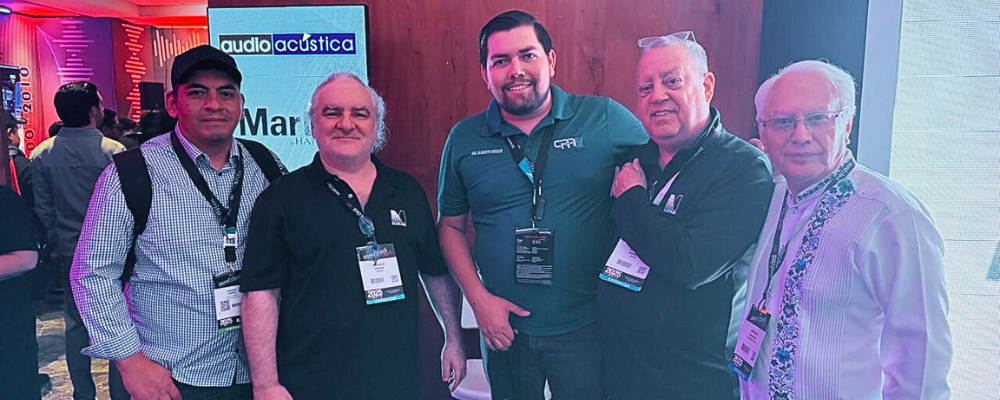
A meeting that changed everything
The turning point in Alberto Virgen’s path came—as often happens in this industry—during a training course. In one of the workshops led by Pepe Ferrer, a well-known technical reference in professional audio in Latin America, he came into direct contact with a Marani processor for the first time.
“I saw that Pepe had brought a Marani and I asked him what he was going to do with it. He told me that Gilberto Morejón, the brand’s representative in Latin America, had given it to him so that, if someone wanted it, he could sell it at the end of the course,” he explains. Alberto didn’t hesitate. “I told him I could tour with it with an artist in Mexico so people could see it. And that’s what happened.”
Until then, he knew Marani through online references and through Ferrer’s courses. He had even worked with OEM equipment from the brand in his region. “When I saw it, I realized it was the same as what I had already used. So I spoke with Gilberto and told him: ‘I want that processor, I want it touring with us.’ He gave me a very good price, and before the course even started, I had already paid for it.”
As soon as the session ended, everyone was asking about the unit. But it already had an owner. “I took it with me and started touring with it. And let me tell you, the change was very noticeable,” he emphasizes.
That same year, Remmy Valenzuela was celebrating 15 years of his career with a special tour throughout Mexico. An ideal opportunity to put the system to the test on diverse and demanding stages. “Remmy is young—he just turned 35. But he has a lot of experience. And he also supports us working with the right tools, which is key for our job,” Alberto notes.
During the tour, many of the shows took place in small and acoustically challenging spaces, such as the famous Mexican palenques. Designed as an intimate tour, the artist sought closeness with the audience, but that decision brought complex audio scenarios with it. “It put us in some dilemmas because we would arrive at very small, very reverberant places. And the palenque is a challenge: the artist in the center, the seats rising, and the PA up high, pointing downward. They’re not places designed for concerts… but there we are, solving it,” Alberto acknowledges with a laugh.
That’s how a new stage of discovery with Marani began, marked by technical exploration, sonic confidence, and support at every show.
Technique in the service of art
With the Marani in his rack, Alberto began to notice an immediate sonic difference, especially in small, reverberant environments. “We were touring in places that were extremely reverberant… and I started making the adjustments the way I learned from Pepe, and that reverb went down. I’m not saying it disappeared, but it dropped by about 70%. That changes everything,” he states.
The change was not only perceptual; it was strategic. The processor allowed him to bring a much clearer, more defined, and more precise mix to the front. “It makes everything come forward, makes you hear it as if the artist were singing close to you. You no longer hear everything in a diffuse way,” he explains.
But that was only the beginning. Alberto also identified other fundamental technical advantages. “After adjusting with Marani, it feels like the system doesn’t reach its limit point as easily. It develops more energy without being forced. And the best part: it doesn’t hurt. You can push it without ending up fatigued. That, for me, is a huge advantage.”
The key lies in the phase response. “Because it adjusts the phase, all frequencies come out at the same time. You no longer have impulses colliding at different moments. And that’s less fatiguing for the ear. You feel everything more clearly. It’s not just about volume; it’s about coherence.”
He has become so accustomed to the results that today he takes his processor everywhere. “Wherever I go, the MARANI goes,” he says.
He then shares an anecdote that made it clear just how much of a difference a good, well-used tool can make. “At a show they told me: ‘Nobody sounds good here. You should have brought another system.’ But when we started and it sounded good, the owner just stared at me and said: ‘What are you doing? International artists have come here and nobody ever sounded like this.’ So I grabbed the processor and said: ‘This is what makes the difference.’ I put it in bypass… and the mix disappeared. He was frozen. I turned it back on, and everything came forward again. That’s when he understood.”
The fascination didn’t end there. Over time, and already in direct contact with the Marani team, Alberto continued discovering new ways to optimize his systems. “When I met Michele Marani, he taught me many more things. And I understood that this isn’t just a brand. It’s a work philosophy.”

Tools that make the difference
Alberto’s experience with Marani is not limited to using the processor; he pushes it to its limits. And when asked about the key functions that make the difference, he doesn’t hesitate to highlight three tools that have become essential in his workflow.
The Dynamic Loudness Filter has also earned a privileged place in his setups. “It’s very much based on the Fletcher and Munson curves, on how the human ear behaves. When you lower the volume, it emphasizes the frequencies that the ear stops hearing. And you get the sensation that it still sounds the same. It’s very beautiful.”
And if he had to choose a favorite function, he leans toward the Dynamic EQ. “In a mix, as the final stage before the system, it’s impressive. Michele’s algorithm is so subtle, so beautiful, that it clarifies everything. That tool—I love it.”
With a system that also includes limiters, presets, and filters, what Alberto values most is what he doesn’t find in any other processor. “The linear equalizer that we are working on with Michele is another example. It doesn’t move the phase. And that type of tool is what makes Marani so special.”
On the other side of development: the relationship with Michele Marani
One of the aspects that most excites Alberto Virgen is the direct relationship he has established with Michele Marani, the founder and principal developer of the brand. He defines it with admiration. “With Michele, I’m constantly gathering information. What do engineers see in the brand? What can we improve? I take all of that to him, and he does it.”
That constant openness to feedback is, for him, one of the strengths that truly makes a difference. “I tell Michele, this doesn’t work, this does work, we need to fix this… and in a matter of days everything is solved. That is fundamental in any brand: that they listen to the end user.”
The exchange is not isolated or occasional, but part of an ongoing collaborative dynamic. “I have completely direct contact with him. And that’s what he wants. To listen. To learn. To improve.”
They are currently working together on an ambitious project in Mexico that involves integrating Marani amplifiers into an Adamson system. “They are fascinated by hearing their system with Marani. And from there, many learning curves emerged for everyone.”
More than a technical relationship, what Alberto finds in Michele is a shared philosophy: evolving from real-world experience. “He has never told me, ‘That’s wrong.’ He always tells me, ‘Let’s fix it.’ And that’s how we carry that learning curve forward, embedding it into the products. For me, that has no price.”
But the collaboration doesn’t stop at ideas. Naturally, that constant exchange ended up consolidating a key role. “I’m now the brand’s technical support for Latin America,” Alberto says enthusiastically.
And it is no small task. He channels questions, proposes improvements, and conveys feedback from real users on real tours.
It all started as technical curiosity, and today it is an active part of product development. “I started touring with the processor, questions began to come up, Gilberto helped me… but when the questions became very technical, we created a group with Michele on WeChat. And that’s when we really got into it.”
Since then, that dynamic has become routine. “Michele works at night, and I don’t mind staying up learning. There are days when Gilberto wakes up to 500 messages from us. But that’s what I like: they listen, they test, they adjust. And all of that turns into real improvements.”
The final sentence sums it all up. “I think the way we started using the processor from this side appealed to him, and that’s why he asked for my help. As the brand’s specialist in Latin America and as his technical support in product development.”

What’s next: future vision and commitment to the community
For someone so deeply involved in both development and use of the equipment, the future of Marani is not speculation; it is a path under construction. And Alberto is clear about it. “What’s important now is to have connectivity with many systems. To be able to deliver on all protocols—AVB, AES, Dante—directly, without conversions. A real multiplatform approach. That’s the goal, and I don’t think it’s that far away.”
With all of the brand’s processors and amplifiers in use, and new products under development, his role as technical support for Latin America and external advisor becomes increasingly strategic. “New models are coming, and we’ll review what they have too much of, what they’re missing. That’s beautiful. Being able to participate from the inside in that growth.”
And what place does Marani occupy in his work ecosystem? “In the number one spot is Marani. I can use other consoles or microphones and reach similar results, but with Marani I can do interesting things even with other toys. I can’t take it off my list.”
Before saying goodbye, he leaves advice for those just approaching the brand. “Don’t be afraid to try it. It’s a great tool. It changed a lot about how I understood sound. I no longer worry about how the system is going to sound, only about what I have to do during the show.”
And he closes with a direct invitation. “Come to me, to Gilberto, to anyone. I’m passionate about the brand and I can help anyone. You’ll see that what can be achieved is impressive.”
In a context where technology often speaks louder than people, the story of Alberto Virgen and MARANI reverses the equation. First comes real-world experience, then the tool. From touring to product development, the bond between the two shows that the best audio is not born in an isolated laboratory, but on stage, in front of the audience and under pressure. When a brand listens to those in the trenches, the result is not just better sound; it is a philosophy that evolves with every show and projects itself into the future of professional audio in Latin America.


