

At the start of the year, LINK introduced one of the most compelling proposals in professional connectivity: a modular system that completely rethinks how signal distribution systems for audio, lighting and data are designed, assembled and maintained.
In a context where operational efficiency and flexibility are becoming increasingly critical, the Italian company focused on a solution that directly addresses this need: the Widgets ecosystem, based on the AES72 standard, which allows fully customized systems to be built using interchangeable modules.
RJ Kenney, Technical Services Manager at LINK, explained the concept clearly: “It’s a distribution system based on AES72, but it’s actually much more than that—it’s a modular, ‘do-it-yourself’ solution for building custom audio, lighting and signal systems.”
The key lies in its architecture. Instead of relying on fixed wired panels, the system is built around independent modules—3- and 5-pin XLR, multipin connectors of up to 32 channels, power connections, CAT6, audio and DMX—that can be combined within different rack formats or enclosures.
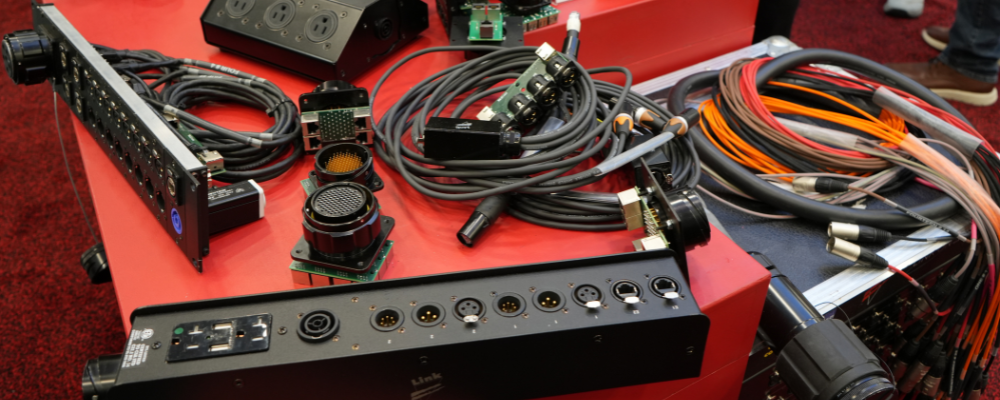
“We have different modules and different types of frames that allow you to build these configurations like Lego,” Kenney explained, highlighting a logic that fundamentally shifts the traditional cabling paradigm.
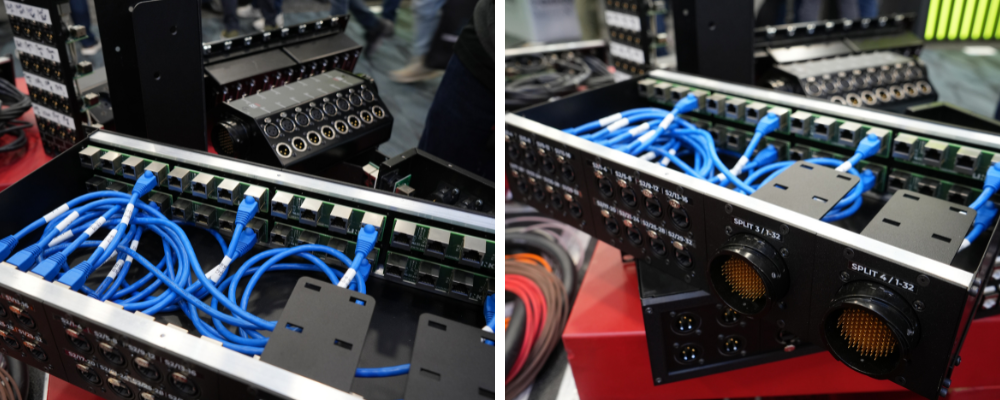
This modular approach not only impacts the initial design, but also day-to-day operation. One of the examples showcased at ISE was a 32-channel system with a 4-way split in a 2U format, which can be quickly reconfigured depending on project requirements.
The flexibility is total: changing the configuration no longer requires rebuilding an entire panel, but simply rearranging modules through internal RJ45 connections.
“If you need a different configuration, you can easily modify it by swapping modules and reconnecting the RJ45 jumpers,” Kenney noted, emphasizing the system’s speed of adaptation.
From a technical standpoint, the entire ecosystem is built on the AES72 standard, which defines the use of Ethernet-based connectivity for transporting balanced analog audio. This is a key factor, ensuring consistency, reliability and compatibility in professional environments.
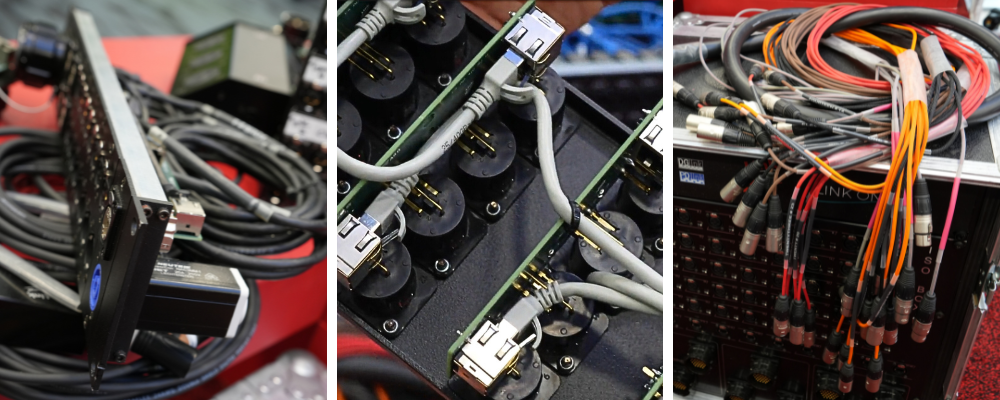
According to LINK, the system not only matches the performance of traditional methods but also eliminates some of their limitations. “There are no disadvantages in terms of interference, signal loss or level compared to traditional wired systems,” Kenney stated, supporting the claim with specific technical documentation.
Where the system truly stands out, however, is in field operation. The ability to perform quick repairs becomes a critical factor, especially in touring, live events or installations where time is limited.
“If something fails, you can replace an entire module simply by disconnecting the RJ45s. That makes field repairs much faster and simpler,” he added.
This approach also has a direct impact on sustainability and long-term costs. Unlike traditional systems, where each new project often requires building dedicated panels, the modular system allows the same components to be reused across different configurations.
“You can reuse all the modules and simply reconfigure the frames for each project, instead of building new panels every time,” Kenney explained.
In terms of applications, the solution is designed for rental companies, fixed installations, studios, broadcast environments and complex integrations, where signal distribution demands adaptability, organization and reliability.
During the ISE demonstration, the company also showcased concrete examples such as fully wired 24-channel stage boxes with CAT connectivity, custom panels combining audio, data and power, and hybrid configurations ready to integrate into existing systems.
The brand’s approach aligns with a clear industry trend: moving from rigid solutions to dynamic ecosystems, where hardware keeps pace with the speed of modern projects.
From Barcelona, LINK delivers a strong message: signal distribution no longer needs to be fixed or complex. It can be modular, scalable and adaptable. And in a market where every second counts, that difference goes beyond technical—it becomes strategic.


