
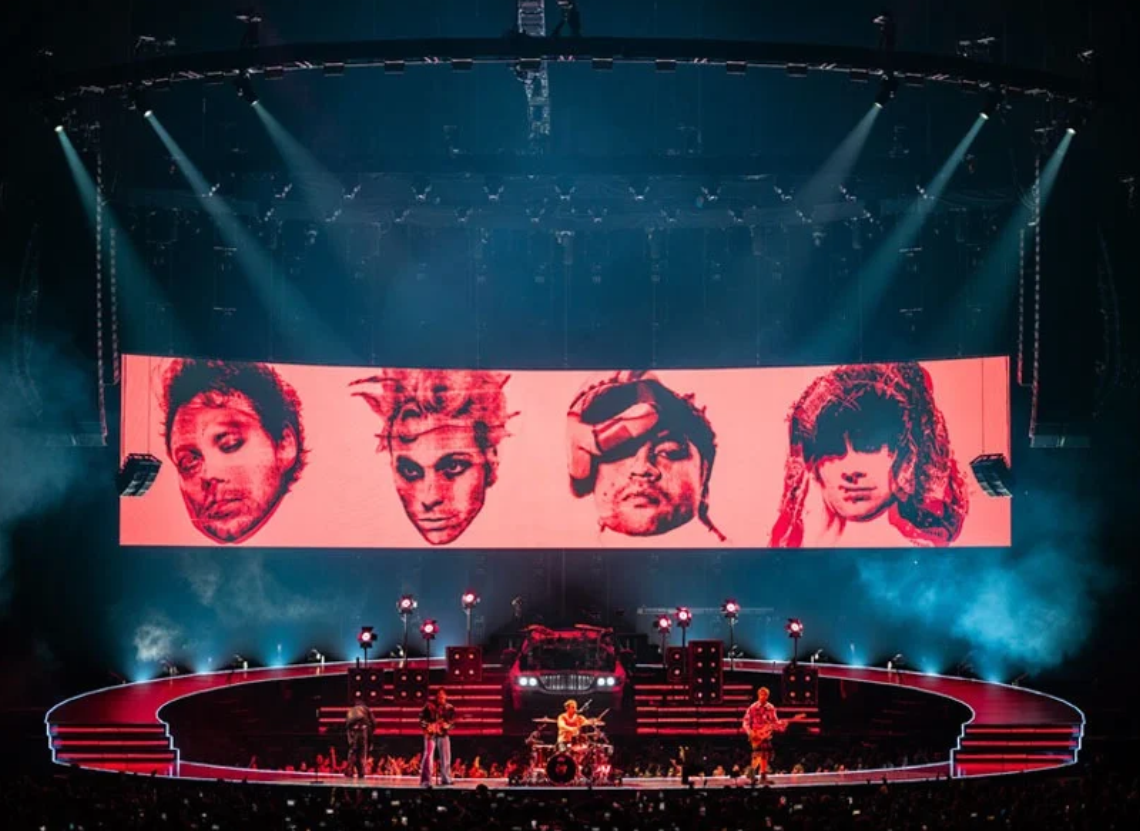
International – The unusual geometry of the stage for the Everyone’s a Star! World Tour required the sound coverage to be approached from a different perspective. With a 75-foot circular stage, a VIP pit located inside the ring, and four vocalists moving along a curved thrust, Adlib developed an L-Acoustics K Series system capable of maintaining control and definition without relying on a central cluster.
The worldwide tour by Australian pop rock band 5 Seconds of Summer began on March 26 at the SSE Arena Belfast and will continue through December, visiting arenas and amphitheatres across the UK, Europe, North America, South America, Australia, New Zealand and Asia. Venues range in capacity from 8,000 to 20,000 spectators.
The audio design was created by Adlib systems engineer Billy Bryson, an L-Acoustics UK Certified Provider, while Sebastien Teti is handling the FOH mix. Bryson has been touring with the band since 2020, and his experience with the group played an important role in adapting the system to an unconventional stage design.
A stage that changes the rules
The circular stage measures approximately 75 feet in diameter. On the upstage half, the band performs in front of a curved video wall, while the downstage section extends into the audience through another curved thrust. A second drum kit is positioned at one end on an automated lift.
The area inside the circle serves as a VIP pit, meaning that part of the audience is literally surrounded by the stage.
This configuration presented a particular challenge: both the VIP area and the thrust had to receive consistent coverage while avoiding unwanted interaction between the two zones. At the same time, production ruled out a central cluster because it would have obstructed sightlines to the video wall.
“One of the priorities was having a dedicated systems engineer who was deeply invested and detail-oriented,” says Teti. That responsibility fell to Bryson, who also had to develop a solution that could be adapted to different venue formats without sacrificing consistency.
A system designed for the circle
The main configuration uses up to 14 K1 and four K2 per side. On the K2, the Panflex fins are adjusted to reduce spill onto the thrust. Up to eight K1-SB can be flown behind the main systems on each side, with both the box count and electronic low-frequency steering adjusted according to the characteristics of each venue.
Coverage along the sides, extending to the 180-degree line, is provided by up to 16 K2 per side. Inside the main configuration, four Kara II per side operate as stereo in-fill for the VIP pit. Once again, the Panflex fins help control the energy directed toward the thrust and main stage.
The subwoofer section also responds directly to the circular geometry. A total of 18 KS28, mounted on Adlib’s custom touring dollies, are deployed in an end-fired configuration around the outer edges of the circle. Four of them are positioned in the center to provide dedicated reinforcement for the VIP pit.
The system also incorporates two A15 units as out-fills and two X12 loudspeakers for utility duties. Ten X8 provide front-fill for the VIP pit from the downstage lighting shelf, while another eight X8, mounted on custom brackets, follow the outer perimeter of the thrust to create nearfield imaging during the B-stage songs.
For larger venues requiring additional coverage, the system adds four hangs of six K2 accompanied by a flown LARAK II.
The entire architecture is powered by 32 LA12X amplified controllers, primarily installed in Adlib’s triple-wide racks on both sides of the stage. A further LARAK II is positioned underneath the stage for the VIP and thrust fills, alongside five P1 processors and an L-ISA Processor II.
Managing four voices in motion
The unusual stage layout affected more than the PA coverage. Four members of the band share the lead vocals and move along the thrust, while an acoustic drum kit operates at high levels behind them.
For Teti, this combination created a particularly demanding situation in terms of bleed.
The production was also among the first to adopt Source Intelligence, L-Acoustics’ new vocal processing technology, ahead of its public launch in May 2026.
The technology uses a machine-learning source separation algorithm operating in real time on the vocal channel. Its purpose is to reduce crowd noise, instrument bleed and spill from the PA system, achieving a reduction of up to 40 dB in elements that are not part of the voice.
Four simultaneous instances are used on the tour, one for each lead vocalist.
“Being one of the early adopters testing L-Acoustics Source Intelligence was also critical, as it helped manage the bleed from four lead vocalists moving along the thrust, alongside an extremely loud acoustic drum kit on the mainstage,” Teti comments. “Between L-Acoustics and Adlib, facilitating that tool has been a genuine game-changer compared to workflows I’ve used in the past.”
Consistency across arenas and amphitheatres
For Bryson, one of the main objectives was to ensure that the system maintained consistent performance as the tour moved between arenas and amphitheatres and across venues of different sizes.
“A K Series system was the clear choice for Seb and I, providing the precise control needed to work with the show’s design,” explains Bryson. “The comprehensive tools in Soundvision allow the system to be scaled to fit venues of different sizes and tuned in detail for each room.”
The design also allows the low-frequency section to be tailored specifically to each venue. The number of elements and electronic steering are modified according to the acoustic and physical characteristics of the room, while Soundvision makes it possible to anticipate and fine-tune the configuration before each performance.
“This translates into excellent tonal consistency day-to-day, and has allowed us to deliver the same sonic signature as we’ve transitioned between arena and amphitheatre shows in the US,” Bryson adds.
A sonic experience designed for the audience
Adlib’s solution was not based simply on a predetermined number of loudspeakers. The stage geometry served as the starting point for determining how sound energy should be distributed and how interaction between the different audience areas could be controlled.
The VIP pit received an almost independent treatment, with the goal of giving it the intensity of a smaller, more intimate space. “Billy solved this during the design phase by engineering coverage to give that section the high-energy feel of an intimate club,” Teti highlights. “It sounds fantastic. I almost wish I could mix the show from down there.”
At the same time, the loudspeakers distributed around the thrust maintain a close sound image during the B-stage songs, while the main and side systems provide coverage for the more distant audience areas.
The tour also included two performances outside the touring system. At Lollapalooza Chicago, 5 Seconds of Summer performed on the festival’s main stage using L-Acoustics’ own system, specified by Lollapalooza for all artists performing there rather than by Adlib.
With the production continuing across multiple continents until December, the challenge for 5 Seconds of Summer goes beyond transporting an audio system between different venues. The combination of circular stage geometry, four moving vocalists, a high-level acoustic drum kit and an audience positioned inside the stage has made sound design an integral part of the overall production.


