
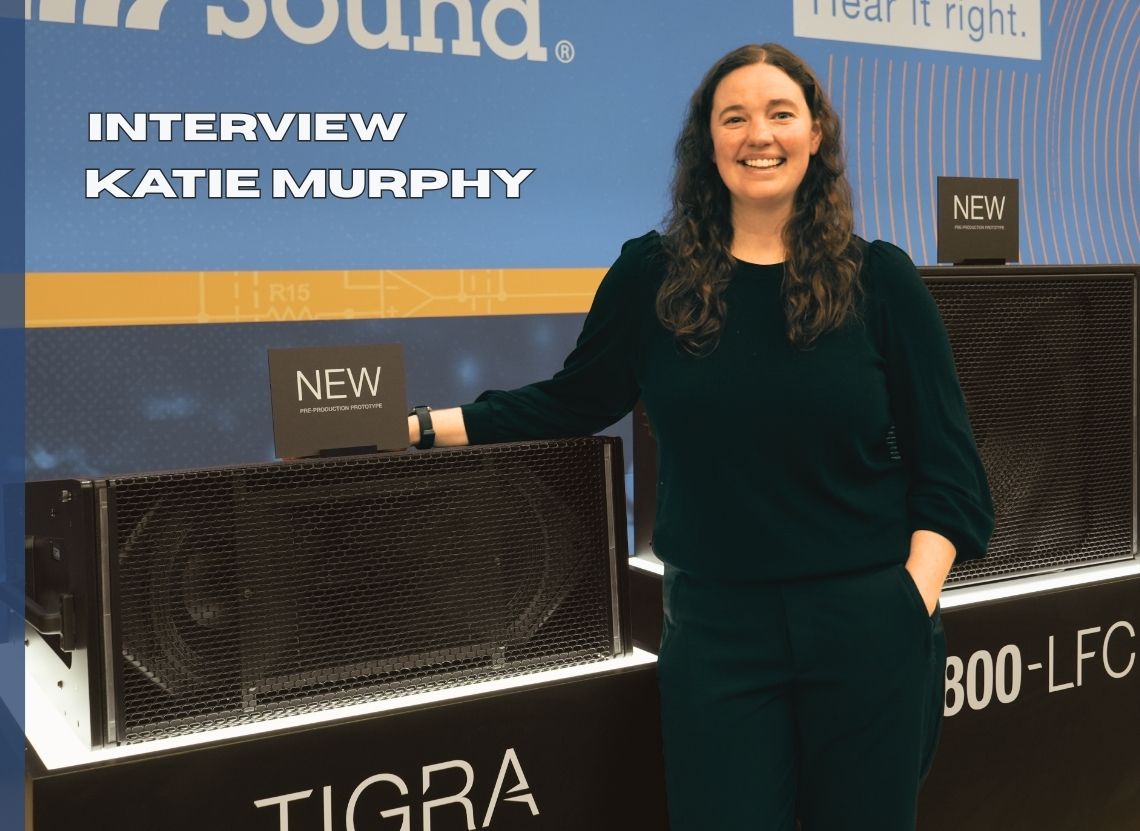
Between science and music, Katie Murphy found a place where both coexist with precision. Today, at Meyer Sound, she is part of the development of systems that not only sound: they respond to the real demands of the industry.
When music meets engineering
Not all paths into professional audio begin from a technical background. In Katie Murphy’s case, the starting point was music. “When I was young, my dream job was to be a session musician in the studio and play on film soundtracks,” she recalls. But over time, something else began to take shape: a natural ability for science and mathematics.
That intersection was decisive. “I realized that I could use that talent to go into engineering and stay connected to the world of professional audio.” That decision led her to study at the University of Southern California, where she pursued electrical engineering with a specialization in music recording.
It was there that she understood something key: the industry does not only live on stage. “There are so many jobs behind the camera, behind the microphone. Without that equipment, the industry does not function.”
In that discovery, she found her place: at the exact point where music becomes technology.
Meyer Sound: from system to leadership
Her connection with Meyer Sound was not accidental. During her university years, Murphy worked in student-run performance venues, where she had her first contact with the brand’s systems. “I already knew how they sounded. I knew they made really good loudspeakers.”
That first exposure was enough to set her direction. “When I saw an opening as an acoustic test engineer and had the opportunity to interview, I knew it was the right place.”
Her path within the company has been as broad as it is strategic. She started in operations, moved into transducer design, and then advanced into development and program management roles. That comprehensive journey shaped her way of thinking.
“I understand that, at the end of the day, if we cannot manufacture something, the whole idea falls apart.” That vision connects directly with the essence of applied engineering: designing not only to innovate, but to produce.
That growth also brought challenges. “Advancing within a smaller company can be difficult, especially as a young woman in leadership roles.” However, she highlights the environment as a key factor. “I am grateful to be surrounded by really good people who support that growth.”
Designing with purpose: from the lab to the real world
For Murphy, every project is different. There are no repeated formulas, only contexts that demand specific solutions. “We try to approach each project with its own perspective, not simply repeat what we have already done.”
One of the clearest examples was a specific challenge in 2021: an Ed Sheeran tour in a 360° format. “We needed a loudspeaker of an exact weight and with specific power. Otherwise, the whole thing would fall apart.” That type of requirement defines the real playing field of engineering: precision under pressure.
In her career, there is one product that marks a before and after: Panther. “It was the project where I designed my first horn and where I led a larger team. When I think about what defined my career, that is the moment.”
But inspiration does not come only from work. Murphy actively seeks experiences outside her environment. “I like to step out of my comfort zone, meet people from different places, travel, try new things.”
That openness feeds her way of creating.
And when it comes to giving advice, her message is direct: “Do not be afraid. It can be intimidating to enter an industry where you do not see many people like you, but the worst they can say is no. And you will regret not trying more.”
An industry built by everyone
Before closing, Murphy leaves a reflection that goes beyond technique and settles at the heart of the industry.
“For women, people of color, or any minority in audio: once you climb the ladder, lower it for those coming behind.”
It is not just a phrase. It is a statement of principles.
“Diversifying the industry is key to innovation, to moving forward, to making this a better place. But that does not happen if we do not all work together.”
In a sector where technology advances at great speed, that idea puts something fundamental into perspective: real progress does not depend only on what is designed, but on who has the opportunity to do it.
And in that balance between knowledge, experience, and community, is where professional audio finds its future.
The journalistic production, research, writing, editorial approach, and editing of this content are original works of LATAM STAGE and are protected by copyright.
Its reproduction, copying, adaptation, or publication, in whole or in part, in any medium or format, without the prior written authorization of LATAM STAGE, is strictly prohibited.
PHOTO @ LATAM STAGE


