
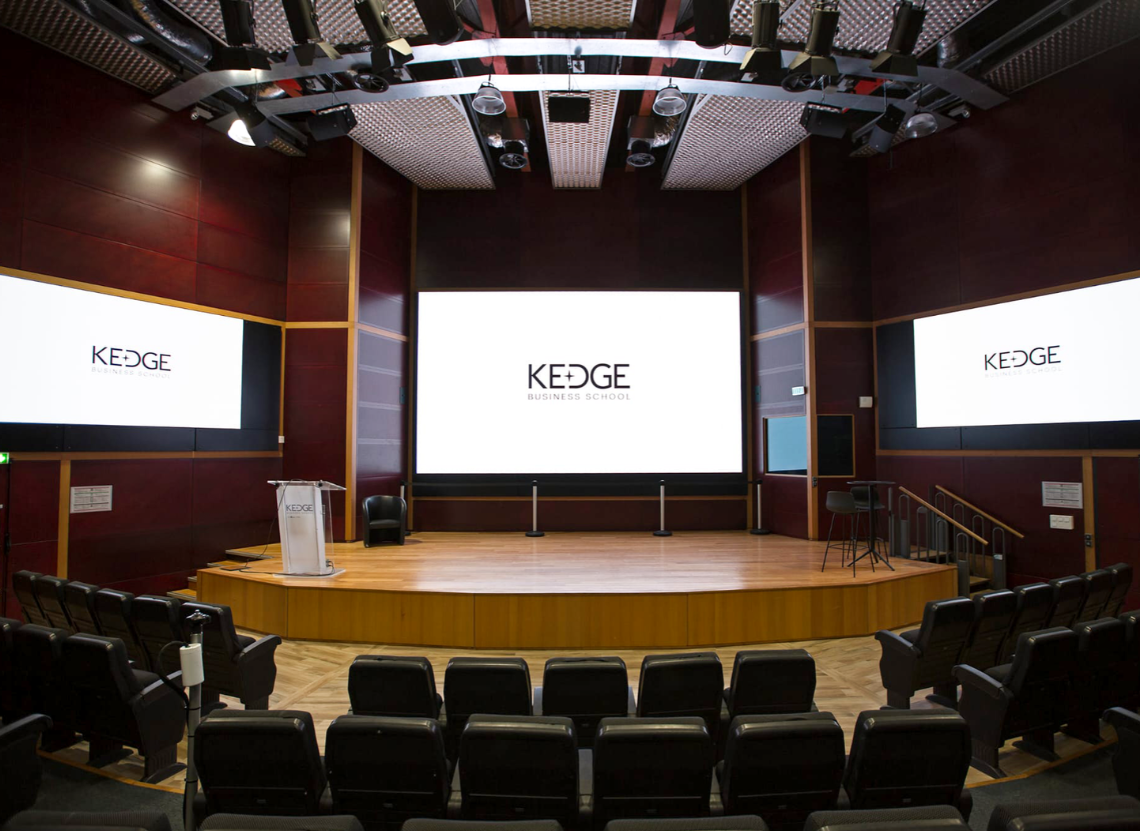
France– KEDGE Business School, a TOP 10 French business School, has replaced the projection system in the amphitheatre at its Marseille campus with three INFiLED WT Series LED displays, specified and installed by integrator On Tech France. The single most practical consequence is that the room no longer has to be darkened for anyone to read what is on screen. “Our main challenge was creating a very large image at high enough resolution that content stayed sharp and readable from every seat in the amphitheatre,” says Pierre Duffaud, AV director, KEDGE Business School. “What we have now gives every student a clear, bright image without darkening the room.”
KEDGE is a French grande école formed in 2013 from the merger of two of the country’s oldest business schools, founded in Marseille in 1872 and Bordeaux in 1874. It is one of a small number of business schools worldwide to hold the AACSB, EQUIS and AMBA triple accreditation, and it teaches nearly 15,000 students across eight campuses in France, Senegal, Côte d’Ivoire and China. Its teaching model is built on learning by doing, and the school’s own 2030 strategic plan commits it to responsible purchasing as part of a wider sustainability position, which shaped what it was willing to install.
The amphitheatre had run on three laser projectors, each with their own screen. The arrangement was reliable and had served the school for years, but it had reached the end of what it could do. Contrast fell away as soon as the room lights went up, small text became hard to read from the back rows, and colour washed out in photographs, video and detailed diagrams.
“Keeping brightness and colour consistent across three projected images was a constant battle as well,” Laurent Bonhoure, president of On Tech France. “COB was the decisive factor. It gives deep blacks, high contrast, accurate colour and a protected surface that suits a busy teaching space.”
The replacement keeps the three-screen layout the faculty already taught with, so lecturers can still run slides on one surface, a document camera on another and video on a third. The central display measures 6.0 m by 3.37 m at 3,840 by 2,160 pixels, flanked by two Full HD displays at 1,920 by 1,080. All three use WT Series flip-chip COB panels at a 1.56 mm pixel pitch. Across 150 cabinets of 600 by 337.5 mm, the installation covers slightly over 30 square metres and 12.4 million pixels at a density of 409,600 pixels per square metre.
The matching problem that defeated the projectors was addressed in manufacture rather than on site. INFiLED built all three displays in a single production batch for colour consistency, then pre-assembled and calibrated them at the factory before shipping. What arrived in Marseille was already matched.
That mattered because the timetable left no room. The entire changeover, from stripping out the legacy system to a fully tested and working installation, had to happen inside a student vacation period. On Tech removed the old equipment and built the supporting structure before the panels arrived, and the WT Series’ slim profile meant three LED displays could occupy the space three projection screens had vacated without reworking the room.
“The window was fixed and there was no margin in it, so almost everything that could be done in advance was done in advance,” says Bonhoure. “We stripped out the old equipment and built the supporting structure before the panels arrived, and because the screens had already been assembled and calibrated at the factory, what was left on site was installation and commissioning rather than problem solving. The auditorium was ready when the students came back.”
“The change was immediate. All three screens are bright, sharp and perfectly matched, even with every light in the room on,” says Duffaud. “Lecturers no longer have to dim the lights, so students can take notes and stay engaged. Plus, text and fine detail stay readable at the back of the room. Several lecturers have told me they feel as though they rediscovered their own slides.”
The performance behind that comes from the WT Series’ micro-pitch construction, which carries up to 100,000:1 contrast with 16-bit greyscale, a refresh rate of up to 3,840 Hz and 1,000 nits of output, across a 160-degree viewing angle in both planes. In a lecture theatre, the figure that matters most is the contrast, as it is what allows the image to hold up with the house lights at full.
The sustainability requirement of this project is answered by how the panels are driven. INFiLED’s ColdLED technology combines flip-chip LED assembly, common-cathode driving, 60 nm driver ICs and a redesigned PCB layout. The common-cathode element is the substantive one. Red, green and blue LEDs need different forward voltages, and supplying them separately rather than from a shared rail cuts the voltage loss that conventional common-anode designs accept. Less waste means less heat. In turn, that means lower consumption and longer LED life. Across the 150 cabinets, the installation draws a maximum of around 9 kW and closer to 3 kW in normal operation.
Durability was treated as a requirement rather than a bonus, since the amphitheatre is used all day by students, lecturers, visiting speakers and event organisers rather than by one technical team. The COB construction seats the LEDs beneath a protected surface, which INFiLED states resists knocks and dust, and there is no individual LED casing to break away. Servicing is carried out from the front using a magnetic tool, so a panel can be reached without clearance behind the structure. Plus, the displays start instantly rather than warming up.
What the school has gained is a room that does more than it could before. Lectures, conferences, student presentations, video conferences, remote guest sessions and school events all now run through the same system, and the image is clean for the people in the room and for anyone joining remotely. The equipment asks nothing of the person using it, which in a space booked by non-specialists all day is the difference between a system being used properly and being left on a default setting.
“Fine-pitch LED adds the most value in amphitheatres and large teaching spaces that need a big image with high brightness and very high resolution, as that is what text, charts and detailed content demand,” says Duffaud. “This project showed us that it is a credible and durable alternative to projection in higher education, and we see it as a long-term foundation for our teaching spaces.”
Photo © INFiLED


