
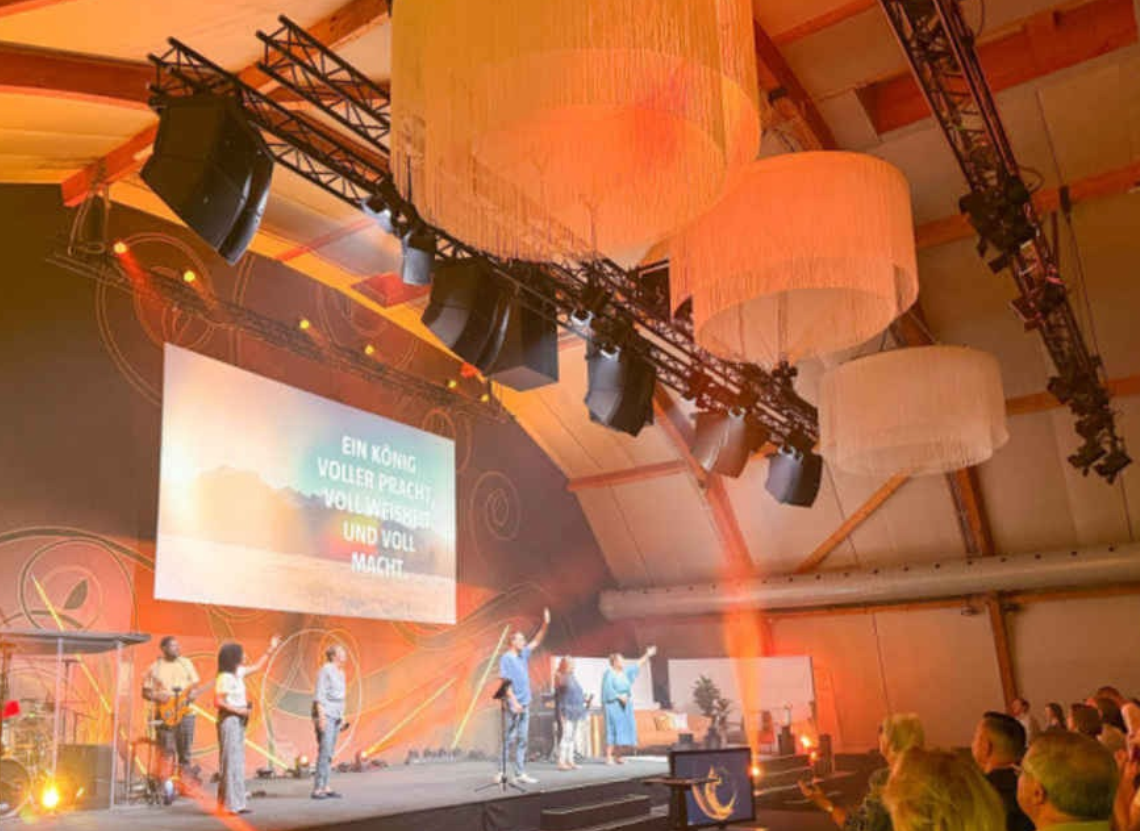
Switzerland — What began as a search for a replacement PA has resulted in a landmark installation for Grace Family Church in Bubikon, Switzerland. The church has become the first house of worship in Europe to deploy an L-Acoustics L-ISA immersive sound system, creating a new audio environment designed to improve both speech intelligibility and musical localisation inside its distinctive Church Dome.
Located in the Zürich Oberland, the venue accommodates up to 350 people and features a 24 x 26 metre floor plan beneath an eight-metre-high tensile fabric dome. A large chandelier, front projection and lighting positions added further constraints to the loudspeaker design, while the church’s existing PA was approaching 20 years of service.
The initial requirement was straightforward: replace the existing left-right system with something comparable. However, an assessment of the room showed that retaining the existing loudspeaker positions would not provide the localisation required for either spoken word or music.
That finding changed the direction of the project.
Working with Swiss L-Acoustics distribution partner SDS, Soundrig AG, Stagelight and systems integrator Impact Atelier, the team began exploring what an immersive approach could offer. An initial listening demonstration was held at the SDS Auditorium in Winterthur, followed by a full-scale 1:1 demonstration inside the Church Dome itself.
The results convinced the church to move beyond a conventional PA replacement.
With L-ISA object-based processing, individual voices and instruments can be positioned within the sound field according to their apparent location, rather than being tied to the left or right loudspeaker system. For a venue that hosts both regular services and live Worship Nights, this provided a way to bring greater spatial definition to speech and music while working within the architectural character of the room.
“The domed roof and a striking chandelier were certainly a standout feature that made the installation and design unique,” said Roger Sommer, company owner at Soundrig AG. “We also had to design the L-ISA configuration around the front lighting and front projection.”
Designing around the building
The Church Dome presented a number of competing requirements. Loudspeaker positions had to provide consistent coverage while respecting sightlines, the projector’s field of view and the existing front lighting system.
L-Acoustics Soundvision played a central role in finding that balance. The software was used to model coverage and SPL distribution and to determine how the loudspeakers could be positioned within the building without compromising the other production elements.
Michael Graf of Impact Atelier was involved in the system and network integration as well as the loudspeaker design process.
“Soundvision calculated the optimal loudspeaker positions and SPL distribution, but it was also a huge help for placing the loudspeakers virtually within the building and finding the best compromise between sightlines, the projector’s field of view and the front spotlights,” he said.
The final L-ISA Scene System uses five main hangs, each combining one A15i Wide with one A15i Focus. Low-frequency reinforcement comes from two centre-flown hangs, each equipped with two KS21i subwoofers. Two X8 loudspeakers are flown at the sides to cover the lateral areas toward the front of the room.
A single L-ISA Processor II provides the object-based processing, while an LA7.16i amplified controller powers the complete 16-enclosure system.
The signal path begins at a Yamaha Rivage console, with audio travelling via MADI to the L-ISA Processor II before being distributed over Milan-AVB to the LA7.16i.
The project also included a renewal of the church’s audio network, with Impact Atelier handling the network and console integration. According to the church, the updated infrastructure has contributed to greater overall system stability.
The building itself also offered an acoustic advantage. Michael Graf noted that the Church Dome is remarkably well insulated, keeping external ambient noise to a surprisingly low level.
A system designed for volunteers
Technology was only one part of the challenge. Grace Family Church relies on a semi-professional volunteer team to operate its production systems, making accessibility and day-to-day usability important considerations.
L-ISA offers extensive possibilities for shaping an immersive sound environment, but the system was configured so that its basic operation would remain approachable for the church’s operators.
“Set against the almost endless possibilities the system offers, the basic functions are kept as clear as possible, so getting started isn’t overly difficult,” said This Hochstrasser, head of audio at Grace Church.
The transition has also been well received visually. Rather than introducing a conventional line-array arrangement that could become another dominant element in the room, the new configuration works within the architecture of the dome.
“It integrates very well into the building and is visually a win compared to a classic line array hang,” Hochstrasser said. “Feedback from every side has been enormously positive.”
From replacement project to European first
The installation was completed within an unusually tight five-day window. Work began immediately following a Sunday service, with the system, installation and rehearsals completed in time for the following Friday’s Worship Night.
Soundrig AG was responsible for the rigging and PA installation and remained involved throughout the process, from the initial demonstrations through to the final handover. SDS provided sales and application support, with its team working closely with the L-ISA application specialists.
“The support from Christian Schmid and the L-ISA application team was great from day one,” said Patric Schafroth, sales and application engineer at SDS.
For Grace Family Church, the project ultimately delivered more than a new sound system. What started with the practical need to replace an ageing PA became an opportunity to rethink how sound could work inside the Church Dome.
The church plans to continue developing its use of L-ISA over time. The object-based platform may also provide opportunities for closer integration between audio and lighting workflows as the production team becomes more familiar with the system.
The result is a system that combines the technical demands of an immersive audio installation with the very particular requirements of a house of worship — while preserving the visual and architectural identity of the space.


