
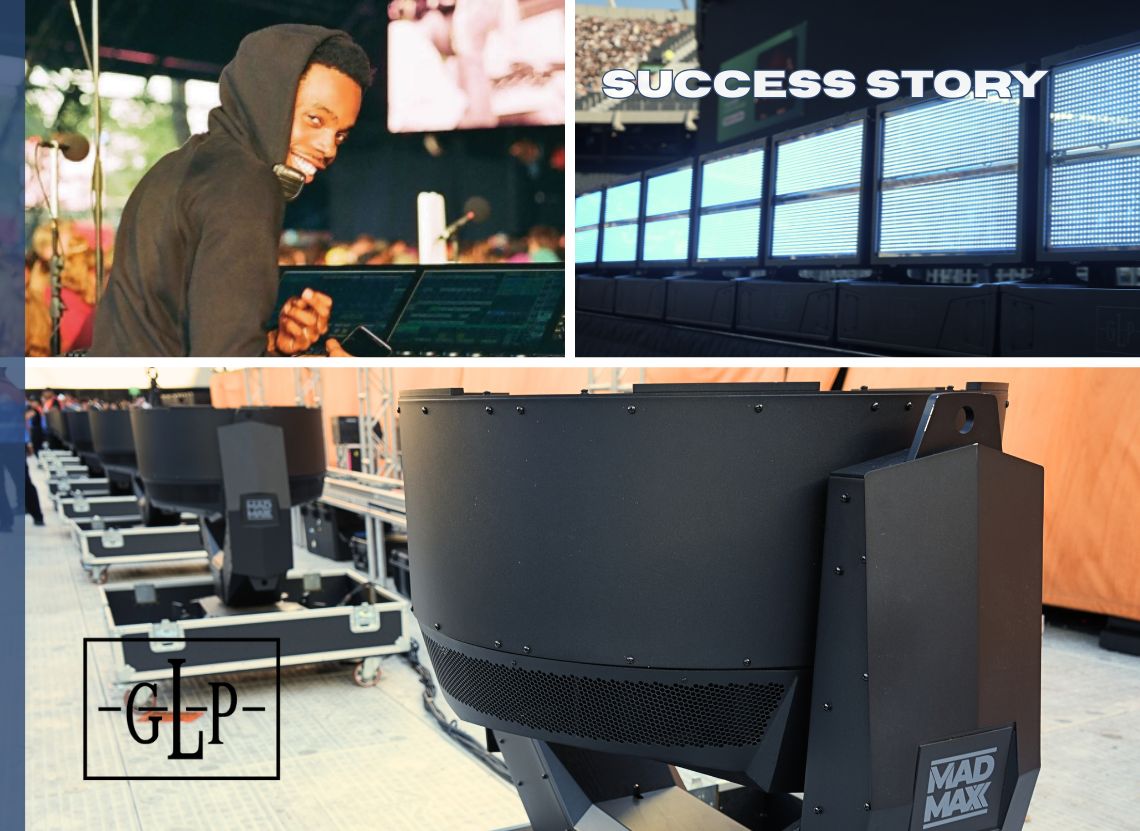
GLP fixtures played a leading role during Bad Bunny’s stop in Buenos Aires, delivering power, scale and a striking visual aesthetic on the Debí Tirar Más Fotos Tour. With Mad Maxx dominating the sky and JDC2 shaping the show’s dynamics, the lighting design supported every moment with precision and character.
When Bad Bunny landed in Buenos Aires with the Debí Tirar Más Fotos Tour, Estadio Monumental ceased to be just a venue: it became a living, constantly evolving environment where every beam of light helped define the space.
There was no single focal point, no single direction: the entire environment was activated, designed to sustain a large-scale experience without losing the emotional pulse that defines the artist.
Within that space—between the massive and the intimate—lighting took on a quiet yet decisive role. And GLP fixtures became a key tool.
Behind the design is Marcus Jessup, a name now associated with one of the largest tours on the global circuit, though his journey began long before, far from stadiums. “I started working with lighting at 14 in church,” the LD recalls. “It was a fairly large space, so I was able to get involved in nearly every aspect of production.” That first contact was not partial—it was total. It wasn’t just about learning, but about understanding how every technical decision impacts what happens on stage.
That early path led him to study theatrical lighting at Indiana State University and later continue his education at Full Sail University in Orlando, where he deepened his focus on show production. At the same time, the nightclub circuit gave him another dimension: immediate audience response, rhythm and energy. Shortly after, at just 17, he moved to Miami to work with Everlast Productions. “During that time I was able to gain experience in virtually every aspect of lighting,” he explains, “and that’s where the door to touring opened.”
Interestingly, none of this was part of the original plan. “Ironically, lighting was my plan B,” he admits. “As a kid I wanted to be a baseball player. When that didn’t work out, I immediately knew I wanted to take lighting seriously,” he says with a smile, confident he made the right choice.
The Debí Tirar Más Fotos Tour marks a turning point in that trajectory. “Without a doubt, Bad Bunny is the biggest milestone so far. Although in the past three years I’ve designed many tours, this is by far the largest.” It’s not just about scale, but about the significance of being part of a project that transcends the individual. “It was always a goal to design large-scale shows before turning 30. I’m grateful for every opportunity. Even though I’ve been in the industry for a decade, it still feels like this is just the beginning.”
One project. One choice.
The creative process does not start with lighting—it starts with the stage. “For me, everything begins with the stage. From there I can do my job as a lighting designer.” From that starting point, the tour design was built around the emotional universe of the Debí Tirar Más Fotos album, seeking an aesthetic capable of moving between extremes. “I wanted the design to feel atmospheric—something that could shift from massive moments to more intimate ones.”
That duality becomes the show’s core: moments where light nearly disappears, allowing space to build tension, and others where everything expands to fill the entire stadium.
Bad Bunny’s music, with its distinctive energy and strong connection to the audience, was key to that construction. “I knew I needed very powerful fixtures to start with,” Jessup notes. “And I knew it would be a very colorful show, so visual appeal was a key factor. But designing for a stadium means changing your usual approach. In a stadium, everything is different. There are opportunities for big looks, but also for intimate moments when the artist requires it.”
That balance—between impact and proximity—is what sustains the show’s narrative.
In that context, the choice of tools was no coincidence. “I needed something big, powerful and unique,” he summarizes. With that in mind, he turned to two GLP fixtures that became pillars of the design: the Mad Maxx and the JDC2. “I’ve had a great relationship with GLP over the years, so I chose them without much hesitation.”
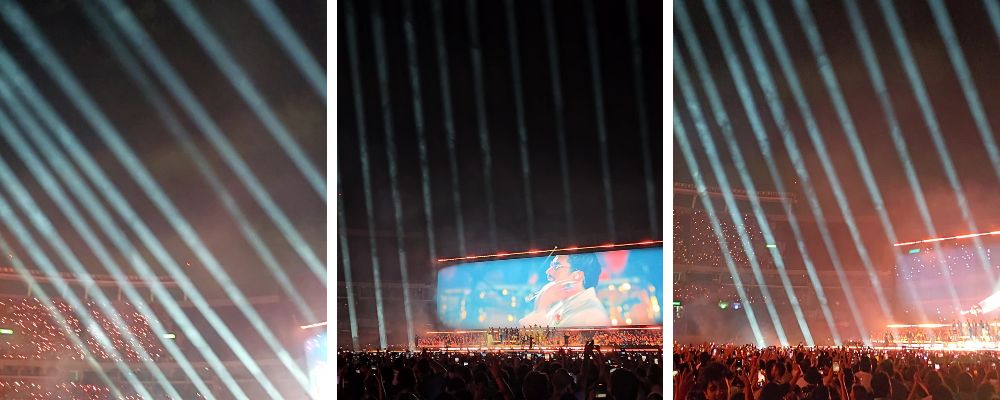
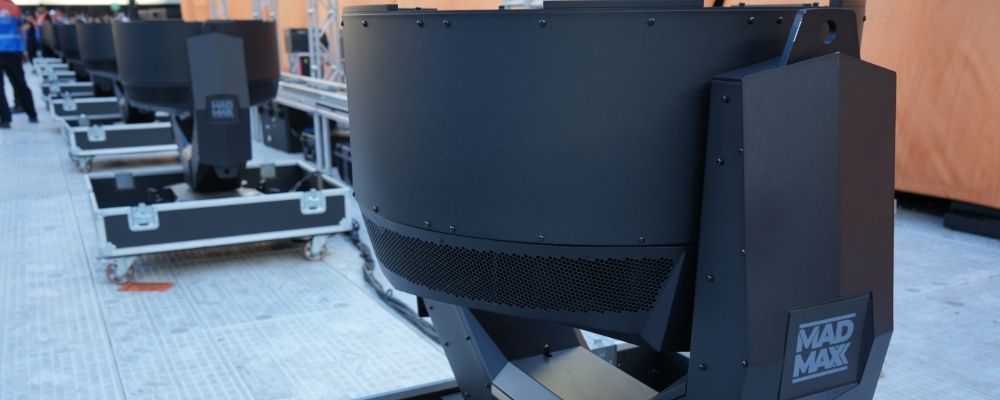
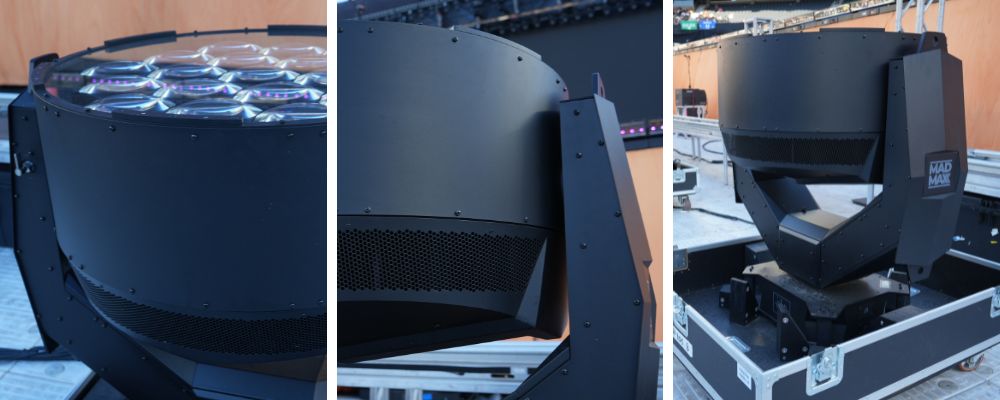
The giant Mad Maxx defines the scale of the show. It is not just a light source—it is an element that transforms the space.
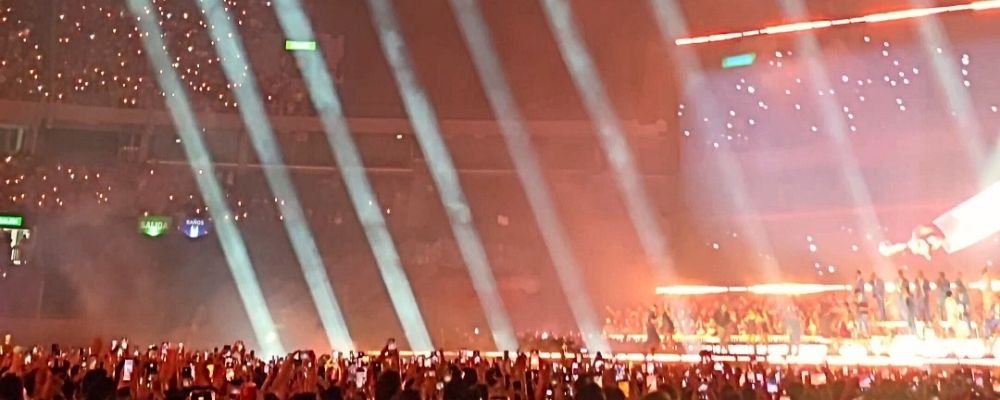
“It’s a relatively new fixture on the market, and I wanted something fresh.” Its impact becomes evident in moments when beams shoot into the sky, extending the show beyond the stage. “That big beam pointing into the sky really shows the power of the design.” Even if the audience doesn’t always perceive the technical details, the effect is undeniable. “Most of the audience just sees a lot of lights. But as a designer, I know it has a huge impact. It’s the strongest beam in the rig and cuts through any other fixture in the design.”
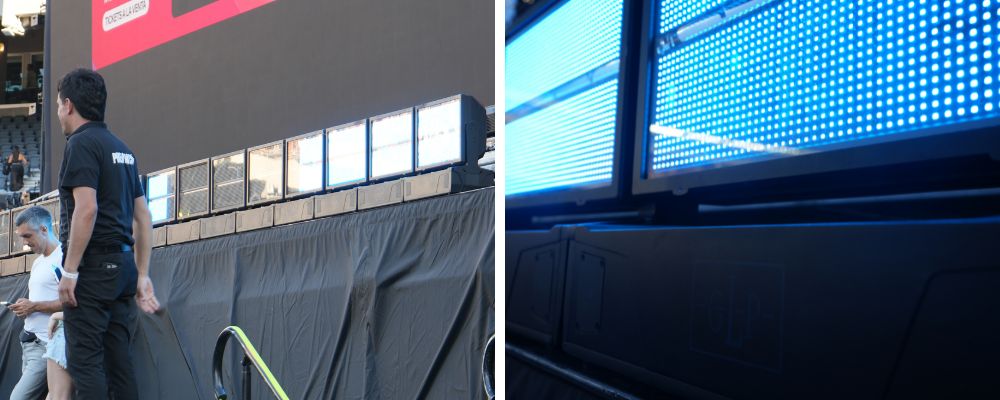
Behind it, the JDC2 adds another layer of language. If the Mad Maxx establishes presence, the JDC2 builds rhythm.
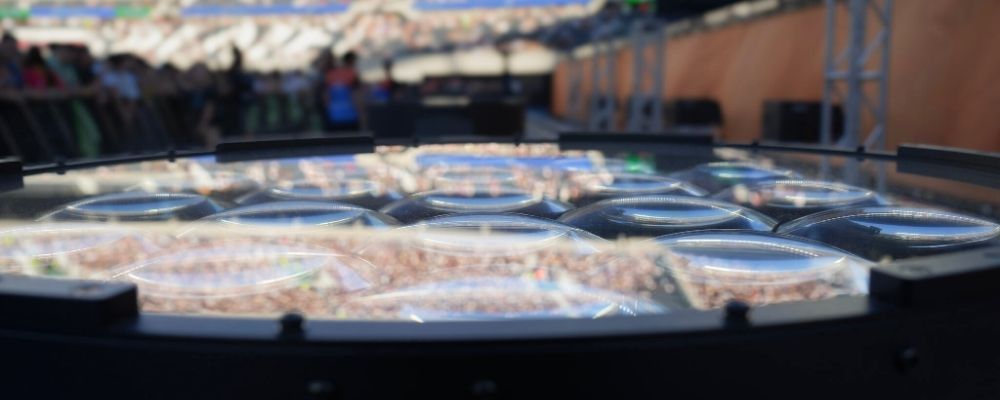
“It played a huge role in the energy of the show,” Jessup says. “It’s not just a strobe—it’s also a very powerful and flexible wash source.” Its zone control capabilities allow internal movement, creating patterns and dynamics without relying solely on fixture movement. “That allowed us to build layers within a single fixture,” Marcus explains. Throughout the show, its presence is constant, adapting to both high-intensity moments and more restrained ones. “It was essential throughout the entire show. It allowed us to create strong silhouettes and also moments.”
However, one decision runs through the entire design: “The idea is for lighting to support the narrative, not dominate it. Often, the key moments are the quieter ones.”
More than light, a vision that goes beyond.
After a project of this magnitude, Jessup does not limit himself to the role that brought him here. “I don’t consider myself just a lighting designer,” he says. “I’m a designer.” That vision extends into Moving Through Space (MTS), the creative collective he is developing to expand his work beyond lighting. “The world will know that name soon,” he adds with clear enthusiasm.
His motivation also carries a deeper dimension. “There are not many African Americans in this space. That gives me even more motivation to pursue excellence every day.” In that sense, his work is not only measured in technical or visual results, but also in the impact it can generate moving forward. “I always knew from a young age that I would be here,” he concludes. “And I want to show the next generation that anything is possible if you truly set your mind to it.”
On the Debí Tirar Más Fotos Tour, that vision is built into every decision, where technology and design align to sustain an experience that is felt as much as it is seen.
And along that journey, light finds its true protagonism: the versatility and power of the JDC2 bring rhythm and depth, while the scale and disruptive character of GLP’s Mad Maxx elevate the show to another dimension, taking visual impact beyond the stage.


