
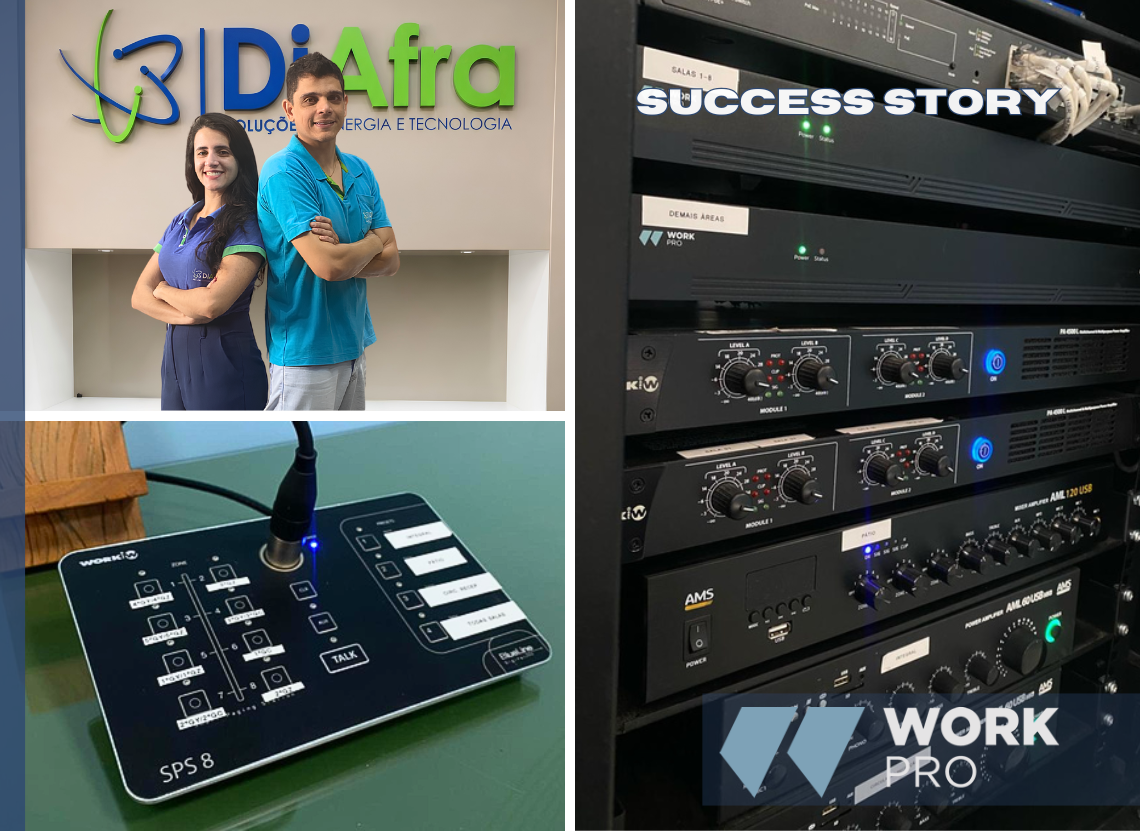
Brazil – Located in Minas Gerais, Brazil, the school sought to completely modernize its internal communication system. What began as an implementation for 11 zones ultimately became a scalable, flexible IP audio architecture prepared for the future.
Behind the project was the integrator DiAfra Soluções, technically led by Josias Amós, together with the specialized support of Grupo Discabos and the ecosystem of solutions from WORK PRO, a brand belonging to the Equipson Group.
In many educational environments, internal communication still depends on analog systems, manual operations, and infrastructures that have grown without clear technological planning. The problem appears when the needs increase: more classrooms, more sectors, more activities, and an operation that can no longer depend on someone walking to another room to press a physical button.

That was exactly the situation at Colégio São Francisco in Brazil.
The institution needed to modernize its sound system to manage announcements, institutional messages, and background music more efficiently, in a more organized and flexible way. But the real challenge was not only technical: the school was looking for a solution that was simple to operate, intuitive for the staff, and prepared to grow in the future without having to rebuild the entire infrastructure.
That is where the work of DiAfra Soluções began, with Josias Amós leading the project, supported technically by Grupo Discabos, WORK PRO’s distributor in Brazil, led by Francisco Pereira.
“At first they needed a solution for 11 zones within the school,” recalls Josias. “I started researching which system could work best for this project, and that’s when I began talking with Francisco and the Discabos team.”
The starting point was complex. The previous system operated completely manually and analogically. To send a message to a specific room, the staff had to physically move to another room, select the zone using mechanical buttons, and then make the announcement.
“Repeating that process was really very uncomfortable for them.” The sound quality did not help either. “Sometimes even pressing the buttons, the system did not respond properly. It was not a good solution.”
The operational transformation ended up being total. What previously depended on physical movement, manual operations, and limited flexibility became a centralized system distributed over the network and fully controllable from mobile apps, tablets, and computers.
WORK PRO as a scalable and easy-to-implement ecosystem
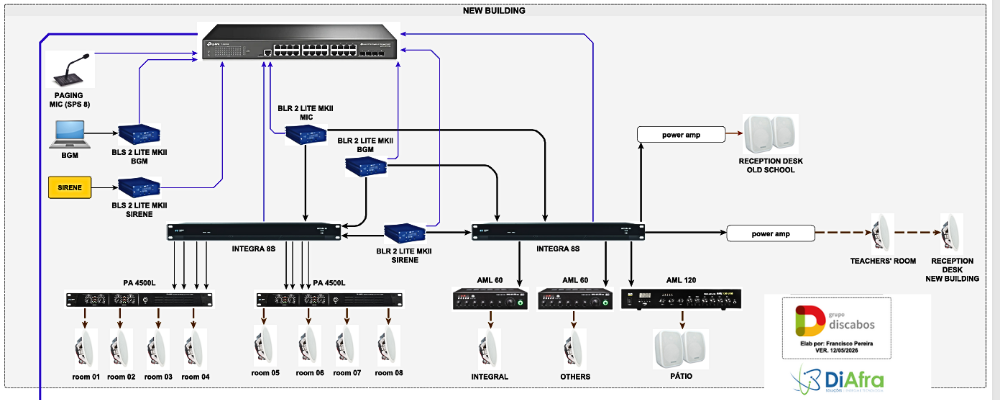
The solution developed was based on WORK PRO’s IP audio ecosystem, using Integra 8S matrices, BLR and BLS modules, PA4500L amplifiers, AML120 and AML60, as well as SPS8 paging stations for zone announcement management.
The architecture allowed audio distribution using the school’s own network infrastructure, integrating control from tablets, computers, and mobile phones.
“When we configured the scenes and buttons on the SPS8, and also added the app to the system, their reaction was immediate,” Josias admits with a laugh. “They said: ‘I can’t believe I can now control everything from my phone.’”
The change not only improved daily operations: it completely simplified the school’s internal dynamics. Announcements no longer depended on operators walking through hallways and began to be managed from intuitive digital interfaces. In addition, the system made it possible to select only the necessary zones for each communication, avoiding unnecessary interruptions throughout the institution.

At the same time, background music began to be managed centrally through the BLR and BLS IP audio modules.
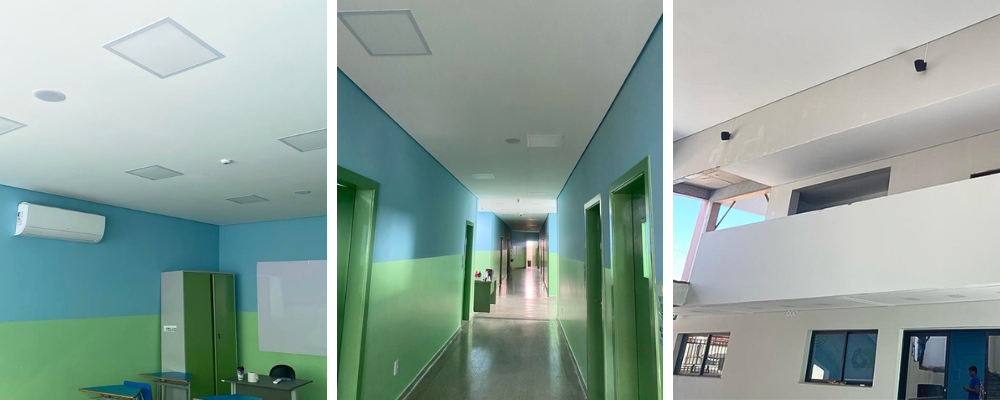
For indoor areas, AMT 5 MKII loudspeakers were used, while Neo IP65 models were installed in outdoor areas, prepared to withstand more demanding environmental conditions.
However, one of the most important aspects of the project was the ease of implementation of the ecosystem.
“It was the first time I worked with WORK PRO,” admits Josias. “The programming of the dashboard and the adaptation between tablet, notebook, and cellphone was a major challenge for me. But the system is very intuitive compared to other solutions.”
This point is especially important because the project involved advanced configuration tasks, including customized dashboards, scene management, mobile device integration, and VLAN configuration together with the school’s IT department to ensure network stability and security.
In addition, some areas presented significant reverberation problems, forcing the team to make fine equalization and processing adjustments to guarantee vocal intelligibility in all environments.
Even so, Josias highlights that the WORK PRO ecosystem allowed them to move forward quickly despite it being his first experience with the platform.
“It is a very simple system to program and has a very good cost-benefit ratio,” he explains. “It allows you to execute large projects without the implementation becoming impossible.”
That ease was also key for the project to grow rapidly. Initially planned for 11 zones, the system eventually expanded to integrate 23 different areas within the school.

“At first they were thinking only about the new building,” points out Francisco Pereira. “But once they saw the system working, they decided to integrate the old building as well.”
And the expansion is still continuing. “The school is even evaluating adding new zones in a farm-style area they have inside the property,” comments Josias. “The children spend a lot of time there and also need to receive announcements.”
The case clearly demonstrates one of WORK PRO’s main strengths: the ability to build open and scalable architectures where the system can grow without needing to replace the entire existing infrastructure.
The value of technical support and shared experience
A project with this level of dedication and such a demanding operation can only be sustained through true collaboration between people, experience, and technical knowledge. And Josías had the best support possible, working alongside Marina Pereira, engineer at DiAfra Soluções, as well as his business partner and wife. From her technical background, Marina contributed fundamental expertise to the development of the system architecture, actively participating in integration planning, network configuration, and the structural organization of the solution. Her involvement was especially critical during the stages related to connectivity, operational stability, and infrastructure adaptation, ensuring that the WORK PRO ecosystem could operate in a solid and scalable way within the educational environment.
Although technology played a central role, both Josias and Francisco agree that another decisive factor in the project was the constant technical support between integrator and distributor.
“It is important to understand that we are talking about a professional and powerful system that is at the same time accessible for integrators who may never have worked with this type of architecture before. That is why support is fundamental,” says Francisco.
Throughout the entire implementation, the Grupo Discabos team supported the project’s technical development by providing permanent support, remote assistance, and specific training.
“Francisco helped me all the time, even on weekends and holidays,” says Josias. “Since we often worked when there were no students at the school, he was always available.”
Beyond the installation itself, the project ended up functioning as a technical growth experience for all parties involved.
For Francisco, this type of implementation also reflects where the market is evolving. “Today institutions need systems that are flexible, easy to operate, and prepared to grow,” he states. “And that is exactly what this ecosystem allows.”
Beyond the technological modernization of Colégio São Francisco, the project also reflects how WORK PRO solutions can adapt to completely different environments while maintaining operational simplicity, flexibility, and expansion capability. The possibility of growing by zones, integrating new areas without rebuilding the infrastructure, and centralizing control within an IP architecture demonstrates the value of an ecosystem designed to evolve together with the real needs of each space. From educational institutions to corporate or commercial environments, scalability and ease of implementation ultimately become some of the system’s greatest differentiators.


