
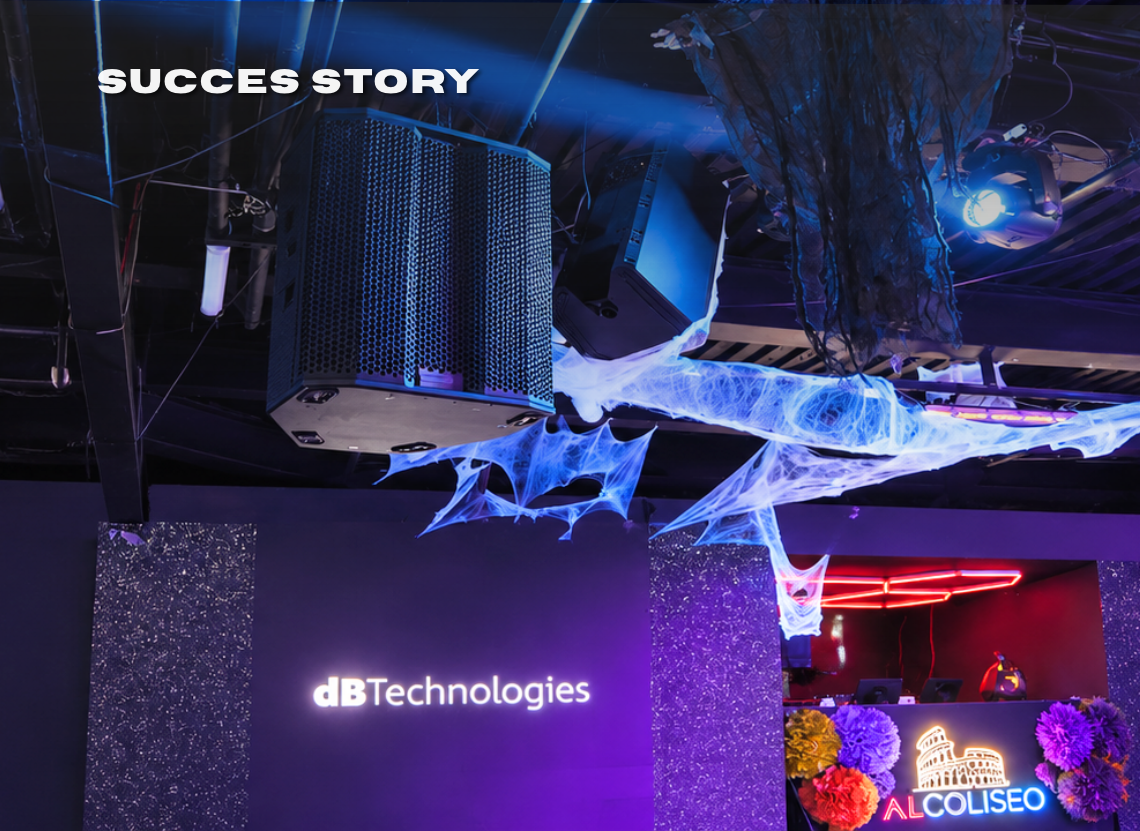
The renovation of Alcoliseo, in Mexico City’s Zona Rosa district, called for a sound system capable of delivering high sound pressure levels, definition, and coverage in areas with different requirements. Muuk, with technical support from Ampere, developed a solution based on dBTechnologies, with Fifty Line taking center stage on the main dance floor, independent zone control, and an installation designed to preserve the club’s commercial space.
Mexico – On Génova Street, one of the busiest thoroughfares in Mexico City’s Zona Rosa district, Alcoliseo decided to renew its nightlife offering. The venue was transformed to attract an audience over 30, with a new atmosphere and a program combining DJs, recorded music, and live performances.
The change involved completely rethinking the audio system. The dance floor needed to deliver high sound pressure levels, while the sound also had to maintain its definition in lounges, private rooms, hallways, and the terrace. Added to this were the venue’s architectural characteristics and an important business consideration: making the most of the available space for customers.
The project was entrusted to Mario López, from Muuk, an integration company with experience in nightlife venues. He worked alongside Gustavo Zarco, from Ampere, on equipment selection, implementation, and calibration.
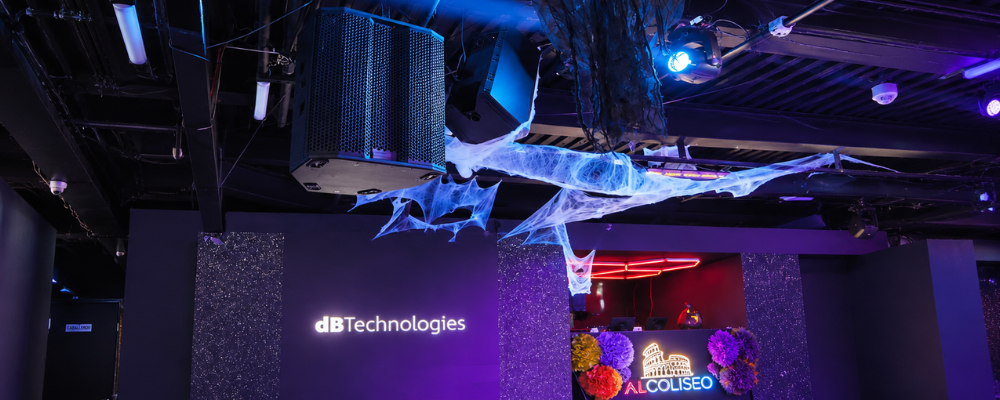
A choice defined by listening
Muuk became involved through a lighting supplier that was already working on Alcoliseo’s renovation. The owner was looking for an audio solution, and Mario proposed holding demonstrations at the venue itself to evaluate different options.
Systems from four manufacturers were presented, with the participation of the staff involved in the club’s administrative and operational decisions. The process included a second round of tests, requested by the client to compare the shortlisted alternatives once again.
The story took a turn just one day before one of the demonstrations. Mario had planned to use another system, but during a product presentation at Ampere, he discovered dBTechnologies’ Fifty Line. Its performance caught his attention, and he decided to change the proposal. Gustavo helped make the necessary arrangements to bring the new equipment to the venue.
The choice had not been made in advance. It was the system’s performance inside Alcoliseo that ultimately tipped the scales.
Mario particularly remembers how Fifty Line performed under the venue’s acoustic conditions, where other configurations had produced unwanted reflections when the volume was increased.
“The venue responded very well to that point-source design because, unlike a line array, it did not interact as much or produce as many reflections. It sounded like a club, the way it should,” he explains.
Sound pressure was a priority for the client, but Gustavo identified another equally important requirement: achieving powerful sound that could be enjoyed for several hours without losing clarity.
“I think the requirement I identified was for it to sound really good, without being harsh, and to be intelligible,” he points out.
The team’s performance during the demonstrations ultimately convinced the venue’s management. Fifty Line was selected as the core of the main dance floor system, as part of a solution that also had to address the specific requirements of each area.
Sound for every space
The tour of Alcoliseo begins at a relatively narrow entrance that leads into a hallway and then into the club’s main area. Lounges, private rooms, and a terrace are distributed around it, each with different activity levels and coverage requirements.
Mario developed the design by considering not only the acoustic characteristics but also the experience of people moving throughout the venue.
A dBTechnologies system with additional bass reinforcement was installed at the entrance to give the music a presence from outside. Compact loudspeakers were installed in the hallway, while the cloakroom area was deliberately left without direct reinforcement to make communication between staff and guests easier.
The dance floor, where demand is highest, features two Fifty Top and four Fifty Sub units. This configuration made it possible to concentrate the sonic impact in the main area without resorting to a conventional line array.
To complete coverage throughout the venue, the project included eight 12-inch OPERA, two 15-inch OPERA, three K162, and one dBTechnologies KL10, distributed among the different areas according to their requirements. Low-frequency reinforcement was provided by four S918 and one S612, complementing the system’s response in areas requiring greater bass presence.
The terrace required a solution with greater capacity than other complementary areas. Its proximity to the bar and the concentration of people justified significant sound pressure levels, although not necessarily reaching those of the dance floor.
Audio management was handled through an Allen & Heath AHM16 matrix and a CQ18 digital console, which allow the sources and levels of the different areas to be managed.
This configuration addresses a particular need at Alcoliseo: switching between DJ sessions and performances by live musicians while keeping operation simple for the staff.
The console allows a band’s engineer to work on the show mix, while the matrix maintains control over the overall levels and the different zones.
It is also possible to send different sources to specific areas. Mario mentions, for example, the possibility of playing a birthday song in one of the private rooms for a few minutes and then returning to the regular program without changing what the rest of the audience hears.
In this way, the design accommodates both the club’s physical layout and its different operating modes.
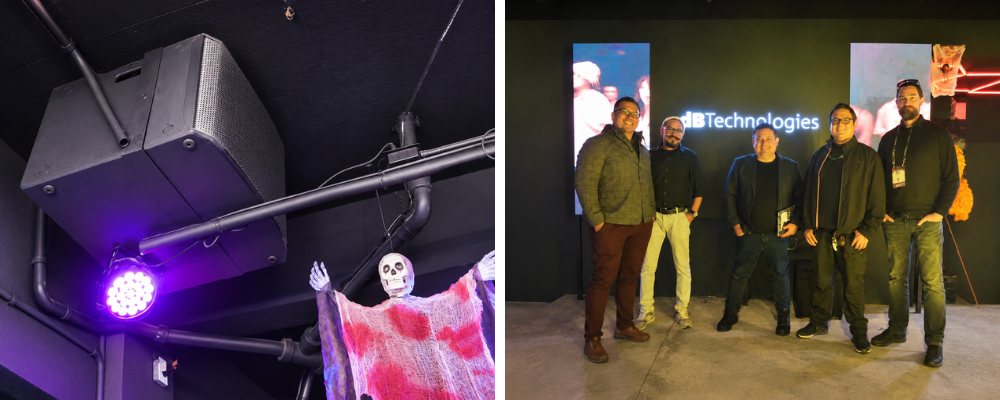
The challenge of installing overhead
One of the most distinctive aspects of the installation was the decision to keep much of the equipment suspended, avoiding the use of surfaces intended for tables and circulation.
In a nightlife business, loudspeaker placement has consequences that go beyond sound coverage. Every square meter of available space can represent a business opportunity.
Mario estimated that placing the equipment on the floor would have meant losing approximately 30% of the existing tables.
This consideration was decisive in defining the installation, although the goal was always to preserve acoustic performance.
“I always try to keep both loudspeakers and subwoofers overhead so we can make better use of spaces for tables and give my clients the opportunity to recover their investment as quickly as possible, without sacrificing acoustics,” Mario acknowledges.
The solution required developing custom mounting brackets for some of the equipment, as certain subwoofers did not come with factory suspension hardware for the proposed configuration.
Muuk worked with specialized personnel to manufacture these components, while Gustavo participated in determining the loudspeakers’ angles and positions.
Installing considerably heavy cabinets above areas intended for the public made safety a central concern.
Gustavo points out that this was one of the project’s most significant challenges and recalls the responsibility involved in carrying out a permanent installation of this kind.
“Imagine suspending a cabinet that weighs almost 50 kilos and having it stay there for years… it has to be safe, because there are people below enjoying the party,” he comments.
The architecture added another challenge. Alcoliseo has relatively low ceilings and metal surfaces that encourage sound reflections. During the demonstrations, some configurations had shown problems precisely because of this interaction with the venue.
Mario recommended adding sound-absorbing materials at specific points, although the owner decided to leave this additional acoustic treatment for a second phase.
The team then focused its efforts on system selection, placement, and orientation. Gustavo worked particularly on coverage angles and calibration, while Muuk handled the overall distribution and mounting components.
Once the furniture had been installed and the venue’s new atmosphere was complete, the acoustic performance proved more favorable than Mario had initially anticipated.
The combination of Fifty Line and the rest of the equipment made it possible to meet the venue’s requirements without resorting to the additional acoustic treatment proposed during this first phase.
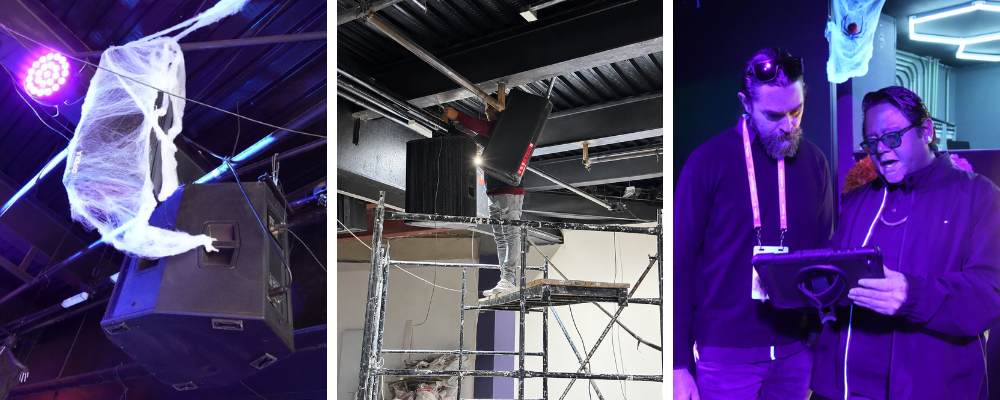
The ultimate test: the club in operation
The work did not end when the loudspeakers were installed and calibrated. Actual operation made it possible to verify how the system responded to staff requirements and the dynamics of a busy night.
Before the official opening, Alcoliseo organized a trial event with invited guests, allowing the team to evaluate the venue’s operation under conditions close to normal use.
Mario and Gustavo were able to observe how the control interfaces were used and identify adjustments needed to make the operators’ work easier.
One aspect that required attention was the balance between live performances and the surrounding areas. When musicians performed, the levels in certain zones had to be reduced so that the stage sound could take center stage.
Gustavo took part in these adjustments and paid particular attention to making the control tools easy to use.
In his view, a well-designed system must meet not only the needs of sound engineers but also those of the staff who manage it every day, even when they do not have specialized technical knowledge.
“You need that hands-on experience of being able to walk up, move a button, and solve the problem quickly,” he admits.
This perspective was decisive in organizing the functions of the console and matrix, ensuring that everyday operation would not require complex interventions.
The project also reinforced Mario’s appreciation of Fifty Line. Based on his experience with installations in bars and clubs, he considers the system to occupy a space between conventional point-source loudspeakers and larger-scale line arrays.
“There was a need for a product with this kind of sound pressure for clubs,” he maintains, highlighting the combination of size, definition, and capability he found in the system.
For Gustavo, the experience demonstrates the value of supporting the integrator from the initial tests through to commissioning, with decisions based on the project’s actual conditions.
The Alcoliseo installation brings these two perspectives together. Muuk provided the design and integration solutions needed to adapt the equipment to the space, while Ampere supported the selection, demonstrations, and technical adjustments.
The result is a dBTechnologies system that meets the dance floor’s sound requirements, allows the different areas to be managed, and preserves space for commercial activity. An installation in which sound was not conceived in isolation, but as part of the audience experience and the operation of the business.
Credits
Cover photography: LATAM STAGE
Additional photography: LATAM STAGE
The journalistic production, research, writing, editorial approach, and editing of this content are original works of LATAM STAGE and are protected by copyright.
Reproduction, copying, distribution, adaptation, or publication of this content, in whole or in part, through any medium or format, is prohibited without the prior express authorization of LATAM STAGE.


