
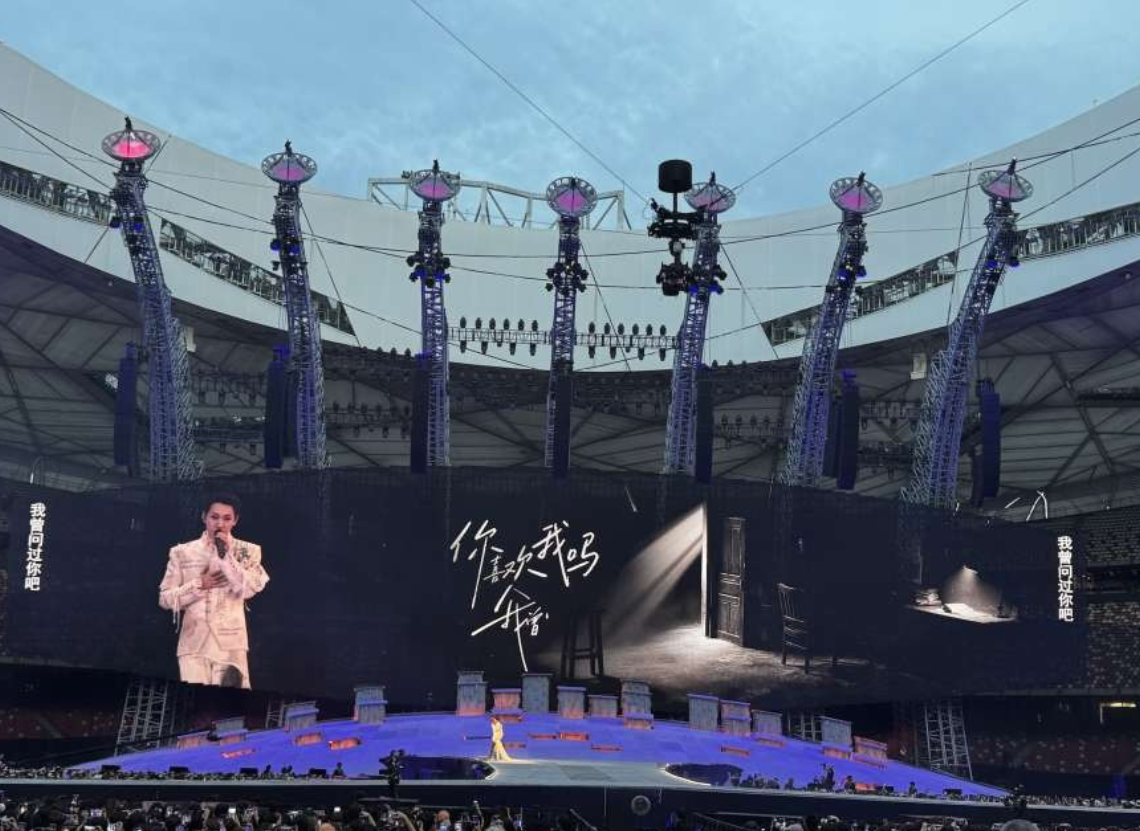
China – Ten consecutive Silence Wang concerts at Beijing’s National Stadium put the possibilities of spatial audio to the test at stadium scale. For the residency of his Age of Romance World Tour, more than 60,000 spectators each night experienced a d&b Soundscape 360 system designed to significantly expand the listening area while maintaining precise sound imaging throughout the venue.
The series of concerts took place during August at the iconic Bird’s Nest, venue for the 2008 Beijing Olympic Games. The system was supplied by OST Productions, one of China’s leading specialists in sound solutions for large-scale concert tours and productions.
The scale of the project was not only related to the size of the audience. According to d&b, the implementation represents what is believed to be the largest Soundscape deployment to date in a stadium environment.
Silence Wang, whose real name is Wang Sulong, is one of China’s most recognized contemporary singer-songwriters and producers. Since 2010, he has released 12 studio albums and built a significant following both in China and among Chinese-speaking audiences internationally. His Age of Romance World Tour had already visited different markets across Asia, North America and Oceania before arriving in Beijing for this series of performances.
For this residency, Wang became the first original singer-songwriter to use Soundscape at this scale at the National Stadium.
The project was developed through a joint effort between d&b Greater China, d&b’s local and global EAS teams, OST Productions and Jin Shaogang, Silence Wang’s long-standing sound designer.
Shaogang has extensive experience in tours, broadcasts and major national events. His credits include the main sound design for the opening ceremony of the 2008 Beijing Olympic Games. For Wang’s show, his goal was to maintain the level of detail, balance and vocal clarity that characterizes his productions.
The challenge of bringing Soundscape to a stadium
One of the central aspects of the design was taking advantage of the characteristics of d&b’s SL-Series together with Soundscape.
“The d&b SL-Series is exceptionally beneficial when used with Soundscape. With its full-range directivity, there is remarkably little energy emitted from the rear of the cabinets,” explains Shaogang.
This characteristic became particularly important in an installation where 360-degree arrays and delay speakers shared the same trusses. Precise control of the coverage pattern helped reduce low-frequency spill into delay zones, audience areas or backstage, preventing the so-called bass bleed across the stage.
But for Shaogang, the main difference was in the listening experience.
“Soundscape dramatically expands the stadium sweet spot, from around one third of the venue to an impressive 60–70% of the entire audience area,” he says.
The designer also highlights the system’s ability to work with spatial imaging, layering and depth, aspects that, in his experience, make it possible to create an immersive experience that a conventional stereo system cannot reproduce in the same way.
“The moment the lights come up and the music starts with the first song, you immediately feel an enormous sense of impact and spatial openness. I believe artists will use Soundscape wherever venue conditions allow,” he adds.
A sound architecture distributed throughout the Bird’s Nest
At the heart of the system was the DS100 processing engine, responsible for managing the spatial elements of Soundscape.
In an implementation of this scale, the precise positioning of each sound object became one of the main challenges. Sam Wang, Head of Mobile Sales & Senior System Engineer at d&b audiotechnik Greater China, explains that the system was optimized using Function Groups and object latency management through the DS100’s delay mode.
The objective was to minimize phase interference and maintain precise localization, smooth panning and a stable image across the different areas of the stadium.
“In a stadium-scale Soundscape 360 system, every listener should be able to follow sound in motion with precision,” explains Sam Wang. “By optimizing loudspeaker layouts through Function Groups and managing object latency with the DS100’s delay mode, we minimize phase interference across the system.”
The result allows dynamic movements and rotational audio effects to remain stable, clear and engaging throughout the listening area.
The physical configuration began with seven frontal hangs of KSL8/12 arrays, accompanied by two hangs of SL-SUB subwoofers flown behind them.
To create Soundscape 360 coverage, 22 hangs of GSL8 were installed around the stadium bowl. These were joined by 22 groups of V10P forming two rings of fills, along with an additional SL-SUB array.
The system was completed by more than 150 KSL8 cabinets used for out fills, side fills, rear delays and side delays. All loudspeakers used ArrayProcessing to optimize their performance.
Create.Control as a programming tool
The scale of the project also presented a challenge from a programming perspective. Create.Control, d&b’s platform designed to simplify and expand the creative possibilities of Soundscape, was used to manage the spatial elements.
Lucchi Federico Tobia, responsible for Soundscape Enablement at d&b audiotechnik Greater China, particularly highlights the speed of operation enabled by the platform.
“Create.Control lets us move fast,” he explains. “With more than 400 snapshots and 300 animations programmed in just one month, speed and simplicity were essential.”
The workflow made it possible to build songs quickly, maintain show execution through automation and prepare projects in advance through offline programming before adapting them to different venues.
For a touring production, this capability is particularly relevant, as complex Soundscape workflows can be prepared ahead of time and scaled according to the characteristics of each venue.
Beyond the immersive effect
The Silence Wang project demonstrates an evolution in the application of immersive audio. Soundscape is no longer limited to smaller-scale spaces and demonstrates that it can be implemented in a stadium production with tens of thousands of spectators while maintaining control over sound localization and movement.
At the Bird’s Nest, the challenge was not simply to cover a large venue. The design sought to make the spatial experience consistent across a much larger proportion of the audience, combining a distributed loudspeaker architecture, DS100 processing, ArrayProcessing and Create.Control programming tools.
With ten consecutive concerts and more than 60,000 people each night, Silence Wang’s residency turned the Bird’s Nest into a reference setting for demonstrating how far Soundscape can be taken when spatial audio is integrated from the beginning into the design of a production of this scale.


