
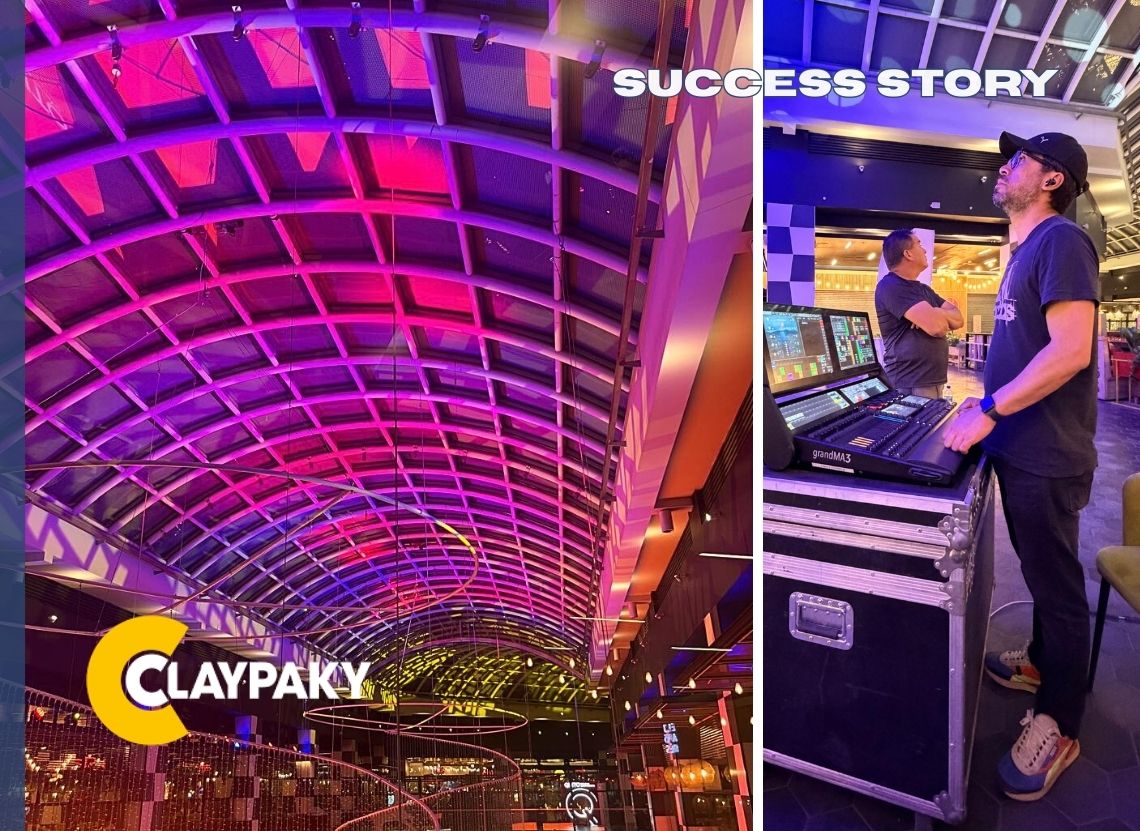
In the heart of Santiago, an unprecedented lighting installation transforms the architectural experience of the tallest mall in Latin America. And Claypaky is a protagonist, with design led by Alex Paredes and the strategic support of MMT Chile.
From the top of the Cenco Costanera —one of the iconic structures of the Chilean capital— a new visual narrative unfolds. The mall’s fifth floor, recently renovated as a high‑end gastronomic hub, was intervened with a large‑scale lighting design by Icardi Producciones, under the artistic and technical direction of Alex Paredes, who took on the challenge of integrating top‑tier technology without compromising the aesthetics of the space.
“They asked us to give the area life, to make it stand out,” explains Alex. “We did a demo with Claypaky that was so well received that the project expanded to four times the originally planned size.” Thus was born an installation conceived not only to illuminate but to transform the space into a daily spectacle of light and design.
With MIDI‑B and Arolla MP Spot fixtures, the team achieved a perfect combination of power, visual elegance, and efficiency, using the glass ceiling as a canvas to project color and movement.
Alex Paredes: three decades among lights, challenges, and stages
In the world of professional lighting, experience is not measured only in years, but in stages traversed, setups completed, and passion sustained over time. Alex Paredes knows this well. He began his path in 1994, between small events and private parties in Chile, not imagining that that first contact with technique would be the prelude to a solid and expanding career.
But the leap did not take long to arrive: joining Producciones Órbita marked a before and after. “There I began to understand what large‑scale production was, already with international concerts, presidential summits. It was a school to see great lighting designers at work,” he remembers.
Since then, Alex has not stopped. Always as an independent professional, he consolidated a sustained relationship with Icardi Producciones, with whom he has collaborated for more than twelve years. “We’ve done some very interesting projects, experiences that leave a mark,” he states.

His fascination with lighting was born from production, but he soon found his true vocation in control. “I really liked creating, interpreting from the console,” he recalls. Alex was self‑taught and a pioneer: he learned on the go, with passion and consistency.
Throughout his career, Alex has worked with iconic artists of the Chilean scene such as Los Tres, Américo, Luis Jara, and Noche de Brujas. Today, he collaborates with an internationally recognized illusionist, but his main focus is on corporate events and, especially, architectural lighting. “I really like it; I feel that Chile lacks color, it lacks light. I think there is an important mission to fulfill,” he states.
That personal conviction drives him to design projects that not only illuminate spaces, but transform the way people inhabit them.
From foundations to heights: the lighting vision of Icardi Producciones
For several years, Alex Paredes has been part of the Icardi Producciones team as lighting director, leading projects that combine technique, aesthetics, and a strong architectural component. “We’ve worked on several architectural projects. We dedicate a lot of effort to lighting buildings, to doing lighting demonstrations,” he says. Along the way, the lighting shows they design for various clients not only accompany events, but become visual experiences in themselves. “There are people who go to see a light show more than an artist. It makes it particularly entertaining, quite challenging… but also very rewarding,” he affirms.
The relationship with Icardi allowed Alex to get involved in large‑scale and highly visible projects, including one of the most ambitious of his career: the lighting intervention at the Cenco Costanera in Santiago, Chile.
“Lighting that 300‑meter tower and bringing it to life, making it move, has been a big challenge,” he acknowledges. Through the design of dynamic and colorful sequences spanning the entire structure, the building became a new nighttime landmark for the city.
His role within the team goes beyond design. “I see projects from start to finish. We support each other with our technical leads, but I try to take care of everything from the cable at the beginning, from the clamp, to the safety cable and the control. I’m a bit obsessive in that sense, I have to confess,” he admits with a laugh, “For me, light communicates, transforms, and creates identity.”
Cenco Costanera: a lighting experience that connects city and architecture
The high‑altitude project was born with a clear goal: to highlight a new high‑end gastronomic universe on the top floor of the iconic Santiago mall. “They needed this area to have additional life, to make it more attractive to the public,” recounts Alex Paredes.
And that’s where Icardi Producciones’ creativity came into play: they proposed a lighting intervention that not only enhanced the space but transformed it into a visual experience.
The first light demo exceeded expectations. “We did a test in a specific area, and they liked it so much that they ended up expanding the project to an area that quadrupled the original space,” he recalls. “The enthusiasm was immediate: the project was formally presented, approved, and the real work began.”
The heart of the project is a large skylight —a glass structure crowning the building’s top level— which became a canvas and focal point of the lighting intervention. But the installation was not conventional. “Between the glass ceiling and the restaurant floor there are technical grates, fundamental to its function. We attached above those grates to project the lighting toward the skylight,” explains Alex. Unlike in live shows, where light is directed at the audience, here the light ascended: it was architecture illuminating architecture.
That choice implied a different installation logic, both technically and aesthetically. The equipment had to integrate visually without disrupting the ambiance of the space. “We tried to make the equipment as invisible as possible,” emphasizes Alex. Surrounded by planters, hanging plants, and the decorative lighting of the gastronomic area, the projectors were camouflaged among the vegetation and design details. “They’re black, technological, but they blend with the environment. The idea was that they would go unnoticed, that the light would be felt, but the fixture wouldn’t interrupt the atmosphere.”
Thus, the installation achieved its goal: a lighting intervention of high visual impact, subtly integrated into the architecture of the tallest mall in Latin America. A project where technology and design conversed in perfect balance.
The creation of the lighting concept was, like any great project, an act of collaboration and aesthetic intuition. “The original idea to light this skylight came from Esteban Icardi, owner of Icardi Producciones,” Alex recounts. “As his lighting director, I support all the crazy ideas he can come up with. We put it together together, from the first demo to the final installation.”
The technical proposal was consolidated with Claypaky fixtures, selected for their precision, power, and versatility for this type of installation. The team used 24 units of the Arolla MP Spot model and 20 units of Mini‑B, strategically placed to cover the entire ceiling surface with subtle yet immersive effects. “Claypaky gave us exactly what we needed: control, intensity, optical quality, and a size that allows the equipment to be camouflaged without sacrificing performance,” highlights Alex.
The result was an installation where each light performs a scenographic function, beyond simple illumination.

The choice of these models was not casual or merely functional: it also responded to a long‑standing professional affinity. “I’ve always been a Claypaky fan. I started in ’94 with the MiniScan, Bazooka, GoldenScan 3… I used them all!” he recalls. “Today the MIDI‑B seems like an incredible machine to me. I like the brightness, the optics, the color. And the Arolla MP Spot has spectacular definition. We chose this line because, besides being 100% LED, it guarantees performance, reliability, and a design that integrates into the space without interference,” he says.
Thus, the installation at the Cenco Costanera not only stands out for its visual result but for a series of technical and aesthetic decisions that consolidate Claypaky as a strategic ally in high‑impact architectural projects.
Undoubtedly, a work that illuminates much more than a space: it makes visible a way of thinking about light as a narrative tool.
Technical challenges and total satisfaction: an installation worthy of the tower
Not everything was design and creative precision. As with any large‑scale architectural project, technical challenges set the pace of the installation. The first and most complex was the channeling system. “Unlike a traditional stage, here the access points were not beside or underneath the system; we had grates connected at different points, and some channeling even went to another floor,” explains Alex Paredes. Solving that distribution with logic, neatness, and compliance with regulations was a titanic task.
Connectivity represented another key hurdle: linking distances of over 100 meters between nodes, all connected to the mall’s central datacenter network. “At first it was complex to adapt, because we were not working with our own closed system, but with an external, highly demanding network,” he details. However, thanks to the control flexibility of MA Lighting, they successfully integrated scene programming and automations. “Today the system turns on every day at 7:30 p.m., turns off at midnight, and follows a fixed program. It’s already working perfectly, and that’s a huge source of pride,” he summarizes.
The result was applauded by both the Cenco Costanera management and the public that visits that gastronomic space daily. “We ran into the tower’s management while we were working, and they congratulated us in person. They’re happy with the result, and they’ve already asked us for support for other lighting projects within the same building,” Alex shares.
The installation not only met expectations but opened new doors and confirmed that when creativity meets technique, everything is possible.
Claypaky in good hands: the support of MMT Chile
Behind every great installation is a technical, human, and commercial mechanism that must function precisely. In the case of the Cenco Costanera project, MMT Chile, official representative of Claypaky, was a fundamental piece in ensuring the quality, delivery, and support necessary for an installation of this magnitude.
“The relationship with MMT has been excellent,” assures Alex Paredes. “Simón Manríquez has always had a very close relationship with lighting professionals in Chile. Not only did he inform us of the available equipment, but he also got involved in follow‑up, post‑sales, and every technical detail we needed.”
MMT’s involvement was not limited to logistics. From the timely delivery of the MIDI‑B and Arolla MP Spot fixtures to the documentation support required for a project of these characteristics, the distributor supported every instance with professionalism. “Everything we asked for, they delivered. They came to see the installation, made sure everything was fine, and offered help with any future needs. That is fundamental for a technician,” Alex highlights.
Additionally, the personal connection with Manríquez added extra value. “At a recent Open Day, Simón came directly to offer his support. He asked me how the equipment was performing, if we needed anything, and that speaks to a real commitment to the project and to those of us working in the field.”
“Alex designed the project with his own specifications, based on products he had already tested previously, and that allowed for a very rich technical dialogue from the beginning,” explains Simón Manríquez, Market Development Manager for Claypaky at MMT. “We were just introducing these models in some theaters in southern Chile. Therefore, reaching an installation as visible as Costanera meant a process of mutual validation,” he recounts.

MMT offered comprehensive support that included technical advice, virtual walkthroughs with the E‑Assist platform, photometrics, and complete documentation. “We were very careful in choosing the correct equipment. We showed how each fixture behaves, even in specific conditions, and we connected the client directly with the headquarters in Bergamo, something that for us is essential in terms of post‑sale support,” adds Simón.
According to him, Claypaky is not only a globally renowned brand but also a structure with long‑term support: from manuals to spare parts with specific part numbers, as if it were a premium vehicle.
The human closeness was also part of the differential. “With Alex and Esteban there was always trust. We appreciate that they pushed their team to trust in our technological vision and the innovation that Claypaky represents. When a designer like Alex places that trust in us, we feel that we are fulfilling the most important thing: being real partners in each project.”
Manríquez concludes with a reflection that sums up MMT’s approach: “Our mission is focused on guaranteeing satisfaction. We want each project to be an opportunity for mutual growth. If we manage to spread that spirit of improvement to users, then we achieve more than a delivery: we build a solid and passionate technical community.”
In a city that looks to the future without losing its identity, Claypaky now projects itself from the heights of the Cenco Costanera, accompanying every architectural gesture with light. It is not just an installation: it is a technical and aesthetic statement that combines creative vision, precise execution, and high‑level technology.


