
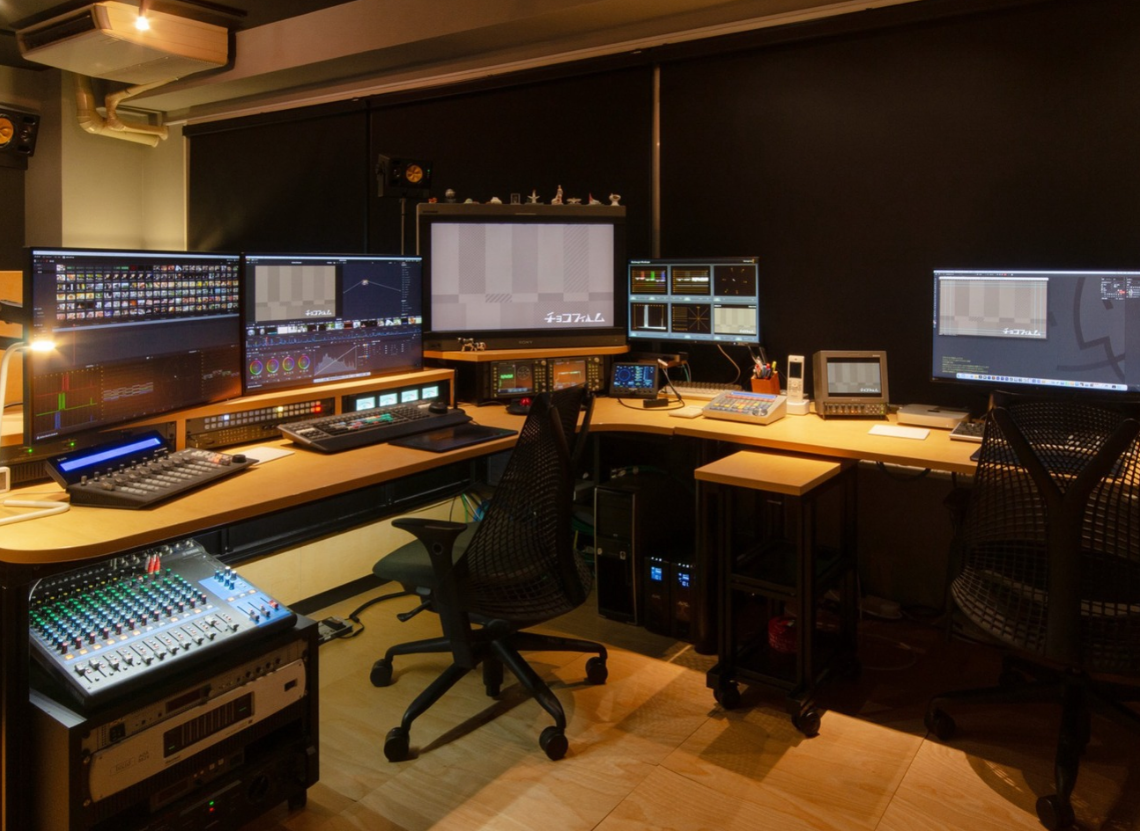
Japan – Blackmagic Design today announced that Osaka based post production company Choco Film is using DaVinci Resolve Studio and Blackmagic Cloud as part of its editing workflow.
Choco Film is a post production company specializing in a wide range of video content, including television programs and commercials. The company handles editing for programs produced by various television networks, including NHK, MBS and Kansai TV, covering a diverse range of genres such as variety shows, documentaries and dramas.
The company has been using a variety of Blackmagic Design products since it was founded. DaVinci Resolve Studio was initially adopted for color grading, but the company now uses DaVinci Resolve Studio for all editing processes performed in house. We spoke with Yuya Watanabe, the company’s representative and an editor, about the operation of its editing studio.
Blackmagic Design hardware that supported the company’s establishment
Choco Film has been using Blackmagic Design products since its establishment and continues to use a wide range of products, including Blackmagic Smart Videohub router, SmartScope Duo monitor, Teranex 2D Processor standards converter, UltraStudio 4K Mini and UltraStudio HD Mini capture and playback devices, HyperDeck Studio broadcast deck and DaVinci Resolve Micro Color Panel.
Watanabe: “I started my post production studio in 2011. At the time, VTR delivery was the norm, and equipment investment was quite expensive. Since I was also still in the early stages of establishing the company, managing our cash flow was not easy. In that situation, Blackmagic products offered outstanding value for money. We equipped the studio with a wide range of Blackmagic products, including DeckLink and converters, as well as major studio equipment such as HyperDeck and Videohub. For us at the time, it was truly invaluable to be able to acquire the equipment we needed while keeping costs down.”
NHK’S adoption of DaVinci Resolve Studio was a major turning point
Choco Film initially used DaVinci Resolve Studio selectively, such as for color grading and effects. A major turning point came when NHK, one of the company’s clients, began using DaVinci Resolve Studio in earnest.
Watanabe: “I had already experienced the speed of rendering and the responsiveness of DaVinci Resolve, but I felt that it was still lacking some of the functionality needed for television program editing. When I heard that NHK had begun using DaVinci Resolve in earnest, I thought, ‘If they can use it, perhaps we can, too,’ and started using it for editing.”
DaVinci Resolve Studio adopted for a weekly broadcast cooking program
The cooking program “Gekitotsu Meshiagare,” produced for NHK, became the catalyst for Choco Film’s full scale adoption of DaVinci Resolve Studio for editing. The company had produced the pilot episode using another NLE, but the workflow needed to be reviewed when the program was developed into a weekly series.
The program features three amateur cooks competing in cooking challenges, with a director assigned to each participant to follow their cooking development process. Because footage from all three participants needs to be handled, the amount of data required for editing is substantial.
Watanabe: “There are a lot of cameras, and because it’s a cooking program, there’s also a lot of color adjustment work. On top of that, we have around 500 to 600 titles per episode, so with the software we were using at the time, rendering alone took a considerable amount of time. Errors would sometimes occur during rendering, so after completing the pilot, I thought it would be difficult to produce around 34 episodes a year as a regular program with that software.”
The company spent the six months leading up to the program’s broadcast thoroughly testing DaVinci Resolve Studio and training its staff. Since the start of the regular broadcast, all episodes of the program have been completed using DaVinci Resolve Studio.
Watanabe: “The offline editing is also done in DaVinci Resolve, so I can take over the project shared by the offline editor and move directly into online editing, making the workflow very smooth. I also became even more efficient by using the DaVinci Resolve Editor Keyboard. At this point, I can’t imagine working without the keyboard.”
A Cloud workflow for efficient work with a small team
Choco Film has also adopted a cloud workflow using Blackmagic Cloud and Blackmagic Cloud Store Mini 8TB network storage solution, creating an environment that allows the small team to work efficiently.
Watanabe: “There are four staff members at our company, including myself. One of them needed to leave Osaka for family reasons. I thought that DaVinci Resolve would allow the person to continue working remotely, so I built a remote environment using products such as Cloud Store Mini. I set up a Mac and DaVinci Resolve and created an environment where they could work remotely. For projects with smaller amounts of media, such as promotional videos and short programs, that staff member works remotely.”
The company also uses Blackmagic Cloud’s Presentation feature to provide previews for projects where the director cannot be present on site.
Features and performance that support everyday editing
Adopting DaVinci Resolve Studio has significantly improved the efficiency of Choco Film’s editing workflow. In particular, the company has seen benefits in reducing the time required for small but time consuming tasks.
Watanabe: “I used to think of DaVinci Resolve as something you would use when you had a sufficient budget and wanted to produce a higher quality project. However, I found that using DaVinci Resolve can reduce production time and the workload on staff, and that it offers significant benefits even for relatively low budget programs that require little grading.”
“For example, when filming an interview in a shopping district, I sometimes need to blur the faces of passersby. I can handle that immediately with Magic Mask. Previously, I used effects software and had to do everything manually. If the duration of a shot changed, I had to start over from scratch, which took a lot of time. With DaVinci Resolve, I only need to redo the tracking.”
Watanabe also performs compositing and motion effects entirely on DaVinci Resolve Studio’s Fusion page. Although the company previously used layer based software, the transition to Fusion was smooth.
Watanabe: “Because Fusion is node based, it’s easy to replace media and combine multiple processes, so it’s easier to work with than the software we used previously. Another advantage is that the built in features allow us to create sufficiently creative results.”
“Previously, we added third party plug ins for things like particle effects, which also meant significant annual subscription costs. Using DaVinci Resolve has helped us reduce those costs.”
Updates that reflect user feedback
Watanabe: “The new feature in DaVinci Resolve 21 that made me happiest is the ability to hide tracks on the Edit page, which I had actually requested myself. Being able to display only the tracks needed for the task makes editing much more convenient. It may seem like a small thing, but features that make everyday editing a little easier are really valuable to editors. DaVinci Resolve clearly listens to user feedback when developing the software, and its usability continues to improve year after year.”


