
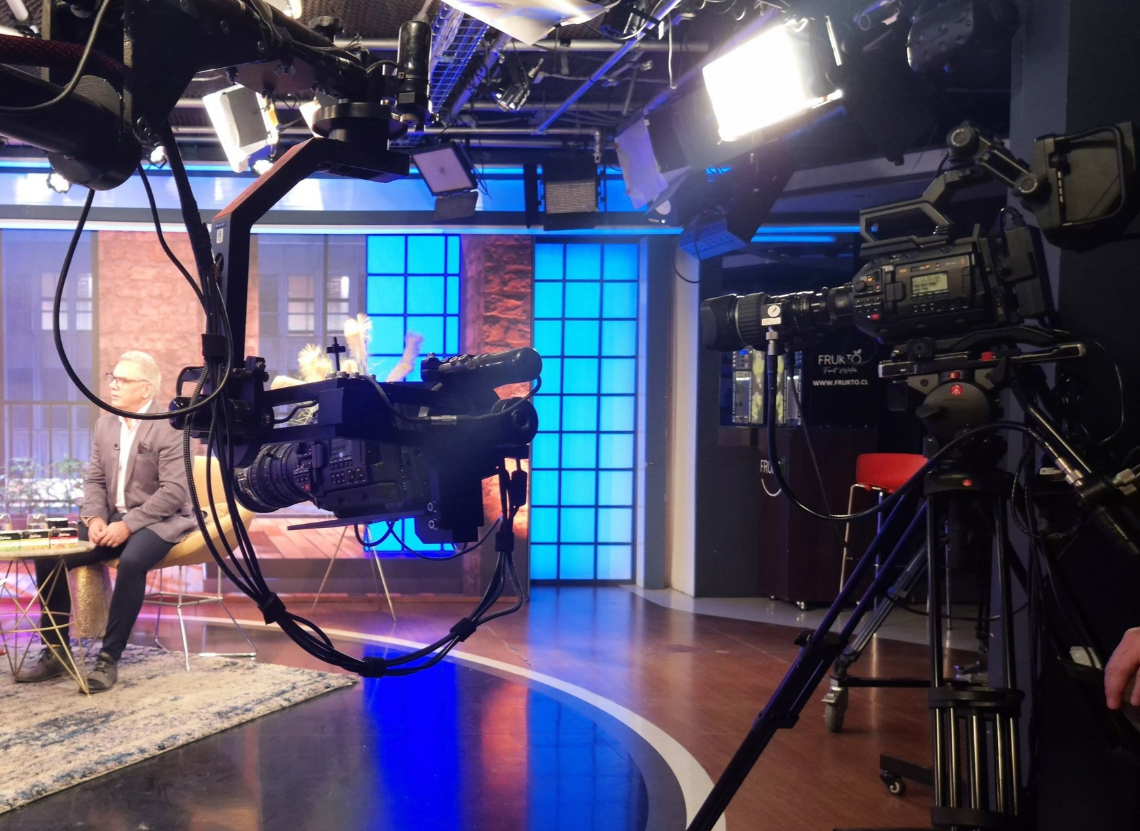
Chile – The search for a flexible workflow capable of integrating with an established broadcast ecosystem, as well as meeting the demands of live production, led Chilean channel TV+ to incorporate a variety of Blackmagic Design gear.
The project, developed in partnership with Chilean system integrator Duo, demonstrates that technological evolution does not always require starting from scratch.
Engineering decisions no longer focus solely on image quality or the addition of new features. Today, the real challenge lies in modernizing the infrastructure, simplifying daily operations and responding to new production methods without jeopardizing operational continuity or discarding investments that continue to add value.
“After a long search, we found a camera that perfectly met our objectives: something that would work in the studio and on location, and that could also be easily integrated with existing equipment,” explained Roberto Epuyao, TV+ operations and engineering manager.
That search led the channel to build a production workflow based on four Blackmagic URSA Broadcast G2 cameras along with an ATEM SDI Extreme ISO live production switcher, ATEM Camera Control Panel, Blackmagic Videohub 10×10 12G router, Teranex AV standards converters and various Mini Converters.
MODERNIZING AN EXISTING BROADCAST ARCHITECTURE WITH THE URSA BROADCAST G2
“There were mainly three factors: price, the possibility of using the same camera both in the studio and in the field, and the ability to work with different lenses,” Epuyao explained.
For TV+, the answer was incorporating the URSA Broadcast G2 as it is designed specifically for broadcast production but is also capable of adapting to television studios, mobile units and outdoor production.
Instead of choosing several cameras for different types of productions, with the URSA Broadcast G2, the channel can work with one camera system, reusing accessories, lenses and operating procedures across different areas.
“The cameras give us the flexibility to use them in the studio, out in the field, and then reintegrate back seamlessly,” Epuyao noted. “Depending on the programming, the cameras can be adapted to completely different needs: from talk shows and cooking programs to special broadcasts or productions developed outside the studio.”
When in the studio, the URSA Broadcast G2s are part of a production environment where LED screens and three dimensional graphics allow the set to be transformed into multiple virtual scenarios without physically modifying anything.
“Today we’re mainly using these cameras in the studio, working with 3D graphics and Unreal Engine. It has allowed us to quickly change recording scenarios and adapt to different productions,” Epuyao added. “The ability to reconfigure a studio in a few minutes represents a significant advantage for a channel whose daily programming includes between eight and ten hours of original production.”
VERSATILITY IN EVERYDAY OPERATIONS
As is the case with most television channels with a long history, the infrastructure has evolved gradually. Equipment from different generations and brands live within the same production workflow, requiring each new addition to be integrated without affecting the system’s stability.
“We already had an infrastructure in place. The important thing was to find equipment that could adapt to that flow, not the other way around,” said Epuyao.
“The most successful projects are those where technology ceases to be the center of the conversation and becomes a tool that facilitates daily operations. Having accompanied TV+ in this process reaffirms our way of working: listening, designing and integrating solutions that respond to the real needs of each broadcaster,” commented Matías Palau, commercial manager of DUO.
Palau concluded, “Looking at this integration, it is clear that Blackmagic Design brought numerous benefits to TV+, both in how the channel upgraded its infrastructure but also how it was able to incorporate new gear into its existing workflow. Instead of building a closed platform, TV+ opted for an open architecture, where different technologies can coexist and be integrated according to production needs. This approach provides greater flexibility to incorporate new tools, respond to changes in production formats, and extend the useful life of investments made over years.”
Photo © DUO


