
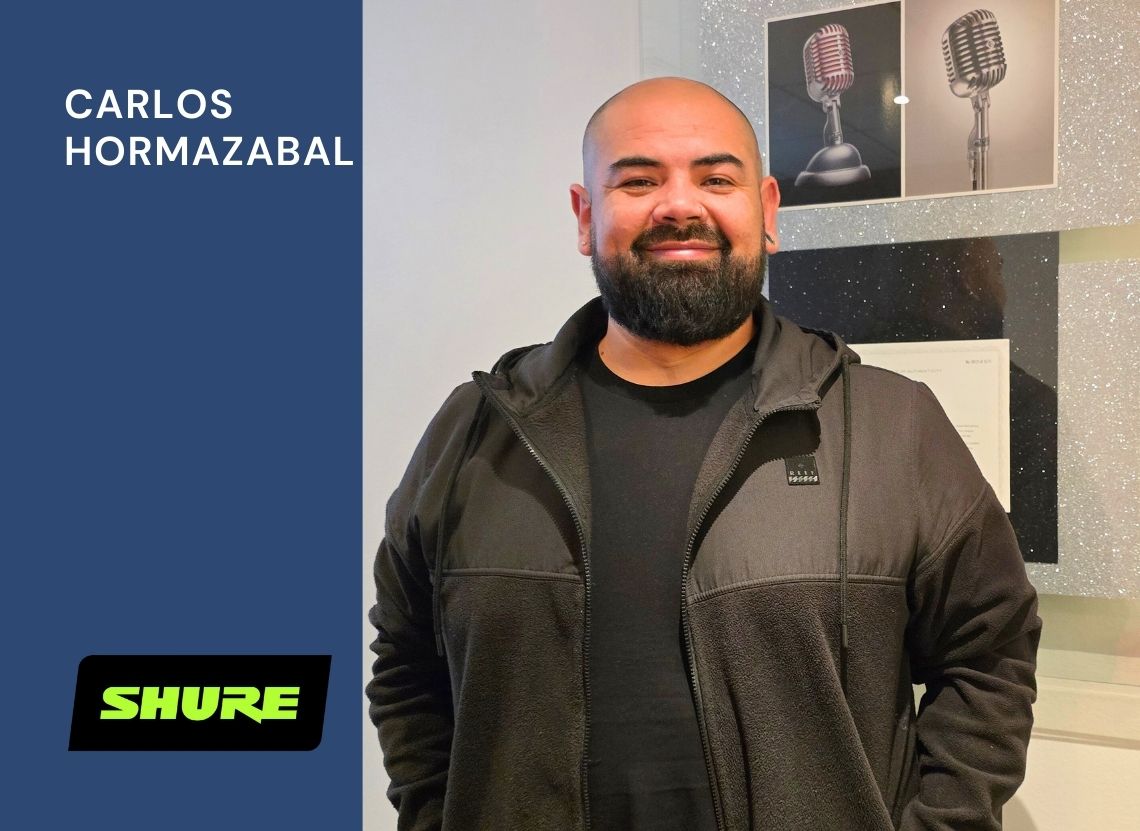
From massive stages to intimate creative processes, Carlos Hormazabal finds in SHURE more than a tool: a technical-emotional language with which he writes each show. His story is that of someone who turned sensitivity into method and chose to walk the audio path with purpose.
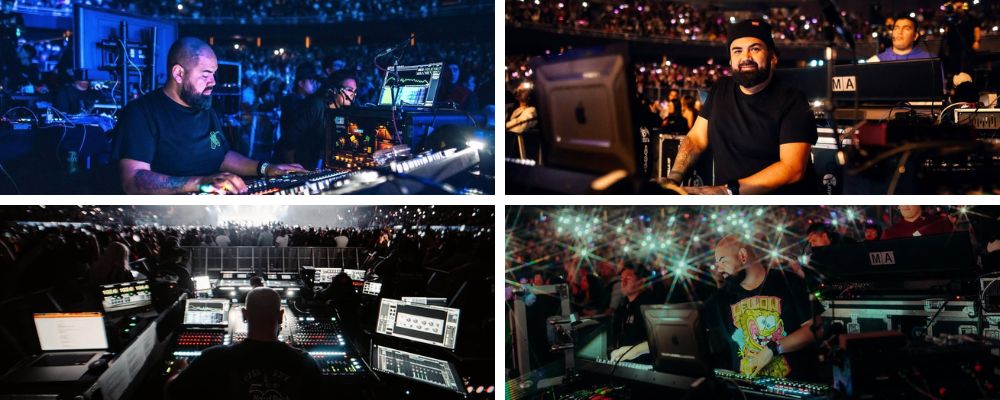
Carlos Hormazabal’s story in the world of audio didn’t begin behind a console, but on stage—as a musician. Born in Chile and with more than twenty years of experience, Carlos defines himself as someone who “knows a bit of everything,” but with a particular sensitivity that led him to change the course of his life.
His first real encounter with professional audio was almost accidental… and totally revealing.
“I started studying music when I was about 10 years old,” he recalls. His education grew organically, surrounded by instruments, harmony studies, and a family connected to the Christian church. A guitarist by origin, he also went through bass, piano, and even singing, in a journey he now recognizes as the foundation of his sonic sensitivity.
The defining moment came at a friends’ show, when they asked him to do a specific task: open the kick channel. “They told me to open channel 1, which is the kick, and I said ‘sure, of course.’ But I forgot I had to wait for the cue,” he says, laughing. Unknowingly, he activated the channel just as the drummer hit the kick drum. And then he knew: “When I heard that, I said: actually, I don’t want to make music. I want to do this.”
Thus, a vocation was born that still guides him today. “I believe those were the 15 years that defined me. There’s a quality that’s more about musical sensitivity than technicality,” he states. For Carlos, professional audio is not just about knobs and frequencies: it’s a way of feeling.
Carlos’ career hasn’t lacked technical challenges. But if there’s one that marked him early on, it was an extreme experience in the heart of the Balkans. “I was at a festival in North Macedonia, about 200 kilometers north of Athens. It was Constantinople,” he says precisely. The context couldn’t have been more demanding: an audience of 8,000 people, a reduced technical team, and an almost total language barrier.
“People only spoke Macedonian. About 5% of the population spoke English… and I’m not bilingual,” he explains. The mission: set up and operate a show with no soundcheck, straight from a line check and with limited communication. A situation that would test not only his technical skills but also his adaptability.
Far from freezing, Carlos turned that moment into a growth platform. A trial by fire that, as he says, “forces you to trust in everything you’ve learned before.”
The sound of the present
Today, Carlos Hormazabal is part of the Apocalipsis Tour, one of the most prominent tours in the Chilean urban scene, working with artist Chris MJ as FOH engineer.
“When you’re on tour, delivering a show with a standard in different parts of the world, your entire rig, your entire configuration has a reason for being,” Carlos explains. “The technical producer receives it, understands it as an operations manual, and you arrive at the venues to operate on that same structure, because that’s what gives you the confidence that everything is going to work,” he adds.
On the sound highway, nothing is left to chance: each technical decision is another cog in a machine that must respond with precision, night after night, regardless of the country, language, or stage.
Shure from his year zero in sound
Talking about Shure for Carlos Hormazabal doesn’t mean remembering a starting point—it means acknowledging a constant presence. “Shure are brands… things that have already been invented. It’s like, since when have you been driving vehicles? Since I learned how to drive. Because vehicles exist. And Shure exists,” he says laughing, but with absolute clarity.
Over the years, Carlos has refined his choices, learning to read what each situation demands. “You start filtering a bit: tastes, things you want to do, things you don’t… and what results you expect in different situations,” he reflects.
Shure’s classic models are in the DNA of entire generations of technicians and musicians, and Carlos is no exception. “I’m from the metal generation… So what did you use to record metal? Metallica with an SM58. What did X singer record with? With that SM58. So they’re always there. They’ve always been the top choice,” he says.
That connection goes beyond the brand: it’s about understanding the microphone as an extension of the artist. “There comes a time when you start to understand the microphone as a tool. That’s why there are so many capture models in the world: they’re all different solutions.”
On Chris MJ’s Apocalipsis Tour, Carlos found a technical and emotional turning point with Nexadyne. After trying multiple options, this was the system that changed everything: “It was when I stopped over-processing the artist’s voice. When I hit that sweet spot, with a bit of this, more of that, and maybe slightly more or less elsewhere… that’s what helped me reach the result.”
Carlos admits having used the KSM11 for years on other tours, but the current vocal and artistic context required another solution—one that Nexadyne delivered with surgical precision.
“I’m using the NEXA capsule in cardioid. The artist’s behavior is different than when they used the KSM11, because one is a condenser and the other is dynamic. They work differently in terms of sensitivity,” he explains. “It’s very different to sing on a stand with full voice, open hand, than to jump around with a mic in one hand on stage.”
The decision to change capsules wasn’t intuitive. It was tested, analyzed, recorded. He compared both in different scenarios, and what Nexadyne delivered was crucial: adaptability. “Nexadyne distorts the response much less when the mic is grabbed by hand. That changes everything in the current performance.”
It’s not just about capturing sound—it’s about not interfering with the art. “When the technical supports and doesn’t restrict, you become an institution aligned with this kind of concept.”
For Carlos, technique and career go hand in hand with a deep conviction: doing this only makes sense if you live it with purpose. It’s not just about getting on a tour—it’s about choosing a path that has meaning, even when the challenges seem greater than the rewards.
In that same vein, his technical approach is shaped by sensitivity. When speaking of his favorite instrument, he doesn’t hesitate: the drums. But not from a common viewpoint—rather as an engineer who understands its complexity. “Drums are a multi-source instrument. It has between 12 and 20 channels depending on the kit, but what you’re looking for is that all of it sounds like one instrument.”
What matters is not just capturing sound, but doing it with agility and fidelity. “It’s a vibraphonic, percussive instrument. So I need mics that are agile in response to that initial impulse. And what responds very well mechanically is a condenser mic. I use the Beta line a lot. Beta 57, Beta 98 on the toms.”
The goal is always aimed at psychoacoustic impact. That’s why he’s a declared fan of condenser mics: “They give that sense of grandeur, allow for processing that makes you feel the instrument is bigger than it is.”
With a setup that includes PSM1000, Axient Digital channels, P10R, Nexadyne capsules, and AD600 scanners, the RF solution network becomes both his technical and mental shield. “The AD600 allows you to capture RF info from other brands, integrate it, scan it, and tell you which ones are ready. Having backup frequencies—that’s also security.”
“From my FOH position, perception is a mix of technical control and auditory sensitivity. I’m in the listener’s position. I can hear the audience’s comments, how they react to show moments, but I don’t have the control that other roles like stage manager or monitor engineer have.”
That feeling of uncertainty, which for many would be stressful, he manages through trust in technology. “I’m a control freak—I try to have all the shows under control. And that’s one element I can’t physically control. So what happens? Today, thanks to Shure’s technology, I have it psychologically under control.”
The key lies in the prior processes, where order and predictability become tools of emotional safety. “Problems show up beforehand, they’re solved before the show starts, and the solutions are defined for the show.”
Audio, then, isn’t just technical: “It has to do with security, with my peace of mind. That everything I have under control is in place, and what isn’t—I already know it’s covered,” he reflects.
More than a brand, a support network
For Carlos, working with SHURE goes far beyond choosing a capsule or programming a preset. It’s a relationship based on trust, support, and technical coherence. “This isn’t Volkswagen, which only works with Volkswagen and won’t allow Nissan. This analyzes yours and others’ stuff in terms of safety,” he says, using a clear analogy to describe the brand’s ecosystem interoperability.
For him, SHURE’s value lies in the real and sustained support it offers in different countries—beyond commercial terms.
“What SHURE has done with me is maintain that support internationally. That network built between manufacturers, distributors, and technicians activates when it’s most needed. It’s happened to me at Rock al Parque, at a festival in Madrid, and many more—and you know you’re not alone, because they understand that your result is also theirs.”
In the end, what defines the choice isn’t just a capsule’s performance, but the work environment that builds around it. “That whole network, that SHURE family always working on solutions, is what allows you to sustain a real technical process. It becomes a mechanism of ‘all for one and one for all.’”
Be prepared, have passion… and trust
After years of touring, technical challenges, and shared learning, Carlos Hormazabal has no doubt about sharing two simple and powerful ideas for anyone looking to build a career in professional audio.
“Everyone looks for the opportunity. Everyone wants to take the penalty shot. The problem is that the opportunity comes very few times in life. The key is how prepared you are when it does. If you’re not ready, everyone will remember that you had the chance… and you missed.”
But in addition to preparation, there’s something just as important: passion. And in that final piece of advice lies a philosophy of work, life, and professional ethics. “If you’re going to do it, do it with passion. Because in an audience of 15,000, 60,000, or 200,000 people… you never know who’s listening. It could be a promoter you’ve never met who’s going to help you. And that’s where a lot of opportunity comes from.”
Carlos speaks with the authority of someone who’s taken many penalty shots in his life—and above all, someone who’s learned to play as part of a team.
The voice, the method, and the bridge that never was
Although Carlos Hormazabal’s present is filled with international tours, reggaetón, and NEXADYNE capsules, there’s one thing that hasn’t changed: his deep admiration for the voice. “Honestly, I’m a fan of the voice. A big fan. It’s something very delicate, very difficult to handle. Because that flower can wither out of nowhere,” he confesses.
That respect for subtlety goes hand in hand with a work ethic forged in consistency. “I’m someone who doesn’t see himself as talented. I see myself as someone with many doctrines. I study a lot. I’m always reading, listening, practicing. I’m all about doing.”
From a young age, he discovered he had a special talent for math. “This career in sound is a branch of engineering. And there’s a lot of math to understand, because it works through an electronic phenomenon.”
While traveling the world, through airports, stages, and colossal structures, something still fascinates him as a parallel dream: architecture. “Every day I see bridges, airports, streets, and I think: I would’ve been a guy who builds things. Who designs.”
His story contains simultaneous passions and deep honesty. “In life, you don’t always get the chance to try all the things out there. Sometimes you’re left wanting.”
But Carlos doesn’t dwell on that fork in the road—because he knows he chose one, and he walks it with the same conviction he once imagined building bridges.
It will all be worth it
If he could speak to his younger self—that 12-year-old Carlos who dreamed of music, unaware of how many paths awaited—he’d say: “Everything that’s coming will be very hard, and many times you’ll wonder why. But it’s just a stage that will test your strength. Keep going with the same energy and perseverance, chasing your dreams… You’ve achieved many of your dreams, and you’re still chasing the ones that remain. Because at the end of the day, everything—absolutely everything—will have been worth it.”
Today, that kid has grown up. And while he didn’t become an architect, he became an international touring engineer, a sonic explorer, and an unconditional fan of the voice.
Carlos Hormazabal is not just a reference in professional audio in Latin America—he’s proof that technique can be learned, sensitivity can be nurtured, and everything makes sense when you work with purpose.
Credits
Cover Photo: Carlos Hormazabal
Inside Photos: Carlos Hormazabal
The journalistic production, research, writing, editorial approach, and editing of this content are original works by LATAM STAGE and are protected by copyright.
No part of this content may be reproduced, copied, distributed, adapted, or published, in whole or in part, in any medium or format, without the prior written authorization of LATAM STAGE.


