
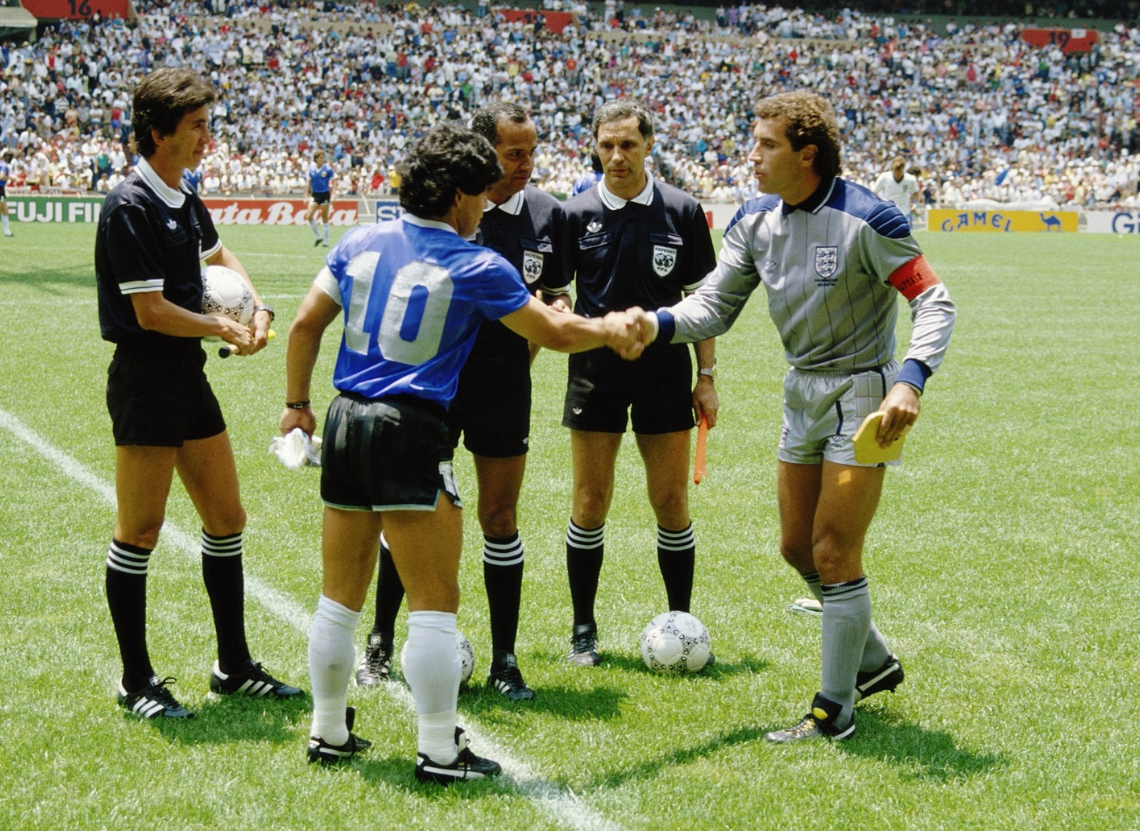
France – Blackmagic Design announced today that “The Match,” a documentary revisiting the 1986 FIFA World Cup quarterfinal between Argentina and England, was shot with the Blackmagic URSA Cine 17K 65 and Blackmagic URSA Cine 12K LF digital film cameras, with post production completed in DaVinci Resolve Studio.
Presented as part of 2026 Cannes Premiere ahead of its theatrical release in Latin America, and recently selected for the upcoming BFI London Film Festival, “The Match” revisits one of football’s most celebrated and controversial games. Through interviews with former players from both national teams, the documentary explores their memories of the match and wider political tensions surrounding it, as they watch archival footage of the game together.
When Cinematographer Pablo García Gallego met with Directors Juan Cabral and Santiago Franco, much of the documentary had already been edited using archival footage. With the interviews still to be filmed, he developed a portrait led approach using the URSA Cine 17K 65 and its larger sensor to bring the camera physically closer to the players while retaining a natural perspective.
“My task was to capture the interviews by treating each shot as a photographic portrait and trying to capture even the smallest reaction, to give their testimonies more personality,” García Gallego began.
After establishing a monochromatic aesthetic based on the contrast between black and white, García Gallego used a large overhead rig as the main light source, supplemented by softer, adjustable side lights to shape the faces and create more pronounced shadows against a black background.
“I wanted the portraits to bring the viewer as close as possible to the protagonists while preserving a natural perspective, without resorting to wider focal lengths or losing intimacy by moving the camera further back,” said García Gallego.
The players watched archival footage on a six meter projection screen during the interviews, with all three cameras rolling to preserve spontaneous reactions. As the archival images changed, the projected light also became part of the visual treatment.
Paired with a Mamiya Sekor C 65mm fixed lens, the URSA Cine 17K 65 served as the dedicated portrait camera. The combination of lens and larger 65mm sensor allowed García Gallego to work much closer to each interviewee. “With a larger sensor I can move the camera closer to someone while still using portrait focal lengths that don’t distort the face,” he explained. “That means the viewer is closer to the person as well.”
An URSA Cine 12K LF paired with an Angénieux EZ-2 cine zoom provided additional coverage, allowing García Gallego to quickly adjust the composition from the same position, moving between wider seated shots and tighter medium framing as the interviews developed and a third camera provided another perspective.
The extended interviews were primarily recorded in 4K to allow for longer uninterrupted takes, while 12K and 17K were used where additional image information offered more flexibility in post. For shots involving television screens, shooting in 12K provided additional detail for VFX work while allowing alternative compositions from the same take.
DaVinci Resolve Studio was used to deliver the documentary film’s edit, grade, VFX and finishing.
Production Credits
Director: Juan Cabral, Santiago Franco
Director of photography: Pablo García Gallego
Production company: Industria del Milagro, Labhouse Films
Co-production company: Blurr Stories
Producer: Flora Fernández Marengo
Post Production Supervisor: Jorge Benjardino
Editor: Lucas Coppolechia Damiani, Sebastian Fasanelli, Juan Pablo Scaglione, Mauro Caporossi
Colorist: Alejandro Armaleo (Armaleo Color Studio), Julia Rossetti
Camera equipment supplied by: Welab Professional Equipment and Moncada y Lorenzo


