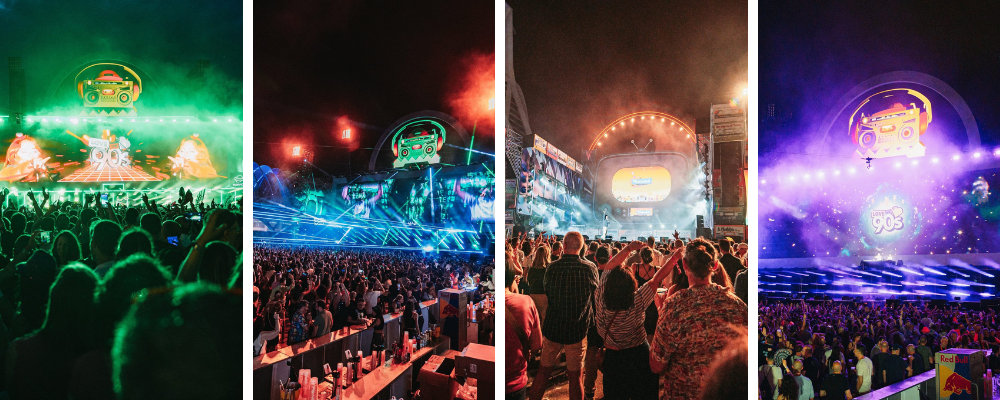
With a brutalist design and a giant 38-meter robot as its emblem, Edu Valverde transformed the I Love 90’s festival into a sensorial journey where light took center stage. With Cameo, each luminaire became a narrative resource to relive a decade with the power and precision of today’s technology.
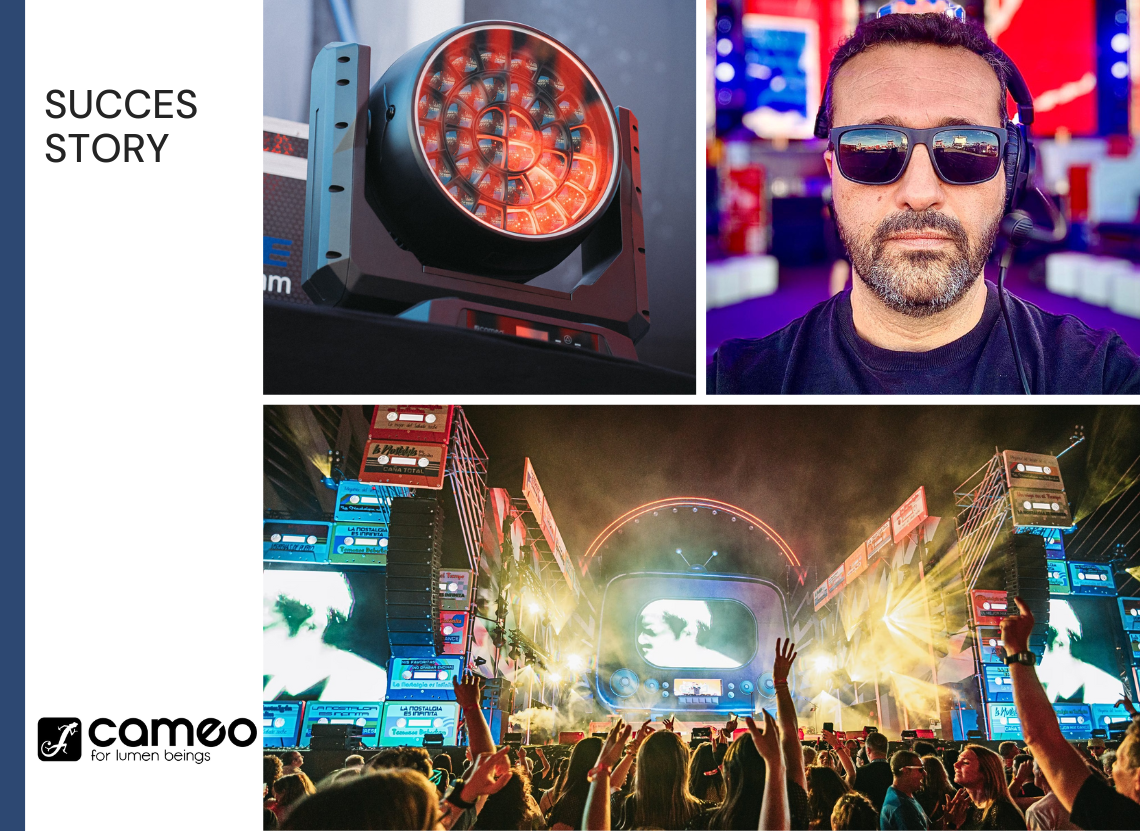
Since 2017, Edu Valverde has signed his name to the Love the 90s festival in Valencia. In this edition, he doubled down with a stage design of brutalist aesthetics: imposing structures, straight lines, and a visual architecture that transforms with light. The challenge was clear: to go from sunset to nocturnal euphoria without losing impact, and to achieve that, he needed tools at the right level. That’s where CAMEO came into play, as a key piece in a technical narrative that fuses precision, energy, and collective memory.
Nothing about empty nostalgia: the technical concept of Love the 90s was a declaration of principles based on efficiency, visual cleanliness, and stage power. For Edu Valverde, each luminaire had to have its own character, respond precisely to the changes of the show, and withstand without failure the demands of the environment. “Shows like this are very complex, so every element has to be perfectly coordinated,” he states. Because behind every 90s hit there is an architecture of light that not only accompanies—it tells the story.
A True Madrileño, Shining Since the Start
Eduardo Valverde—though everyone calls him Edu, even his mother—is Madrileño through and through: born in Madrid, raised in Madrid, and with family also from there. “I’m a gato, gato, gato, as we say here,” he emphasizes with laughter. His story with light began in the 1990s, in a Spain that was experiencing the boom of the Expo and the Olympic Games. That context generated unique opportunities for those, like him, who were beginning to dream of a technical career.
“I started working in this around 1992,” he recalls. It all began with an INEM course in theatrical lighting, taught by two professionals who are still in the field today. “When I finished, they gave me a list of companies, and I started calling them one by one. I had no experience, but I was very eager.” Persistence paid off: at the peak demand for technicians due to the massive summer events, Edu was sent to his first real job, on a TV program filmed in Mallorca.
That momentum took him straight to the Telecinco studios, one of the first private channels in Spain. There he worked for four years, surrounded by Fresnels, large-format structures, and photographic direction. “What I really liked was something else… moving lights, color changers, modern consoles.” It was that curiosity that pushed him to change course: “I started as a lighting technician for shows. That’s when I knew I had found my path.”
Training from the ground up is a school that never fails. Edu Valverde shows this, having grown step by step within the trade: “First in assembly, then as crew chief, configuring consoles and dimmers… until one day they give you a little desk so you can make a small design and operate it,” he sums up. His training was as empirical as it was comprehensive, with direct experience in every stage of the technical process. “I know perfectly well what it’s like to load a truck,” he says with a laugh.
That’s how he opened himself to new disciplines, adding theater, large-format musicals, and even video content production. “As I like to say, I’m an apprentice of everything and master of nothing… but I have quite a range,” he asserts. At a time when there was still no clear distinction in Spain between designer and operator, his versatility led him to do a bit of everything. That cross-disciplinary vision was fueled by great references: David Arribas and Armin Giraldo in television, Juanjo Llorens in theater, and Josito Alegre in the rock world. And when electronic music festivals arrived, he found his place. “I really liked electronic music… when I saw it start to become professionalized, it was like heaven opening. Because there you could design a global experience: you don’t just light up a band, you create stimuli so people can feel the music also with light.”
A Studio, Many Perspectives
“I don’t have a defined style because I do many types of work,” he explains. “And both myself and the team we work with… we’re quite creative, but also very pragmatic.”
That team is part of his studio, Experiencias Visuales, a creative production house based in Madrid with eight staff members and an integral approach to lighting design, visual content, console operation, and technical management. “I’m the creative director, and then I have operators, programmers, video people, designers… a bit of everything,” he says. The key for him lies not only in creating but also in knowing how to listen: “I’ve seen designers who close themselves off to an idea. We don’t. We’re permeable. We can work with art directors or artists who ask for something very specific, and we know how to adapt.”
The story of Experiencias Visuales has its roots in Pixelmap Studios, the first company he founded in 2017 with the team that still accompanies him today. The main client back then was the production company behind the Love the 90s, Love the 20s festivals, and other nostalgic proposals that grew exponentially. “They saw it could grow, and we grew together,” Edu confesses. After the pandemic break, the studio was restructured with the same spirit and a new identity. Since then, they not only consolidated themselves as a reference team for this type of event but also began working with global artists, such as Aitana. “This summer we did three stadium shows for her, in Barcelona and at the Wanda Metropolitano in Madrid. More than 70,000 people each night. A beautiful madness.”
I Love 90’s: A Nostalgic Party with Technical DNA
Edu Valverde has been in charge of the lighting design for the I Love 90’s festival for several years, one of the most beloved productions on the Spanish circuit, which in 2025 celebrates its eighth edition with tours throughout Spain. More than an event, it is a cultural phenomenon that mixes music, collective memory, and visual spectacle. “It’s a show with brutal energy. People come with a very strong emotional connection to these songs. It’s not just a party, it’s a reunion with their adolescence.”
Organized by Sharemusic!, the festival brings together great icons of 90s pop, eurodance, and electronic music, from Vengaboys to Snap! and 2 Unlimited, in a format that combines powerful sound, LED screens, and a lighting design that adapts to both stadiums and open-air squares. “We’re touring with this all year round. From April to November there are dates, but the big production, the one with 20,000 people or more, is usually in Valencia,” he acknowledges. There, the festival has already become a tradition.
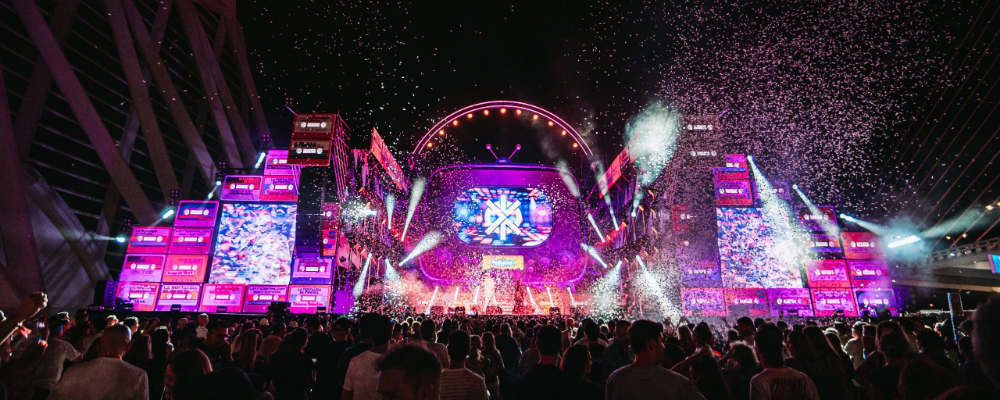
The technical and aesthetic concept not only aims to create an immersive experience but also to maintain visual coherence with the spirit of the 1990s. “In terms of design, we play a lot with blocks, vertical bars, saturated colors, and symmetrical shapes that evoke that era,” he explains. This retro-futuristic line is complemented by a modern and precise execution, incorporating state-of-the-art tools. And in that mix between evocation and modernity, CAMEO became an indispensable ally. “Since I discovered it, it’s a brand that has accompanied me on several projects. I like how it responds, the aesthetics, and above all, the quality of light it offers.”
Edu Valverde’s link with I Love 90’s arose almost like a fortunate coincidence, one of those that transform careers and consolidate styles. “A friend in common, who is the director of one of the largest nightclubs in Europe, Fabric, in Madrid, introduced me to the festival director. And from there, it was love at first sight,” he declares.
Since then, Edu has become responsible for the lighting design of the main stage: a vibrant dance floor where eurodance, italo dance, and all those electronic sounds that defined the 1990s reign. But the festival doesn’t stop there. With four simultaneous stages—including a techno stage, a pop-rock stage, and the “Playa Stage” with beach hits—I Love 90’s unfolds a musical journey as diverse as it is emotional. “Music transports you. There are people who hadn’t heard a song in 20 years… and suddenly, in those 15-minute sets, they put in 12 tracks. It’s a trip.”
The goal is not just to entertain: it is to provoke a genuine emotional response. “It’s a show with a lot of visual concept, designed so that people who lived that era get emotional. To say, ‘this marked me, this was part of my life,’” he concludes. And here, lighting design becomes the perfect vehicle for that emotional memory to transform into experience.
Designing with Cameo, Projecting with Passion
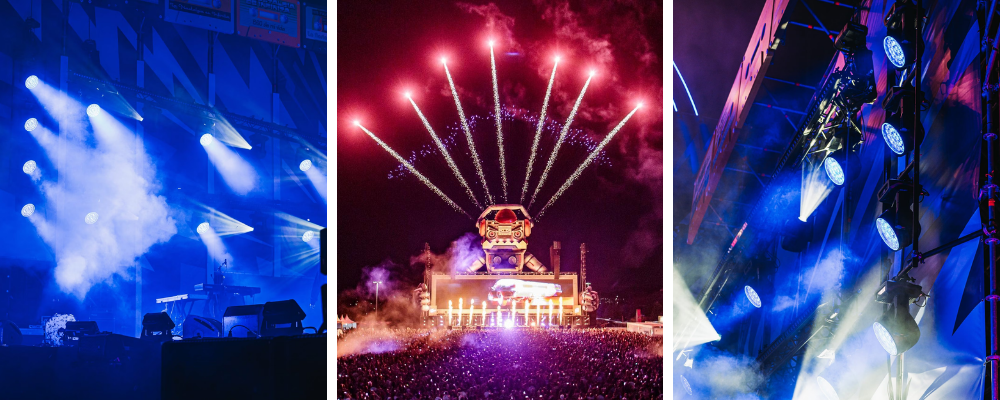
One of the most imposing stage elements of the I Love 90’s festival was, without a doubt, the enormous 38-meter-high robot that stood on the main stage as a symbol of an era that fused technology, music, and fantasy. This visual icon needed lighting that not only highlighted it but also accompanied the progressive dusk of the show: “Festivals here start at eight in the evening, but by one they’re already over. That’s why light changes quickly, and we had to take advantage of that transition to turn the robot into the protagonist,” explains Edu Valverde, the festival’s lighting designer.
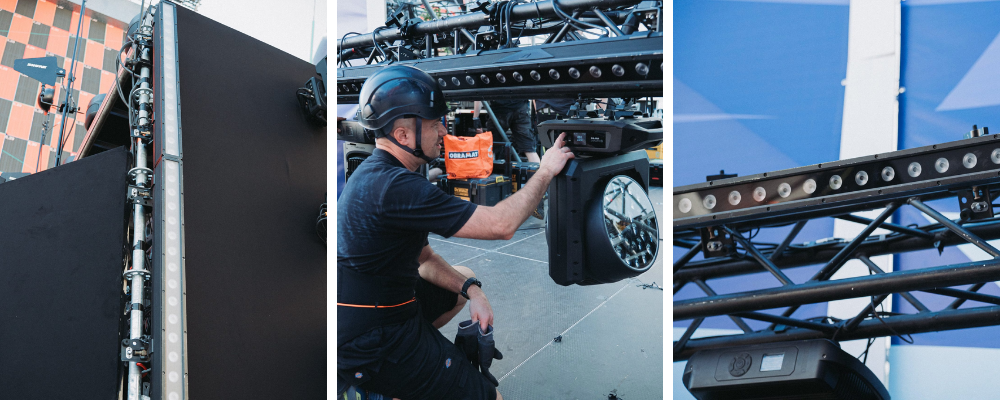
To achieve this, the entire lighting system was carefully planned based on the set changes and the nostalgic character of the event. “The Cameos were used specifically to light the robot. A mix of Otos W12 and ZENIT W600 was what gave us that atmosphere we were looking for. The robot didn’t just have to be present, it had to come alive with the light,” Edu details.
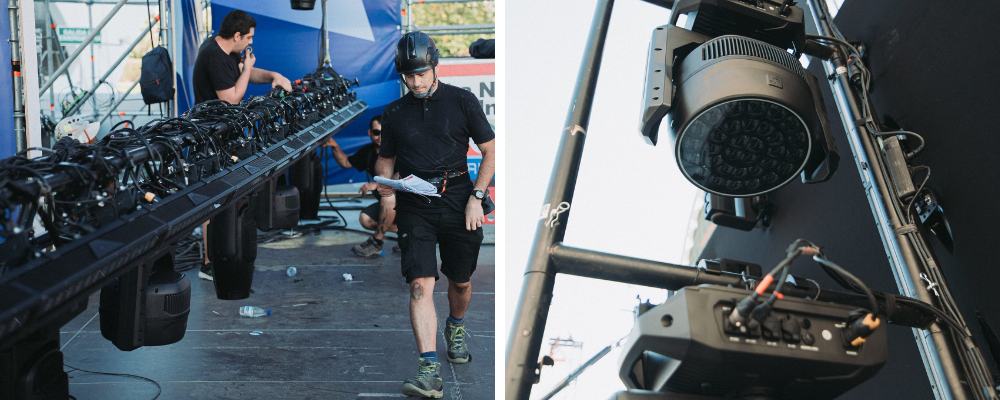
But the technical approach went beyond the central object. The Otos W12s were also used as the main wash of the stage, and the design incorporated a dynamic arrangement that allowed it to follow the live artists, the DJ sets, and the musical transitions between each block. “The entire stage wash was with the Otos, even the footlights. We were looking for a design that didn’t just light up, but created moods. And that combination was key,” he asserts.
Beyond the power, what defined the choice was chromatic expressiveness. “The ZENIT W600 has a chip with very saturated and bright colors, exactly what we needed to highlight the comic-book aesthetic of the festival. It’s a visual story, and the color had to be up to the task,” Edu explains. “That color tone it has right from the start I like a lot. Of course, you can soften it, but from the outset, it already has a very attractive intensity.”
He also highlights its versatile optical system, key to precisely lighting the giant robot from different angles: “The W600 doesn’t move, it’s a brick. But it has something I love: the magnetic diffusers. Out of the factory, I think they’re about 18°, but you can add 45°, 60°, 90°, even 100° lenses. So, with the same fixture you can work different planes. For the top part of the robot, we used it without a diffuser, to reach well up there; and for the lower areas we adjusted with diffusers.”
As for the Otos W12, the creative range expands with dynamic effects designed for audience contact: “It has three independent zoom rings, and that allows you to create very cool beams. In addition, it has a pixelable LED ring on the outer edge, which, even if the fixture is off, maintains a visible effect. It’s a small detail, but it adds a lot when you’re throwing lights at the audience,” Edu describes.
Although he doesn’t have a defined favorite luminaire, Edu closely follows Cameo’s evolution and what’s coming next. “They had told me they were going to release a LED bar, and we’re all here waiting to see what they launch,” he notes.
While many are already looking back, his calendar marks September as one of the busiest months of the year. “Right now, there are five Vegas the same weekend in Madrid,” he says, laughing. Between what is coming and what has already left its mark, Edu Valverde confirms something that doesn’t need lights to shine: lighting design is a way of being in the world. And Cameo is an ally that helps him build experiences with every flash.
A One-Way Trip to the Past… with Today’s Lights
In the nostalgic universe of I Love 90’s, where every song is a collective memory and every beat revives an era, lighting design becomes a time machine. “Music transports you, but light is what makes you live it again.” And for that, he needed a tool at the right level.
Cameo was the perfect ally to light up that emotional journey: from the gigantic stage robot to every corner of the main stage, its luminaires brought color, power, and technical versatility.
Designing with nostalgia, projecting with vision. That was the challenge behind a production that not only revived a decade but also demonstrated how technology, when chosen well, can connect generations.
And in that intersection between memory and spectacle, Cameo shone with its own light.