
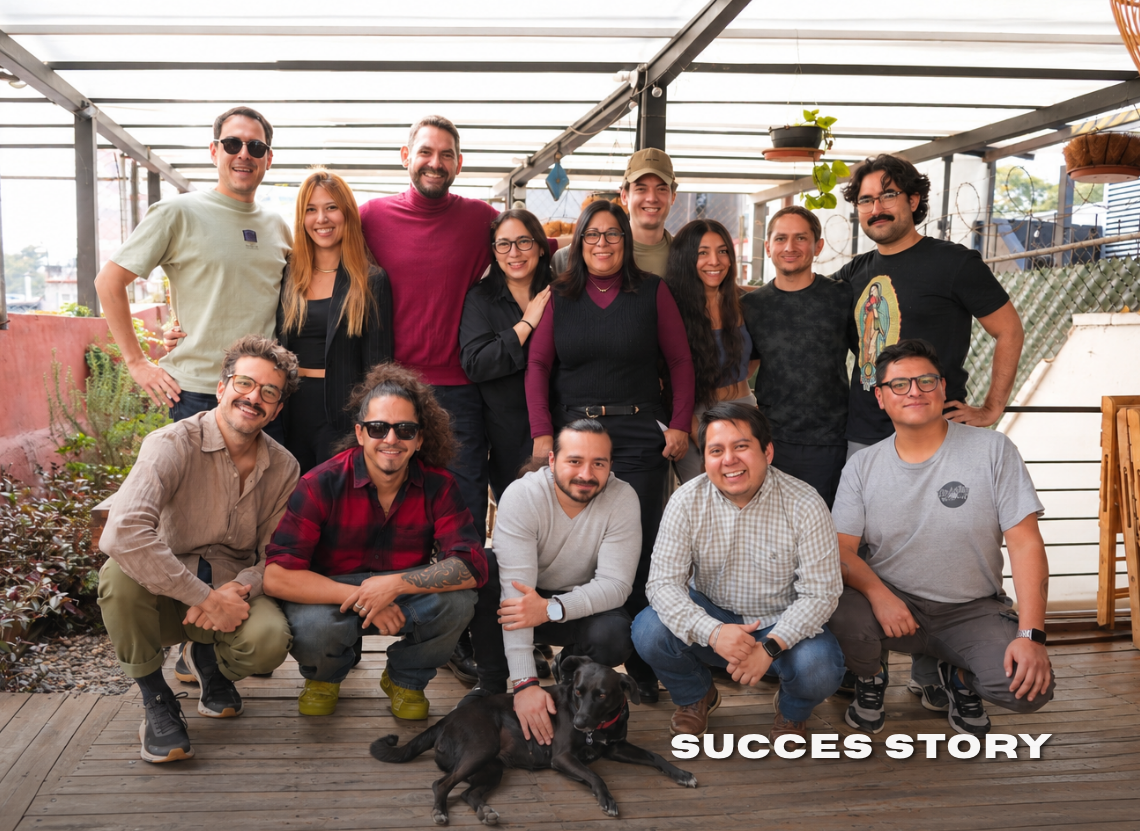
In a historic house in Roma Norte, in the heart of Mexico City, Caffeine brings together young talent, creativity, and an approach that challenges traditional post-production models. What began as a venture during the pandemic has become an internationally oriented studio, where DaVinci Resolve Studio and Blackmagic Cloud connect colorists, VFX artists, and imaging specialists through a collaborative working philosophy.
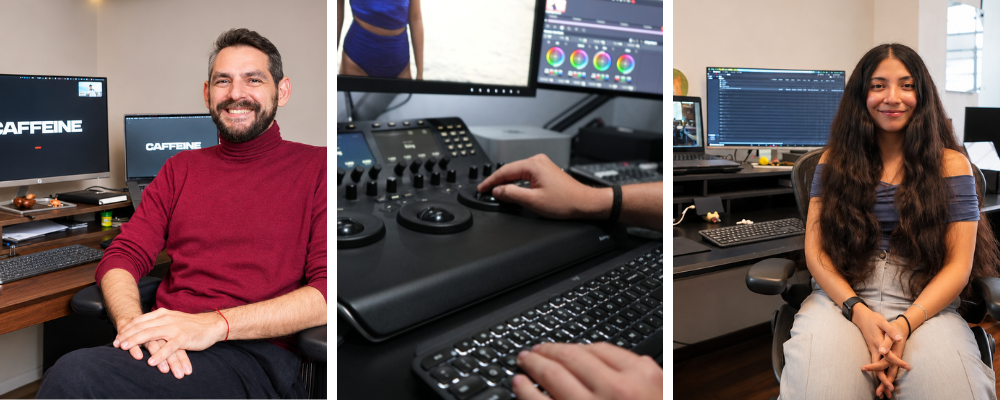
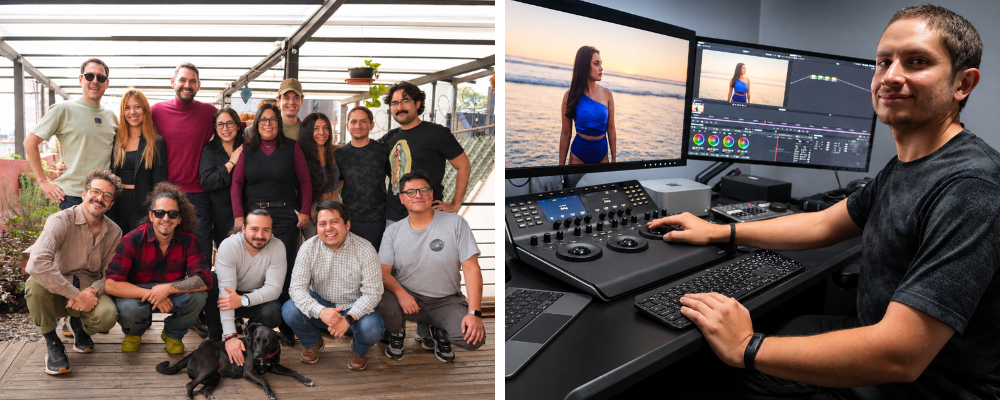
Mexico – At Caffeine, creativity can be felt in every corner. From its thoughtfully designed spaces to the dynamics of a young, passionate team, everything reflects a distinctive identity where talent, collaboration, and a relaxed working atmosphere coexist with the demands of professional post-production.
Located in the heart of Roma Norte, one of Mexico City’s most creative neighborhoods, a historic house is home to a world where technology, young talent, and an informal working environment come together. The architecture retains its character, while the interiors reveal a carefully considered aesthetic, with details that reflect the creative sensibility of the people who work there.
The shared spaces encourage interaction, the work areas are comfortable, and every corner seems to strike a balance between the informal and the professional.
Behind this atmosphere lies a professional operation that develops advertising, film, series, and documentary projects for clients in different countries. And one technological decision has shaped much of its history: building a collaborative post-production workflow around Blackmagic Design.
From three people to a house full of ideas
Caffeine’s story began during the pandemic, when Adrián Geyer, a Venezuelan producer and director based in Mexico, decided to launch a business with a small group of collaborators. His experience in international co-productions had already shown him that audiovisual projects could be developed without every professional sharing the same physical workspace.
He began working remotely on advertising projects and several films in post-production. The studio’s first location occupied just one floor of the house. Over time, that three-person venture grew to approximately thirty professionals and expanded into three adjoining houses.
But what makes this story interesting is not just the growth. It is the philosophy that has remained behind it.
At Caffeine, there is a generation of professionals who combine technical expertise with curiosity, flexibility, and a willingness to experiment. Rather than following a rigid structure, the studio embraces an approach in which specialties intersect and teams are reorganized according to the creative needs of each project.
Geyer believes this openness also defines the future of the business. In an audiovisual industry that is constantly changing, his strategy is not about competing in isolation.
“We are passionate about collaboration,” he summarizes.
Blackmagic Design: a commitment from day one
Caffeine’s relationship with Blackmagic Design dates back to the studio’s beginnings. When the company was still building its infrastructure, gaining access to professional post-production tools without making a disproportionate investment was essential.
“The only way we found to start developing professional projects and have professional equipment with a good cost-to-quality ratio was to invest in Blackmagic Design. That was our first path, and it opened the doors for us to get started,” he explains.
With a young team eager to adopt new tools, Caffeine found in DaVinci Resolve Studio a platform that could evolve alongside its needs. The ability to modify processes, learn new features, and experiment with newly released technologies became part of its identity from the outset.
Training was also fundamental to this process. Ernie Schaeffer, then the studio’s Head of Color, was also a Blackmagic Design trainer. His knowledge of technological developments helped keep the team up to date and explore tools that were just beginning to enter the market.
Geyer recalls that this combination of youth, curiosity, and flexibility made it possible to transform workflows without the difficulties that a more traditional structure might encounter. The team was willing to try new solutions, even when doing so involved taking risks.
That attitude proved decisive when the company faced one of its first major challenges. Its first series had initially been planned as a ten-episode production. However, the project suddenly doubled in length to twenty episodes, without a proportional extension of the delivery deadlines.
At the time, Blackmagic Design had just introduced new collaboration capabilities for colorists in DaVinci Resolve Studio. Schaeffer suggested testing them during production.
The decision involved a risk: adopting a new workflow while working under an especially demanding delivery schedule. The studio decided to move forward. Four colorists began working simultaneously on the same project and the same episode, managing to complete approximately one delivery every day and a half.
“Obviously, it was a risk because things could have gone wrong, but it worked out. From that point on, we became experts in everything related to collaboration,” Geyer recalls with a smile.
That challenge marked a turning point. Over time, the experience Caffeine gained also led the studio to share its knowledge with other companies, helping them implement Blackmagic Design’s collaborative tools.
One project, many hands
Today, collaboration runs through virtually every area of Caffeine. With Blackmagic Cloud and DaVinci Resolve Studio, professionals can work on different stages of a production without necessarily waiting for the previous department to finish its tasks.
Jennifer Flores, a member of the Digital Intermediate department, describes the area as the heart of the operation. This is where materials are received, conforming is performed, graphics and VFX elements are integrated, audio is reviewed, and deliverables are prepared. Her work connects the different post-production processes, from the arrival of the files to the final version of an audiovisual piece.
“We do all our work online. This means the colorist can be working on color correction at the same time that we are doing the online work and developing visual effects (VFX). Everything happens simultaneously and within the same software. Without a doubt, that is one of the great advantages of the Blackmagic ecosystem,” Flores explains.
For Gerardo Valencia, Head of the Color Department, remote collaboration has been particularly important for international projects. The studio uses Blackmagic Cloud to connect colorists, editors, and digital intermediate professionals within a shared workflow.
“We currently don’t work over a network; we work in Blackmagic Cloud. I remember a documentary series where the edit kept changing as licenses for different materials were obtained. While the editorial team was adding new footage from its own location, we were able to keep the project connected and continue moving forward with post-production. That undoubtedly simplifies the work and shortens turnaround times.”
Technology does more than enable remote work. It also transforms the relationship between departments, which no longer operate as completely separate stages.
Color as a creative territory
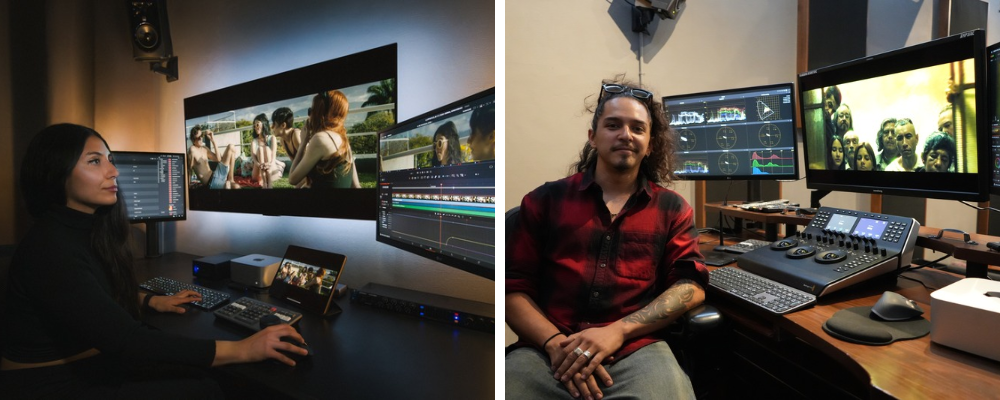
Within this collaborative structure, the Color Department plays a particularly important role. Here, artistic decisions must coexist with technical precision, image consistency, and delivery deadlines.
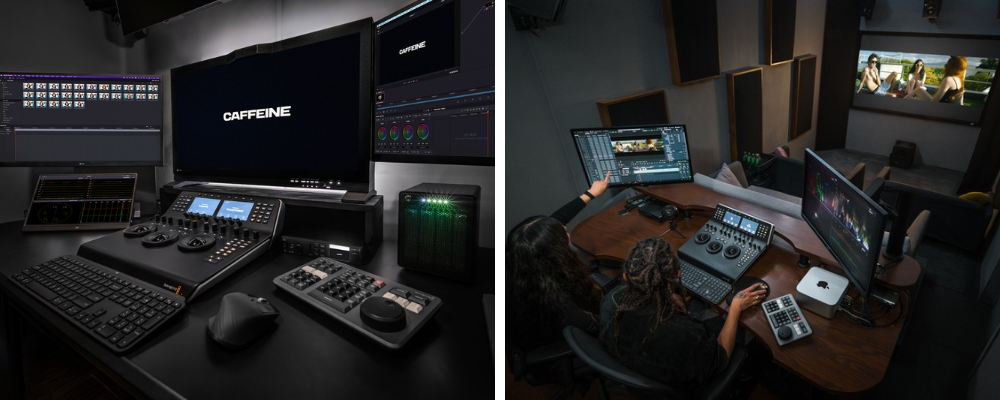
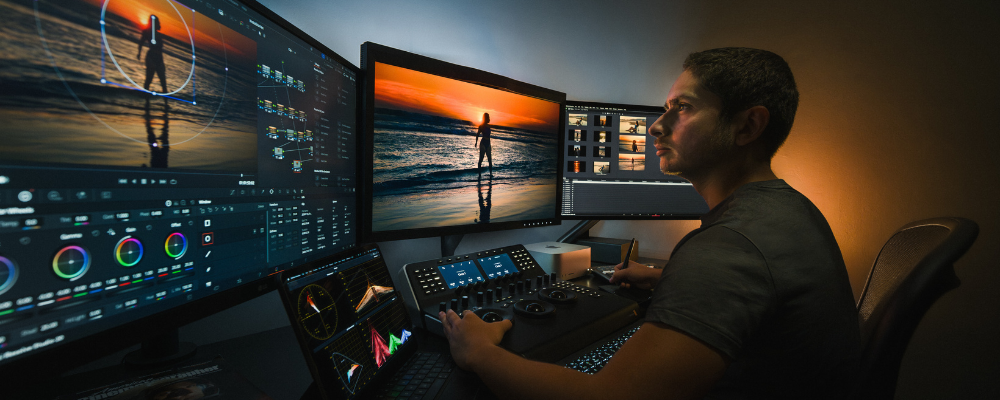
Juan Pablo Reyes, a colorist at Caffeine, works with a Blackmagic Design ecosystem that integrates DaVinci Resolve Studio, control panels such as the DaVinci Resolve Mini Panel and DaVinci Resolve Micro Panel, and video monitoring and output systems.
“The advantage of having everything integrated under one brand is, above all, the confidence of knowing that what I’m seeing is accurate, having a panel that always responds, and being able to work quickly, especially on advertising projects where turnaround times are often very tight,” he explains.
This integration allows him to focus on creative decisions without wasting time resolving incompatibilities between different tools. Panel responsiveness, image monitoring, and working within the software all form part of the same operational experience.
His previous experience as a photographer directly influences his preferences.
“The feature I like the most, and I think this comes largely from my background, is Magic Mask, because it allows me to work in layers. I can work on the model separately, the background separately, or, if it’s a product, separate it from the model,” he says.
For Reyes, the evolution of this tool also reflects the continuous development of DaVinci Resolve Studio. Updates have progressively improved its capabilities, although he believes there is still room to enhance model accuracy and reduce the need for manual intervention.
In an environment where advertising demands both speed and visual quality, this combination of automation, control, and creative freedom represents a tangible advantage.
From one format to another, without leaving DaVinci Resolve Studio
The versatility of Blackmagic Design’s tools is also fundamental to Caffeine’s advertising work.
Alain Alderete, Head of Digital Intermediate for Advertising, develops post-production workflows that must adapt to the requirements of each campaign. A single project may require deliverables in 16:9, 1:1, 4:5, or 4:3, along with specific versions for different platforms.
DaVinci Resolve Studio allows him to manage these requirements within a single environment, from the initial preparation of materials through to mastering.
In his daily work, he generates files for different departments, prepares materials for VFX artists, performs conforming, organizes color processes, and completes final deliveries.
“One of the things I personally love is that it’s divided into modules, which means that within the same environment you can do everything from creating proxies to mastering,” Alderete says.
The ability to integrate different stages within the software simplifies processes and reduces the need to constantly switch between applications.
In his workflow, conforming and color preparation can continue into VFX and conclude with mastering in DaVinci Resolve Studio’s Deliver page. He followed this process on a project he remembers particularly well: a global campaign for Electrolit developed entirely within the platform.
But his experience with the software is not limited to the studio’s productions. Alderete also uses it for personal projects involving editing, sound design, color, and mastering, demonstrating how the same tool can meet professional needs at different scales.
This flexibility is one of the aspects Caffeine’s team values most about Blackmagic Design: the ability to handle complex processes without sacrificing an accessible and adaptable working environment.
Professional technology within reach of emerging talent
The accessibility of Blackmagic Design’s tools also plays an important role in the team’s vision.
For Valencia, the evolution of DaVinci Resolve Studio has transformed the opportunities available to those looking to enter the post-production industry. The availability of a free version and access to professional tools make it possible to start experimenting without significant financial investment.
This continuity between learning and professional work represents an advantage for new generations. At Caffeine, that familiarity also makes it easier to bring new professionals into the studio. Those who arrive with basic or intermediate knowledge of the software can progress toward more specialized functions.
The combination of accessibility, training, and professional-grade tools connects directly with the studio’s identity: a young, curious team eager to explore new technological possibilities.
Real projects, different challenges
The diversity of productions handled by Caffeine constantly puts its technological structure to the test.
Flores particularly remembers her involvement in Aquí hay dragones, a film she worked on from the earliest stages of material reception and management through to final delivery.
Other challenges have included films in which some metadata had been lost for reasons that remain unknown, complicating the conforming process.
The studio also develops documentary productions, films, series, and international campaigns that require professionals from different disciplines to work together.
In the film industry, Caffeine has worked on international projects and independent productions, while in advertising it specializes in luxury and beauty campaigns. Its activities also include graphic identity, credits, motion graphics, and visual effects.
These different situations reflect the same advantage: technology allows workflows to adapt to the needs of a project, rather than forcing the project to adapt to the limitations of the tools.
A new generation, a different way of working
Beyond the screens, color grading suites, and collaboration systems, what distinguishes Caffeine is the way its team approaches work.
The historic house in Roma Norte seems to embody that philosophy. The atmosphere is relaxed, but nothing appears to be left to chance. A creative identity can be felt both in the spaces and in the way its professionals work together.
The youth of much of the team does not translate into improvisation. On the contrary, it coexists with demanding technical processes, international deliveries, and projects requiring careful coordination.
For Geyer, the future of post-production is increasingly connected to the ability to build partnerships. His vision suggests that studios can expand their capabilities by sharing resources, talent, and specialties, even with companies that might traditionally be considered competitors.
Caffeine has developed collaborations with other post-production houses and international professionals, assembling teams tailored to the needs of each production.
“We like putting together tailor-made teams,” he admits, describing a structure that combines the studio’s permanent talent with external collaborators.
Blackmagic Design technology supports Caffeine’s daily operations, but it is the people who determine the direction of each project. The real story lies in how that technology is used.
At Caffeine, innovation emerges from curiosity, the exchange of experiences, and the freedom to find solutions to each new challenge.
It is a philosophy that continues to inspire new ways of creating, collaborating, and pushing post-production beyond its traditional boundaries from that historic house in Roma Norte.
Caffeine represents a new generation of post-production studios that understands the industry’s future is not simply about adopting technology, but about transforming the way people work with it.
The integration of DaVinci Resolve Studio and Blackmagic Cloud demonstrates how collaboration can overcome geographical barriers, connect specialties, and accelerate processes without compromising creative quality.
What began as a three-person venture during the pandemic is now a studio with an international outlook, yet it retains that original drive to experiment and do things differently.
Because when technology meets talent, curiosity, and a genuine culture of collaboration, the boundaries of post-production are no longer the same.
Credits
Cover photography: LATAM STAGE
Additional photography: LATAM STAGE
The journalistic production, research, writing, editorial approach, and editing of this content are original works of LATAM STAGE and are protected by copyright.
Reproduction, copying, distribution, adaptation, or publication of this content, in whole or in part, through any medium or format, is prohibited without the prior express authorization of LATAM STAGE.


