
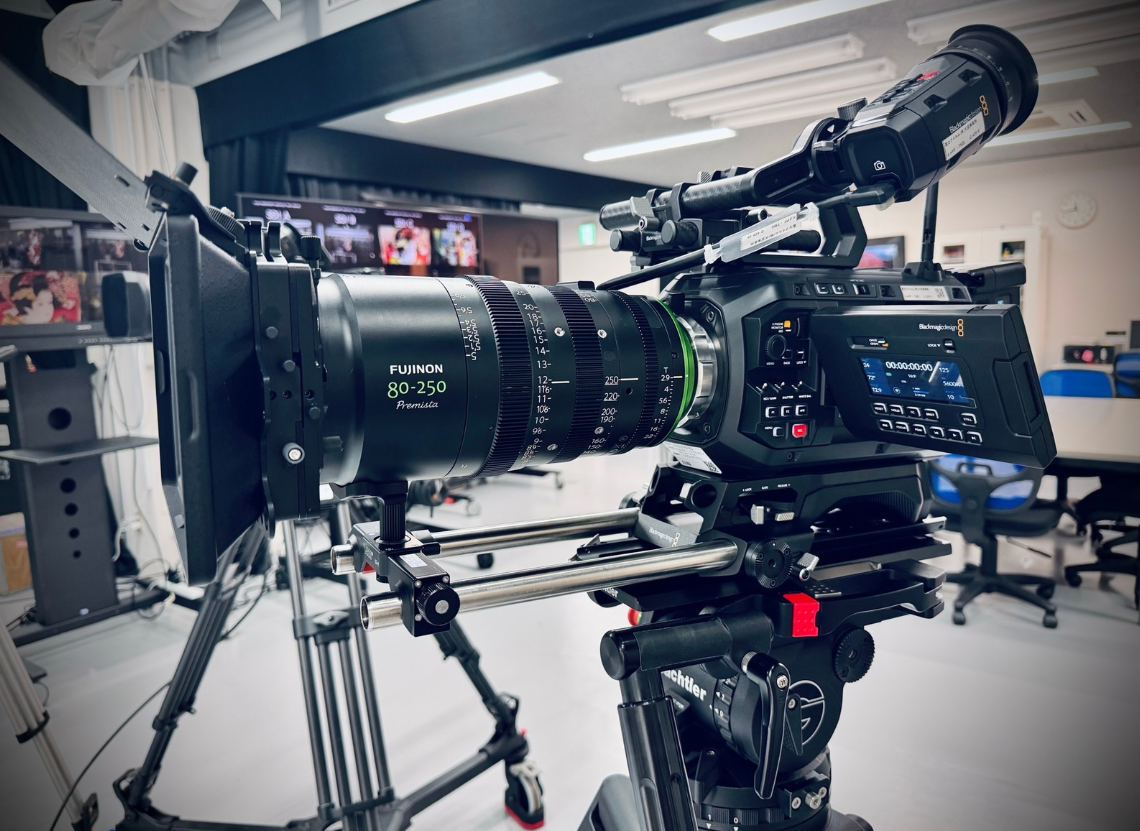
USA – Blackmagic Design today announced that a range of Blackmagic Design products, including ATEM Television Studio 4K8 live production switcher, Blackmagic URSA Cine 17K 65 digital film camera, and Blackmagic URSA Broadcast G2 camera, have been deployed at T-Lab, an in house studio operated by FUJIFILM Corporation. The products are used for a wide range of applications, including camera and lens performance evaluation, market support and in house video production.
FUJIFILM Corporation has expanded its business globally across a wide range of fields, including healthcare, electronics and imaging, building on technologies developed through its expertise in photographic film. T-Lab, operated by the company’s Imaging Solutions Division, is a studio established to evaluate and verify the performance of its cameras and lenses in an environment that closely resembles the conditions in which they are actually used by customers.
Regarding the establishment of T-Lab, Hideyuki Kasai of FUJIFILM Corporation explained: “When evaluating lenses on their own, we ensure quality through a variety of tests. However, in actual operating environments, lenses are used as part of a system together with cameras, switchers, monitors, recording equipment and other devices. At T-Lab, we have therefore created an equipment configuration that closely resembles those found at broadcasters and production companies, allowing us to evaluate product performance within an actual workflow, including video switching and monitoring. This enables us to conduct more practical quality evaluations based on the video production and operational environments that our customers actually experience.”
The company also wanted members of departments other than the technical support and development teams to make use of T-Lab. As a result, the studio has gradually been equipped over several years to support a wide range of video production tasks.
“T-Lab is intended not only for internal product evaluation and verification but also as a place where we can introduce our products and technologies to customers. With this in mind, we have been developing a more practical and attractive environment for testing and demonstrations by installing permanent subjects, upgrading the lighting equipment, enhancing the editing and viewing rooms, and consolidating and expanding the studio equipment,” said Kazuki Otani of FUJIFILM Corporation.
The cameras permanently installed in the studio include FUJIFILM cameras, as well as Blackmagic Design’s URSA Cine 17K 65 and URSA Broadcast G2. 4K video signals from these cameras are routed to a Blackmagic Videohub 20×20 12G router located in the editing room adjacent to the studio, and then distributed to the ATEM Television Studio 4K8 and various monitors.
The studio is also equipped with an extensive video evaluation environment. For example, four 4K video signals can each be down converted using Blackmagic 2110 IP UpDownCross 12G converter, enabling simultaneous display of four 2K signals on a waveform monitor. This allows routine video evaluation and comparative testing to be performed efficiently.
In addition to high precision image quality evaluation using a master monitor, a monitoring environment using a Teranex Mini SDI to HDMI 12G converter has also been established to allow the team to check how images appear on consumer televisions, providing a viewing experience closer to that of actual consumer environments.
Video output from the switcher can be recorded using a HyperDeck Extreme 4K HDR broadcast deck or captured to an editing PC via UltraStudio 4K Mini capture and playback solution. The editing PCs are equipped with DaVinci Resolve Studio as well as multiple NLE software applications, allowing the team to select the most appropriate editing environment depending on the application and workflow. The studio also supports editing and color grading using a DaVinci Resolve Speed Editor and DaVinci Resolve Micro Color Panel.
In this way, T-Lab has been equipped with an environment that supports the entire workflow, from shooting and recording to editing and even online streaming. In addition to evaluating the performance of equipment and systems, the facility can also be used for practical testing based on actual video production workflows.
Kasai explained: “Using the SuperSource feature on ATEM, we can simultaneously display images from multiple cameras on large monitors in the studio or meeting rooms, allowing us to compare the rendering of lenses and cameras under identical conditions without being affected by the performance of the monitor. One of the major advantages of T-Lab is that we can identify differences that are difficult to understand from numerical data alone by actually viewing the images.”
“T-Lab is also used by our sales and marketing teams to produce promotional videos, in addition to performance evaluation. We do not handle everything entirely in house; while we carry out simple shooting and editing ourselves, we also have external production companies come to the studio to shoot. Our team produces videos introducing new features and shares them with sales teams around the world, helping them better understand the products and providing information to customers. Blackmagic products are designed with users in mind and are easy to use, so we can operate them intuitively without having to worry about complicated controls,” said Otani.
Otani also discussed the future of T-Lab: “This studio has been built to support live streaming as well. In the future, we could connect sales offices around the world via Teams or Zoom and conduct online training while actually showing the equipment. We want to make further use of the studio not simply as a place to evaluate product performance but as a hub that can support a wide range of internal functions, including development, quality assurance, after sales support, promotion and training.”


