
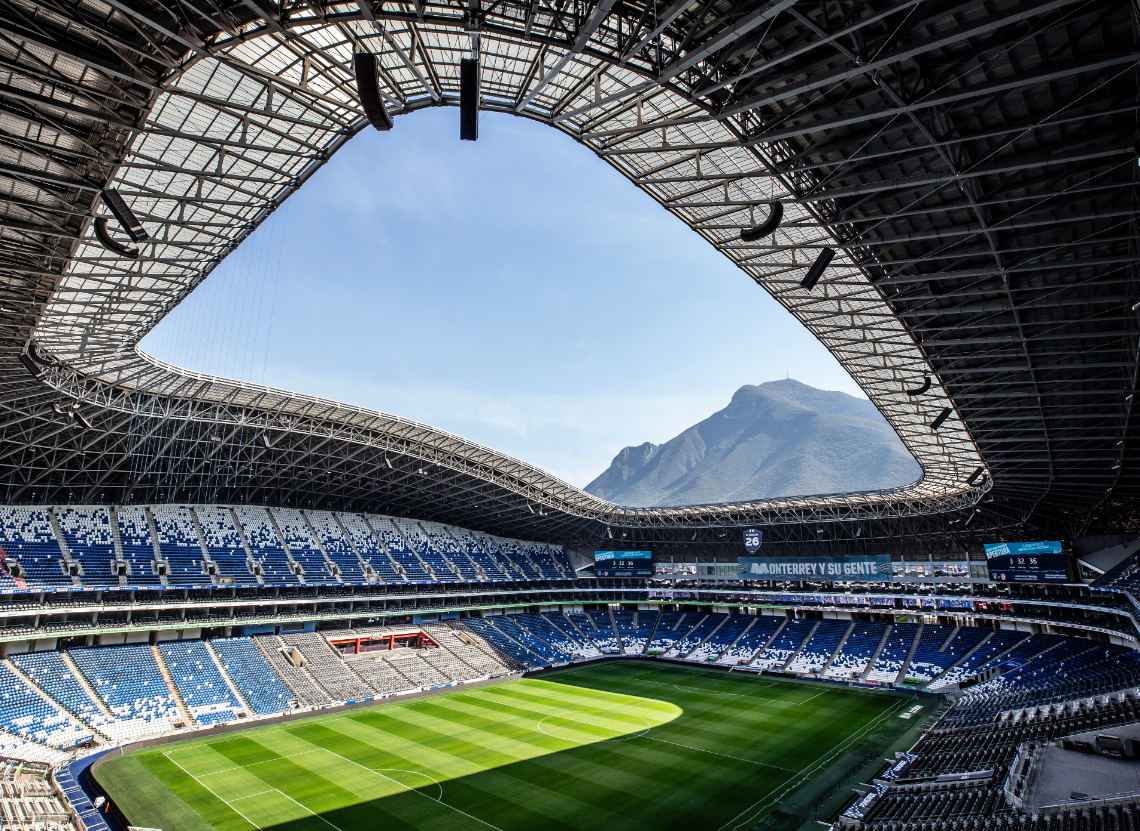
Mexico – Inspired by the industrial heritage of the Mexican city of Monterrey, by the beer and steel that shaped its identity, BBVA Stadium stands out for its aluminum façade, which breathes through “gills” that allow air to pass through, and for its views of Cerro de la Silla. Designed by the international firm Populous in collaboration with the Mexican architecture studio VFO, the venue was conceived to prioritize the comfort and visibility of its 53,500 spectators.
Opened in 2015 and known as the Steel Giant, it is home to Club de Futbol Monterrey, Rayadas and Rayados (its women’s and men’s professional league teams), and one of the most award-winning and modern stadiums in the region. Its pitch hosts local tournaments, international competitions, and concerts by the world’s biggest touring artists visiting Mexico.
Since its opening, the stadium has delivered excellent sound thanks to a Bose Professional-based system developed by the Mexican company Audio & Comfort. “Over more than 10 years of operation, the audio system has demonstrated very solid and reliable performance,” says Roberto Treviño, Head of Technology at Club de Futbol Monterrey. “Its durability and stability speak highly of the quality of the system that was originally installed.”
But today’s fans expect more. The trigger for the upgrade was clear: BBVA Stadium’s designation as one of the host venues for the FIFA World Cup 2026. Although the improvement originated from that commitment, its vision extended far beyond it: the many years of matches, concerts, and events that lie ahead for the venue.
The challenge: reinforce, not replace
As part of the process of becoming a World Cup venue, the stadium received a visit from FIFA consultants, who identified areas for improvement in several technological fields: access control, Wi-Fi connectivity, and audio. Regarding the sound system, the new regulations required a more balanced frequency response, consistent sound pressure levels, and greater low-frequency impact.
The original system, with a total of 883 loudspeakers installed throughout the stadium, including 104 RoomMatch DeltaQ loudspeakers distributed across 14 line arrays suspended from the roof and powered by PowerMatch amplifiers over a CobraNet network, remained in excellent condition. There was nothing to replace; there were simply two things to improve. The first was to provide greater power and depth in the low frequencies. The second was to solve a purely architectural issue: an “acoustic shadow.” The rows of seats in the lower bowl, located directly beneath the overhang of the suite balcony roof, were shielded by that structure; the sound from the main arrays did not reach them with sufficient clarity and, at times, had to compete with the noise from the nearby air conditioning system.
The stadium’s technology team, led by Roberto Treviño, entrusted the project to Audio & Comfort, the same integrator responsible for the original system. The choice was a natural one: no one knew the venue better.
“Our relationship with Club de Futbol Monterrey is fundamental because we understand the heart of the project. No one knows the sound system better than we do. We began this relationship sixteen years ago, and we have been here ever since,” explains Jorge López Berrueta, Director of Audio & Comfort.
An existing 3D model
The engineers at Audio & Comfort, with technical support from Bose Professional specialists, started with a decisive advantage: the stadium’s three-dimensional model had already existed in Modeler, Bose Professional’s acoustic prediction software, since the original installation. Every surface—from the metal roof to the pitch, seating, corridors, and stairways—had already been modeled. It was simply a matter of incorporating the new elements and running the simulation.
Using this model, coverage, sound pressure level, frequency response, and intelligibility, including the Speech Transmission Index (STI), were predicted before a single piece of equipment was installed. Modeler even calculated the mechanical loads that the new arrays would place on the roof and helped define the mounting hardware.
Finally, using the Auditioner auralization tool, the reinforced system was recreated sonically and presented to the club’s technicians and executives before the investment was approved.
Low-frequency reinforcement, coverage, and innovation
To inject the missing energy into the stands, 80 ShowMatch SMS118 subwoofers with DeltaQ technology were installed in 14 arrays suspended from the roof, alternating with the RoomMatch arrays from the original system. This close coexistence guarantees clean, controlled acoustic summation, accurately achieving the desired frequency response curve. DeltaQ technology allows each module to be configured to maintain consistent coverage across the entire frequency range, directing sound evenly toward the audience.
To address the acoustic shadow in the lower bowl, the solution was a system of 72 ArenaMatch Utility AMU208 loudspeakers mounted on the same ceiling that separates the seating area from the suites. With a maximum SPL of 126 dB and a constant coverage pattern of 90° vertical by 60° horizontal, they deliver clear audio to every seat without obstructing anyone’s view. Their IP55 rating and three-layer stainless steel grille ensure they can withstand Monterrey’s extreme weather conditions.
The entire reinforcement system is powered by 27 high-power, high-efficiency PowerShareX PSX4804D amplifiers with network monitoring. Management of the entire reinforcement system is handled by two ControlSpace EX-1280 processors configured in full redundancy. Audio distribution has also made the transition to the Dante protocol, which coexists with the original CobraNet network through precise latency compensation: the new and the existing, perfectly synchronized, with the door open for future expansion.
“The transition to Dante connectivity, together with the new amplifiers, has provided the system with greater flexibility, reliability, and control capabilities,” says Treviño. “Adapting to these innovations is essential, as they not only simplify day-to-day management but also make future system expansions much easier.”
As the project progressed, an additional requirement emerged: a pitch-level monitoring system so that players could clearly hear the referee after reviewing a play using the Video Assistant Referee (VAR) system, and so that those on the field before matches or during special events could clearly hear the audio being broadcast throughout the stadium.
Good communication among the specialists involved and the use of Modeler made it possible to resolve this quickly: four monitoring positions were installed alongside the team benches, each equipped with two ArenaMatch AM10 DeltaQ loudspeakers. Their highly directional coverage (10° vertical by 60° horizontal) focuses the sound exclusively onto the field, without spilling into the seating areas or obstructing the sightlines of spectators in the front row.
Rigorous system tuning
The final tuning was a collaborative effort involving the stadium’s technical staff, Audio & Comfort engineers, and Bose Professional specialists. Over the course of three consecutive days, the team captured nearly 200 measurement positions using a digital wireless microphone system: first, a comprehensive verification of the hardware, routing, and signal flow across the entire infrastructure; then, the adjustment of each loudspeaker and subwoofer, verifying their combined performance throughout every area; and finally, what no software can replace: extensive listening tests using announcer voices, different musical genres, and multimedia content.
This meticulous process, as demanding as it was necessary, completed the installation and ensured that the system performed exactly as it had been designed.
A reinforced system ready for the future
The upgraded system entered operation during the first quarter of 2026 and was tested under real-world conditions. First, during the club’s domestic league matches and during the tournament in which the national teams of Bolivia, Suriname, and Iraq competed for one of the final places at the World Cup. It successfully passed the final evaluation conducted by the governing body’s inspectors.
But the real result is measured in years, not tournaments. Today, the stadium delivers exceptional acoustic performance in every seat: the same quality, the same power, the same immersive experience, from the front row to the highest section of the venue. And for the club, perhaps the most valuable achievement is also the quietest: nothing had to be replaced. The investment made eleven years earlier has been preserved and integrated into a more comprehensive solution that is better prepared for the future.
The sound system upgrade complemented other major improvements: a high-density Wi-Fi network supporting more than 30,000 simultaneous users, the modernization of the access control system, the renovation of the VIP suite, and a state-of-the-art pitch maintenance system.
“All of these actions are part of a comprehensive vision aimed at enhancing the experience of our fans, which is the primary motivation for both Club de Futbol Monterrey and BBVA Stadium,” concludes Roberto Treviño.
Because a stadium is not upgraded for a single tournament. It is upgraded for all the nights that come afterward.
Reinforcement system installed
• ShowMatch SMS118 subwoofers (×80, 14 arrays) for low-frequency reinforcement
• ArenaMatch Utility AMU208 loudspeakers (×72) for coverage of the lower-bowl seating area
• ArenaMatch AM10 loudspeakers (×8, 4 positions × 2) serving as pitch monitors for VAR audio and special events
• PowerShareX PSX4804D amplifiers (×27)
• ControlSpace EX-1280 processors (×2)
• Dante network operating alongside the original CobraNet network


