
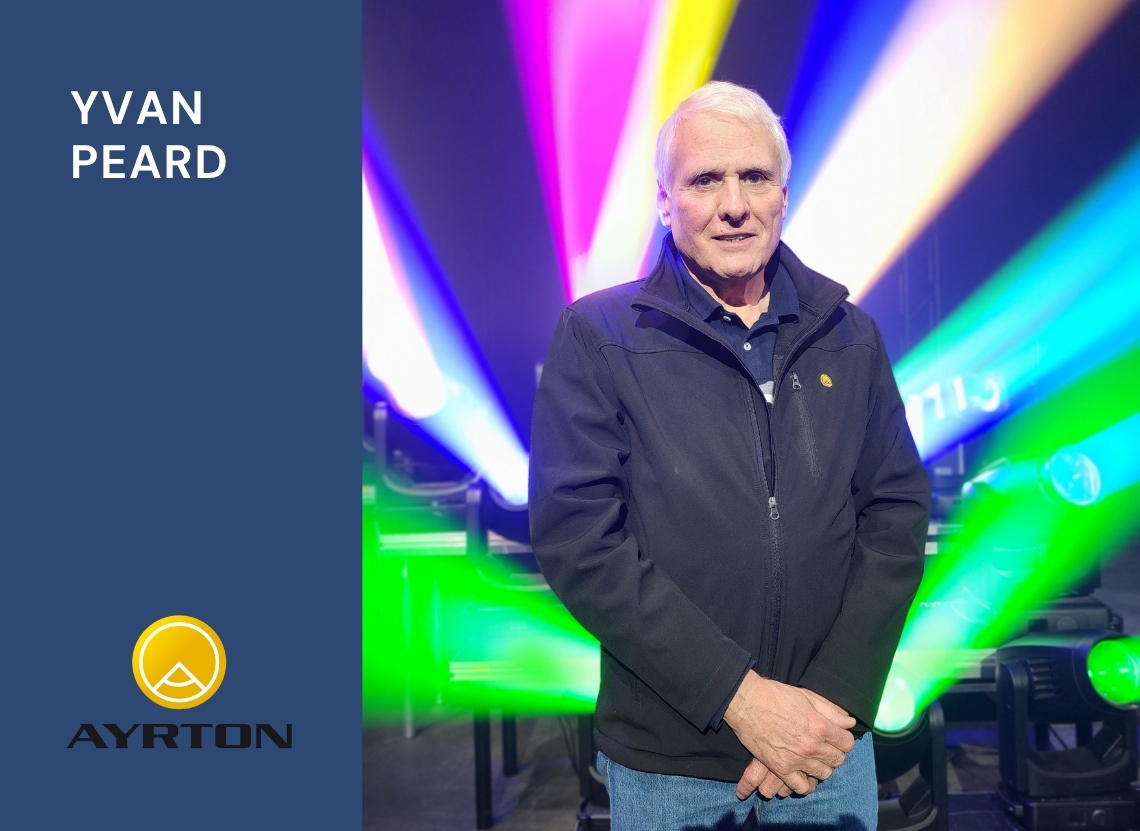
In an industry where light multiplies, AYRTON stands out with its own character. Advanced technology, design with identity, and a clear philosophy: not to follow trends, but to create them. At the forefront is the restless mind of Yvan Peard, a visionary who turned his obsession with light into a brand that defines the course today.
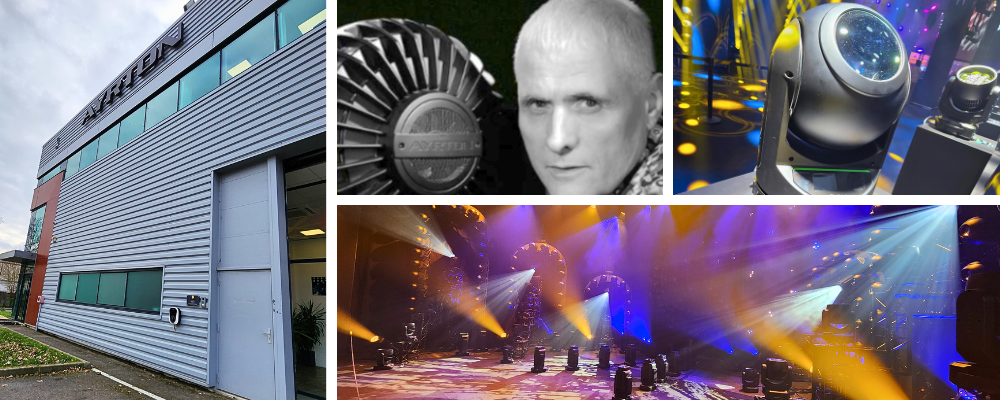
Amidst the technological frenzy and the avalanche of new luminaires, AYRTON stands out for something that cannot be manufactured: a vision. Coherent, daring, and with its own signature, it has managed to forge a path where each luminaire tells a story.
Behind this coherence lies a constant obsession with detail, with true innovation, and with a vision that was born long before the brand: that of its founder, Yvan Peard, a mind that sees light not just as a tool, but as a language.
Born in France, in an environment deeply marked by engineering and innovation, Peard grew up taking apart objects to understand how they worked. “Since I was little, I had a fascination with knowing how things worked,” he says. And that would lead him decades later to become one of the pioneers of the use of LEDs in entertainment, but the path there was anything but linear.
In his childhood, he was captivated by cinema, and in his adolescence, he was mesmerized by the world of nightclubs. “The lights, the sound, the atmosphere… that whole universe captivated me.” His passion for mechanics, design, and technology soon merged with his love of the stage, and thus began to take shape what would become his life’s work.
The story began to be written in a movie theater, when Yvan was just seven years old. “It was a revelation. Cinema still fascinates me 60 years later,” he confesses. That early connection with the image, the atmosphere, and the emotion projected on the screen ignited a spark that never went out.
Today, in addition to being a leading lighting expert, Peard is an avid cinephile, with an endless film collection and his own catalog system, which he revisits daily as a ritual to unwind. “It’s my way of returning to the roots,” he says. Because in every light fixture he designs, there is also a sense of framing, narrative, and atmosphere: light as a visual, almost cinematic language.
At 14, he discovered something else: nightclubs. In those spaces filled with vibrant lights and immersive music, he found something more than just nightlife. “I was fascinated by the combination of light, sound, and atmosphere. So much so that I dropped out of school to explore it fully,” he recalls with a mischievous smile. Thus began his journey into a universe where the technical and the sensorial coexist on stage.
His first formal step came in 1981, when he joined Ever Radio Violette France, a projector distributor. For more than a decade, Yvan Peard navigated the world of distribution, representing prestigious brands, learning from the inside the ways of an industry that was just beginning to transform.
But something didn’t quite fit. “I always had a penchant for creating, for designing. There came a point where simply selling other people’s products wasn’t enough,” he admits.
Before founding AYRTON, Yvan had extensive experience as a distributor. He represented brands such as Coemar and High End Systems, although over time, those experiences began to feel restrictive.
“They actually limited me and didn’t allow me to truly achieve what I wanted,” he confesses. It was this dissatisfaction that pushed him to break the mold and embark on the path toward his own creations.
After years as a distributor of various lighting fixtures, he was already dissatisfied with his role in the industry. In this context, a Chinese company offered to manufacture an improved copy of a popular moving head at the time.
The proposal was tempting, but he rejected it. The reason? He didn’t want clones. “I wasn’t interested in clones; I was determined to create my own products,” he explains. This desire for true innovation led him to design the first EasyColor and EasyColor 2 prototypes, pioneers in the use of LEDs, although still limited in intensity.
The need to go further took shape, until frustration with certain suppliers became a driving force. “I felt I had to make my own products if I wanted to achieve what I imagined,” he says.
Thus was born AYRTON, a brand with its own name, full of admiration and purpose: a tribute to Ayrton Senna, the driver who represented for him the perfect blend of technique, emotion, and vision.
The name was registered as a tribute to his idol and a declaration of principles.
The founding of AYRTON not only responded to a technical need, but also to a deeply personal impulse. “If you want to be special, you have to do something special,” Peard admits.
But the birth of AYRTON was not without its setbacks. In 2001, just as the new stage had begun, a conflict or with an Eastern European manufacturer forced Yvan Peard to abruptly cut ties and rethink the entire business from scratch. “It was an unexpected blow. I had to rebuild the project from the ground up,” he admits.
That experience marked a turning point: it consolidated a philosophy based on resilience, technological independence, and an almost artisanal obsession with quality. The path, however, was not a straight line.
In 2008, the company was on the verge of closure, and Peard went through moments of great uncertainty with his partner Xavier. After several failed attempts at partnership, he once again trusted Golden Sea, a decision that would prove crucial. “WildSun was the first product we made with them,” he recalls. And it would be that model that, shortly after, would change the course: in Berlin, the WildSun 500C won a comparison against top-of-the-line luminaires, thanks to its optical system developed in France, its larger emission surface, and a warmer native color temperature, and became the luminaire of choice for Bruce Springsteen’s tour.
Since then, AYRTON’s evolution has been as steady as it is unstoppable. From a start-up with local ambitions, it has grown into a major global player.
Among the most iconic milestones are its participation in Céline Dion’s world tour in 2008, its inclusion in Bruce Springsteen’s shows in 2012, and, above all, the launch of the revolutionary MagicPanel 602 in 2013. “It was a key piece in showing the market what AYRTON could do. Technically and visually, it made a difference,” Peard notes proudly.
AYRTON’s consolidation as an innovative brand was cemented by concrete achievements. The international success of the MagicPanel 602 not only raised the bar in terms of design and performance, but also introduced a collimation optic that allowed for incredibly narrow light beams, difficult for other brands to replicate. “It was a true revolution. That optic protected our business, because no one could easily match it,” Yvan emphasizes.
That development also marked a turning point in the company’s history. In 2012, AYRTON made a strong entrance into the US market with Morpheus, which boosted global demand and positioned the brand as a creative leader. “We went from being almost unknown to everyone wanting to work with our equipment. It was the turning point we’d been searching for,” he recalls.
Validation came from the big players. “They chose us because our luminaire had a larger surface area and special collimators that improved the zoom,” he reveals about Bruce Springsteen’s decision.
Later, an unexpected request for a Paul McCartney event marked another milestone: “They asked us for 167 MagicPanels, but Golden Sea required a minimum purchase of 500. I was afraid of losing the order… but we ended up making them all.” That bold, and somewhat risky, gamble ended up consolidating one of the brand’s most iconic models.
With an approach that prioritizes quality, innovation, and reliability, the brand has positioned itself as an undisputed leader in the high-end segment. “We are a high-end brand with selective launches. Our reputation is built on creativity, advanced technology, and reliability,” he summarizes clearly.
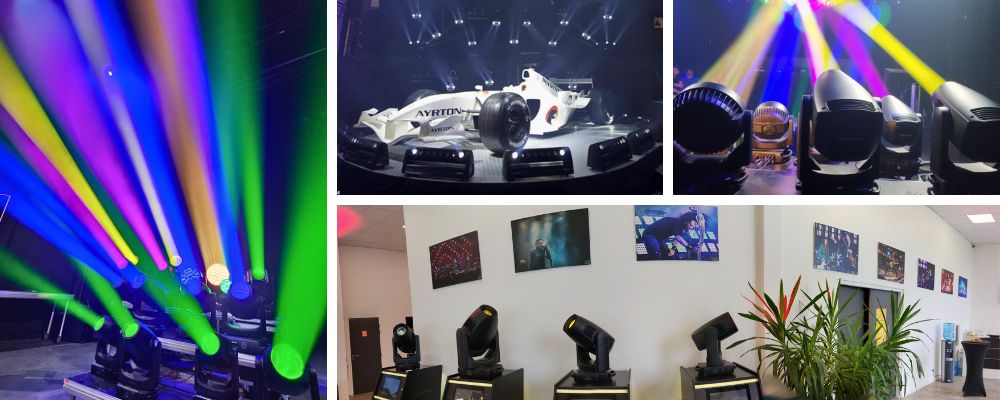
From idea to product.
This solidity is also reflected in their product development process. Each new luminaire is born from active listening to the market, focusing on the real needs of users. “We anticipate trends, but not only that: each new launch must offer something truly innovative. We don’t develop for the sake of development, but to transform,” he explains. Constant field validation is an essential part of this process.
For Peard, inspiration doesn’t come from a single source. Industrial design, motorsports, film, and technology constantly fuel his imagination.
But it’s not just about aesthetics: “The goal is to offer unprecedented tools to lighting designers,” he says. “Creativity is a compass, but always based on the user.”
An emblematic case were the first products, such as EasyColor (2003) and its improved version, EasyColor2, which were pioneers as LED moving heads in a time before the LED boom. Although they didn’t sell very well, they demonstrated Peard’s determination not to settle for market copies: these were luminaires designed to innovate from the ground up.
To achieve an iconic product, the process is not individual but collective. “Lance Liu has been key, with over 15 years of continuous collaboration. Alongside him, a multidisciplinary team of engineers, designers, and technicians, based in France and led by Cyril Union in Research and Development, form the creative core. The collaborative structure allows each luminaire to be the result of a shared and technically robust vision,” he details. Call it with pride.
And as in all processes, there are milestones. Peard highlights key advances such as the NandoSpotSC, a 20,000 lumen white LED spotlight, the result of two years of working with Gaggione on patented optics, and the WildSunK25, capable of replacing 4,000W HMI equipment while consuming only 2,600W.
Without a doubt, both fixtures are already classics and reflect the obsession with efficiency, optical precision, and responding to real market demands.
The names of the luminaires are not random: they are part of the soul of each product. Peard finds a constant source of inspiration in his personal passions—motorsports, film, and music. “Each name reflects the character of the device. For example, Cobra evokes power and precision,” he confirms. “Thus, the emotional impact translates into identity, differentiating each model with its own meaning.”
Behind that name lies an extensive process. From the initial idea to market launch, the development of a luminaire can take between 12 and 18 months. It involves design, prototyping, rigorous testing, and constant adjustments. “We usually have between seven and ten projects in parallel,” he confesses.
More than twenty years after its inception, AYRTON not only maintains its innovative drive, but also renews it with each product generation. Yvan’s vision for the future is clear. “We want to continue surprising with revolutionary luminaires, reinforcing our global leadership,” he asserts.
“We were pioneers in LED solutions long before they became standard. Our mission has always been to push the boundaries,” he says. With more than 70 luminaires under its belt, AYRTON not only evolved the market: it helped transform it.
Along the way, collaborations with lighting designers and partner companies have been key for AYRTON. Far from being an isolated process, product development thrives on direct dialogue with those who use them in the field. “This brings fresh ideas, new perspectives, and allows us to create tools that respond to real needs,” he asserts.
AYRTON’s positioning on iconic tours was also due to strategic alliances. For example, in 2012, Morpheus Lights discovered the WildSun 500C in Berlin and used it on Bruce Springsteen’s tour, thanks to its intensity, compact size, and warm temperature, combined with improved optics and zoom. And from that moment on, global adoption was unstoppable.
The Road Ahead
Regarding the future of digital lighting, Peard projects an increasingly strong convergence with digital technologies. “We are moving toward smarter and more interactive control systems, where laser sources will be the protagonists,” he anticipates.
Like any innovative company, AYRTON also faces its own challenges. The most important thing today is to maintain quality without sacrificing speed or the capacity for innovation. Added to this is the growing pressure to develop more efficient and sustainable products, in line with an increasingly conscious market. “Energy efficiency is no longer an option, it’s a necessity.”
And it has demonstrated this by taking a technological leap forward with the Kyalami, its first IP65 luminaire with a laser source in the Creative Solution series. It is compact and only 265 mm long, integrating a 100W laser module, a three-lens optical system projecting a beam of just 1°, and a luminous flux of up to 400,000 lux at 10 m. This minimal sphere, with a 126 mm lens, incorporates high-definition CMY progressive mixing, 29 metal gobos, two rotating prisms, and even frost filters, all in just 14.5 kg.
Yvan defines it as the beginning of something new: “Laser technology is a new starting point,” he insists, presenting what he already considers “a generation capable of doing almost anything” in professional lighting.
This vision also translates into concrete decisions. Sustainability is not only a declared value, but a strategic axis for the brand. All products are designed with low consumption and a long lifespan in mind. “It’s essential for the future of the industry, and for ours as well,” she reflects.
Inclusion is also part of AYRTON’s DNA. Peard recognizes the fundamental role of women in the lighting industry and notes that the company actively promotes equal opportunities. “Including more women in our development teams isn’t just fair, it’s necessary,” she asserts, and encourages their participation through training programs and an internal diversity-oriented policy.
The team around Peard shares a common code: passion, curiosity, and the ambition to constantly improve. From her position as leader, she seeks to foster an environment where new ideas are welcomed, mistakes are not penalized but understood as part of the creative process, and where collaboration is lived as a value, not a slogan.
“A creative culture is built when everyone feels valued.” He emphasizes.
To ensure that each product meets the expectations of those who use it in the field, AYRTON works closely with all stakeholders. The processes include testing in real-life conditions, direct feedback from technicians and artists, and continuous adjustments based on user experience.
What sets AYRTON apart from other brands? For Peard, the answer is clear: “We don’t follow trends, we create them.” This commitment to uncompromising innovation has been the guiding principle from day one. Every product the company launches seeks to offer something new, and its catalog reflects a unique technological identity that isn’t afraid to break the mold.
His enthusiasm remains undiminished: Peard anticipates more efficient lighting fixtures with better light control and designed from a sustainable perspective. “It’s an ambitious project that will mark a new milestone for the brand,” he concludes with conviction.
And coming from him, the promise is no less.
At AYRTON, every ray of light is also a declaration of principles. And behind every luminaire, there is a story of design, perseverance, and vision.
Yvan Peard knows this well: “We don’t follow trends, we create them.”
That’s why, as the industry advances, AYRTON doesn’t just keep up: it sets the pace.


