
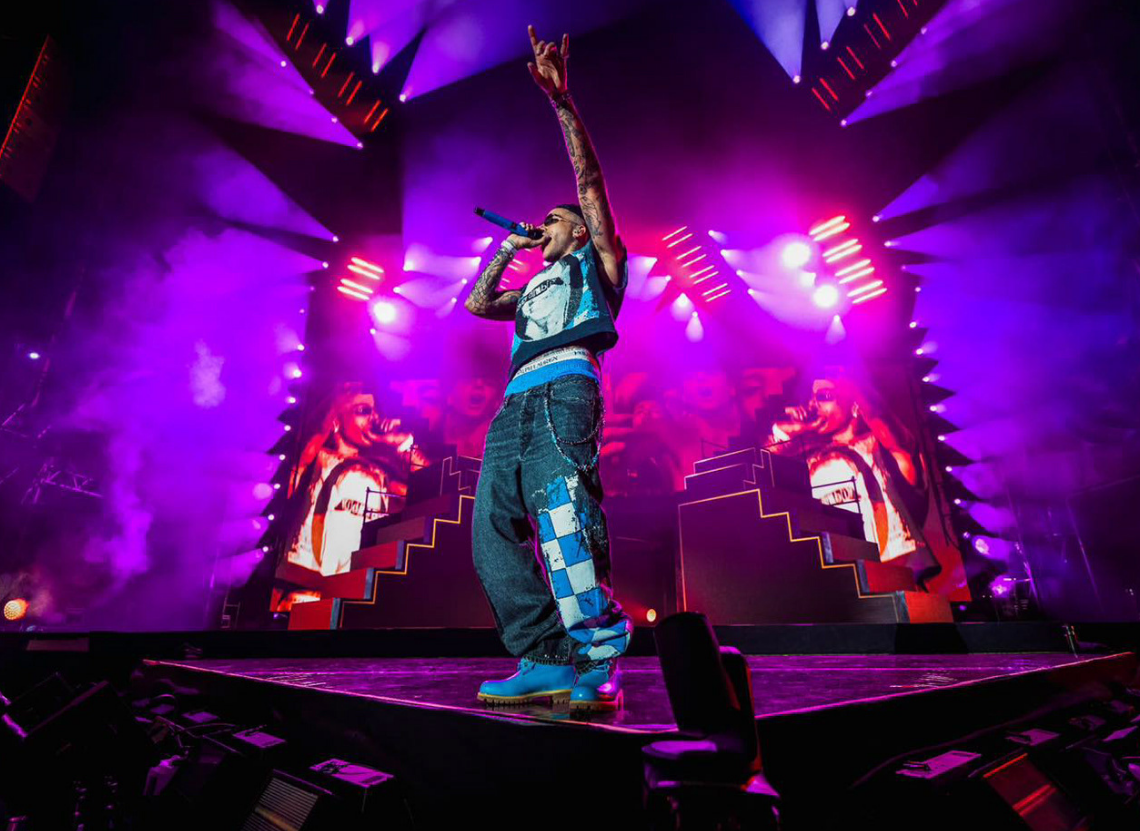
Italy – Italy’s best-selling artist of the 2010s took his 2025 Palasport Tour to packed arenas across the country with additional dates added in Florence and Rome to meet demand after shows sold out. Underpinning the tour’s striking visual identity was AV Stumpfl’s PIXERA four media server, providing the backbone for an ambitious real-time content system created by two of Milan’s most forward-thinking creative studios, SUGO Design and GATE1 Studio.
Sfera Ebbasta’s rise to fame has been one of Italian music’s great success stories. Since the release of his debut album XDVR in 2015, which achieved double Platinum certification from FIMI (Federazione Industria Musicale Italiana), every subsequent release has reached number one on the Italian charts. He also holds the record for the most number one singles in the country’s history. For the 2025 Palasport Tour, the brief for SUGO and GATE1 matched that stature: to create a world-class visual production capable of competing with major international rap and trap tours.
SUGO Design, a Milan-based studio specialising in motion design, video production and live visuals. Led by creative director Andrea Gallo, SUGO was responsible for defining the show’s visual concept, the aesthetic framework and the core content language of the production, translating Sfera Ebbasta’s artistic identity into a cohesive stage language.
While SUGO developed the creative direction, visual concept and core content language for the show, GATE1 Studio expanded the system through real-time Notch processing and interactive visual treatments. “GATE1 Studio was brought onboard by SUGO Design, the studio responsible for the overall AV creative direction of the tour,” says Lorenzo Venturini, Notch designer for GATE1 Studio.
The stage design centred on a multi-screen LED configuration, which included a large central backdrop, integrated IMAG side screens and LED-clad stairs. This complex multi-surface canvas demanded both creative ambition and technical precision. Across those surfaces ran a blend of hyper-realistic 3D environments, abstract graphics distorted in real time and live feeds of Sfera Ebbasta processed through Notch with effects including pyro simulations, particle systems and colour grading. “The goal was to create a maximalist visual experience that blended trap aesthetics, digital architecture and real-time interactivity,” says Venturini. “We wanted to transform the stage into a dynamic ecosystem where visuals weren’t just a backdrop. They needed to become a living extension of the artist’s energy.”
Providing the technical backbone were AV Stumpfl’s PIXERA four media servers, brought into the production by systems integrator STS Communication and programmed on the tour by Andrea Bampa. PIXERA four is a compact 4U media server supporting a maximum output resolution of 5120 x 2880, with options for uncompressed 4K/8K60 4:4:4 content playback and a responsive interface designed for complex 2D and 3D workflows. “PIXERA was chosen for its ability to handle heavy workloads with extreme reliability,” says Venturini. “Its intuitive interface for mapping complex surfaces and the fluid integration of Notch playback makes it the ideal partner for generative design.”
The wider toolset included Adobe After Effects, Cinema 4D and AI-assisted production, with Notch running natively within the PIXERA environment. Visuals originating with SUGO Design were processed through Notch for real-time interactivity and post-processing. Then, they were placed directly into the PIXERA timeline, mapped to the LED surfaces and synchronised via timecode with audio and lighting. Keeping that pipeline tight under live conditions was the key challenge. “PIXERA allowed us to maintain nearly instant response times, all while managing a high number of video layers without frame rate drops,” says Venturini, “and that was crucial for show synchronisation.”
PIXERA’s pre-visualisation capabilities also proved a significant asset in rehearsals. “The speed of pre-visualisation drastically reduced programming time,” Venturini notes. “Less time was spent on technical troubleshooting, and that meant we could spend more time dedicated to creative refinement.” That investment in preparation paid off on the road. The system performed with the kind of stability that gave both crew and artist confidence at every show.”
“Working on a project of this scale with tools like PIXERA and Notch redefines what is possible in an Italian tour,” says Venturini. “It pushes the production bar to an international level.”


