
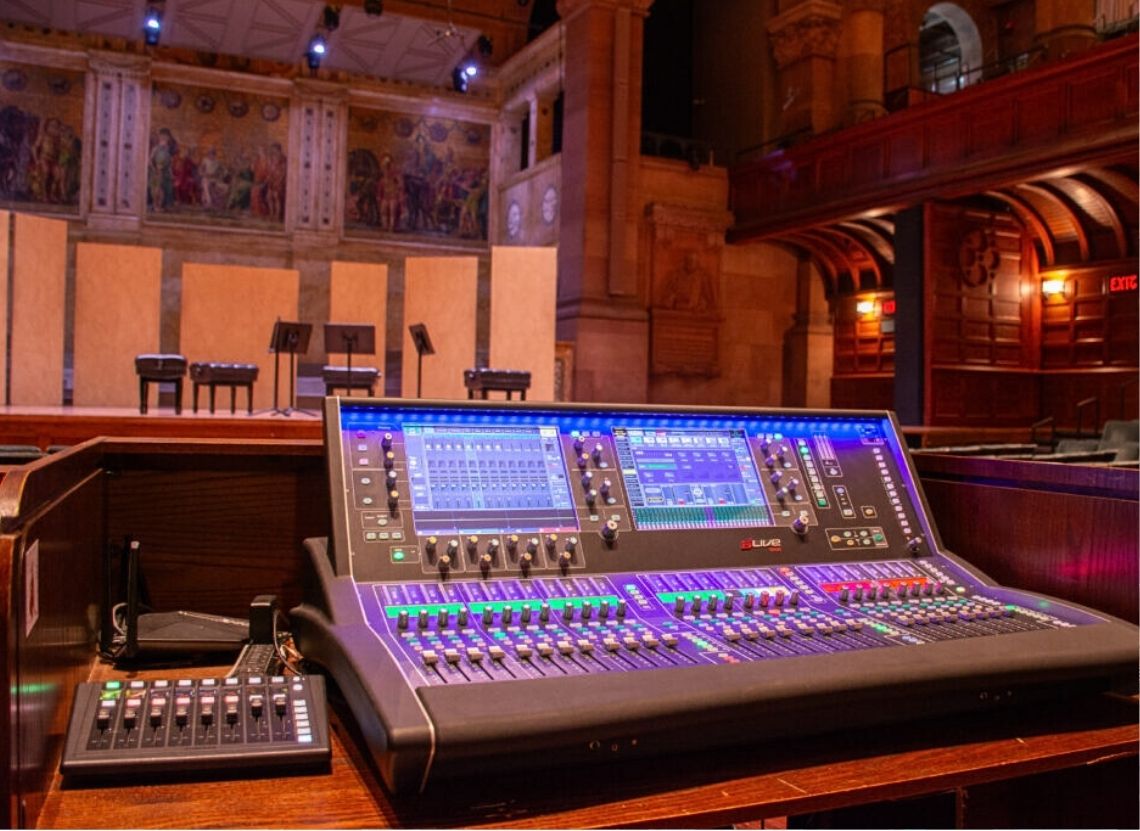
Princeton University’s Performing Arts Services department oversees several performance venues on campus, including a main 800-seat concert hall, several black box theaters, and a smaller performance space in the student union building.
Lucien Dowdell was brought on as the department’s production manager in 2020, and was immediately tasked with overhauling the campus’ aging audio equipment. “I met with the various production teams – the crews actually working with the gear,” recalled Dowdell. “It became clear to me that, with such a diversity of performances, we needed some versatility.”
The university’s main concert hall is host to many classical and chamber music performances, which are unamplified. Other times, the venue features events with greater technical demand – such as discussion panels, film screenings, and fully amplified Jazz and Big Band concerts.
If Dowdell had opted for a one-size-fits-all console solution, it would have required a member of the technical staff to be present during all performances – even those that were unamplified – since it requires operating a full-fledged mixing console to control simple wireless microphones. “In the old system, there wasn’t much flexibility in how we approached these different types of events,” Dowdell recalled. “I wanted to view things more holistically and use current network audio technology to make us adaptable for each performance.”
Dowdell had previously worked as Director of Production for a small AV company, and had some familiarity with Allen & Heath products. “I had used the SQ series mixers before and really liked them,” he recalled. When seeking a solution for Princeton, Dowdell decided to research Allen & Heath’s current offerings. “I watched every video the company published over COVID, and had some discussions with our team – eventually, that’s where we landed.”
The final system for Princeton’s main concert hall now features a dLive S5000 control surface, with 28 faders and dual 12″ touchscreens; and a DM0 MixRack, which handles up to 128 channels of 96kHz audio processing and 64 fully configurable busses. Dowdell opted for dLive for its power, value, and intuitive workflow. “The dLive platform is just way more user friendly compared to other consoles out there,” he noted. “It also costs considerably less than other consoles at that level.” The dLive is fed by multiple DX stageboxes strategically positioned around the venue, and a gigaACE card in the console allows digital splitting to an SQ mixer that can be used for monitor mixing if needed.
Using a Dante expansion card, the dLive console feeds its outputs to an Allen & Heath AHM-64 matrix processor, which is key to the system’s new flexibility. “The AHM is really the last mile, and touches the outputs of every audio source in the venue,” explained Dowdell. Depending on the type of performance, the production team can recall different presets on the AHM to have it take input from the dLive console (in the case of an amplified performance), or simply act as a standalone mixer for wireless handheld mics during conferences or classical performances when the conductor wants to address the audience.
“We have a preset lovingly called ‘HH Talk’, which activates 2 handheld microphones already fully rung out and some floating room mics,” explained Dowdell. “All of that happens in the AHM, and we don’t have to think about anything else.”
The AHM-64 at Princeton acts as a central audio hub, feeding outputs to the concert hall’s main PA, assisted listening system, lobby, streaming system, and two-track recorder – each being different Zone outputs within the AHM.
For non-technical users to control the AHM, Dowdell and the production team have set up a mix of hardware and software controls – including Allen & Heath IP controllers and Custom Control, which is Allen & Heath’s free software to design custom interfaces. “We have an IP8 controller at front of house and another one in the recording booth, and they are basically mirror images of each other,” explained Dowdell. The IP8 is a customizable hardware controller with 8 motorized faders, 8 LCD channel screens, and multiple configurable buttons. “The IP8s allow us to control and mute the individual wireless handheld mics, and they also can adjust the control group that we’ve set up to adjust all mics simultaneously. Another group controls all the PA speakers in the hall, and a third one controls the lobby speakers.”
The AHM can also trigger safety announcements at specific times throughout the day, or manually using the IP8 controller by recalling a preset.
Despite the complex nature of the new system, Dowdell noted that setting it up was a breeze. “The nice thing about working in a venue like this is that we can constantly go back and make adjustments if needed,” he explained. “We are frequently fine tuning to ensure that the various system controls do what we need, and thankfully this system keeps us flexible as our needs change.”


