
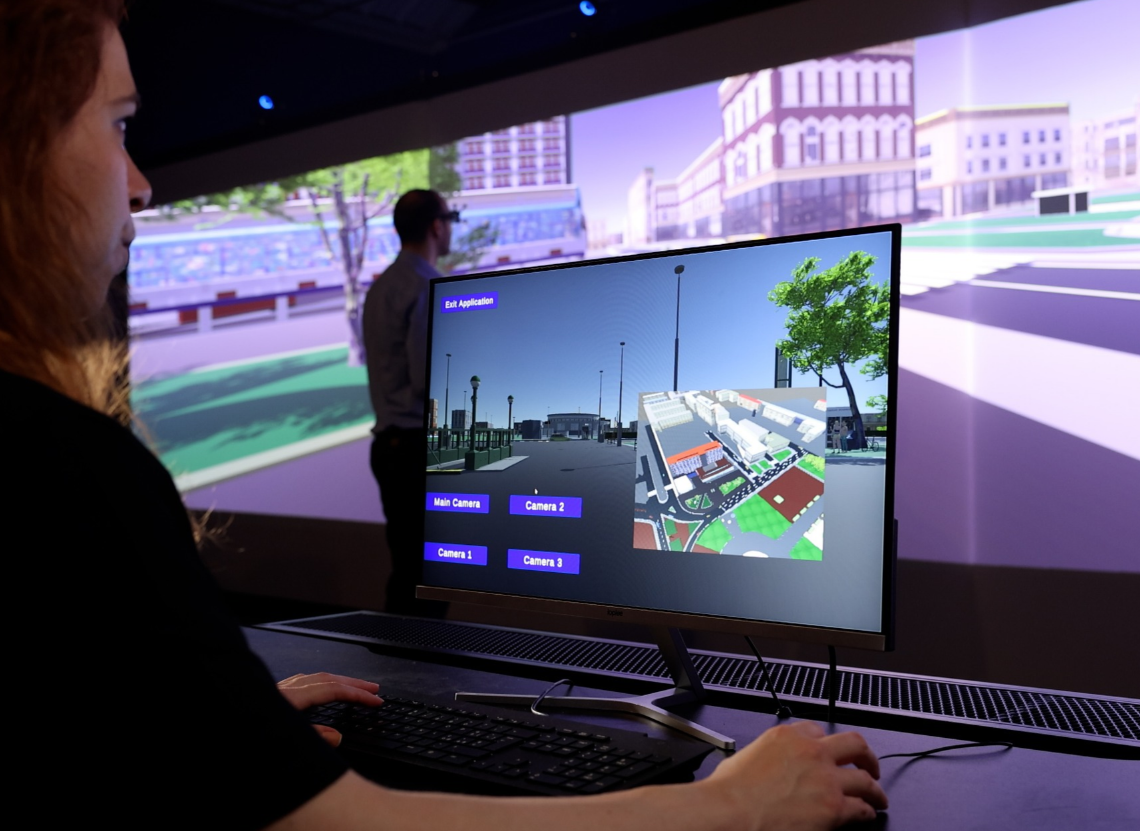
Italy – The University of Bologna has introduced IRIS (Immersive Reconfigurable Interaction) System, a new immersive visualisation facility at its Forlì Campus, designed to support research and education at the Department of Industrial Engineering and developed in collaboration with ST Engineering Antycip (Antycip).
The new infrastructure allows researchers and students to experience, analyse and interact with complex systems and future concepts at full scale. IRIS can operate as a fully immersive CAVE or be adapted for large-scale visualisation. Its research applications include Urban Air Mobility, Human–Machine Interfaces, aircraft cabin design and passenger comfort, full-scale digital prototypes, training and collaborative operations.
The facility was funded through Italy’s National Recovery and Resilience Plan (PNRR), financed by the European Union – NextGenerationEU, and forms part of the National Center for Sustainable Mobility (MOST), Italy’s largest research programme dedicated to innovative mobility. IRIS was developed in collaboration with Antycip, which provided and integrated the immersive visualisation system in accordance with the scientific, educational and technical requirements identified by the University of Bologna research team.
“This infrastructure further strengthens the exceptional experimental capabilities of the University of Bologna”, said Francesca De Crescenzio, Associate Professor at the Department of Industrial Engineering. “It reflects the idea that innovation and tradition are not in contrast with one another; rather, they complement each other.”
One area already being explored through IRIS is the evolution of aerospace systems and Human–Machine Interfaces. Researchers can use virtual reality to experience and assess technologies and interface concepts before they become physically available, helping to inform their development.
“Virtual reality plays a key role by enabling end users to experience and evaluate new technologies and interface concepts long before they become physically available”, said Sara Bagassi, Associate Professor at the Department of Industrial Engineering. “This not only helps users better understand future operational concepts but also provides valuable feedback that can inform and improve the design process.”
The development of IRIS brought together the scientific expertise of the University of Bologna and the technical contribution of Antycip, with the aim of creating a flexible environment capable of supporting different research and educational applications.
“This is a project we are particularly proud of”, said Andrea Gimbo, Business Development Manager for Italy at Antycip. “As our first CAVE delivered in Italy, it represents an important milestone for our team. From the outset, the project was about understanding what the University needed from the environment and creating a system flexible enough to support very different research applications. Seeing IRIS now being used to support real research and future innovation is incredibly rewarding.”
For education, research and industrial collaboration activities at the University of Bologna’s Department of Industrial Engineering at the Forlì Campus, immersive simulation makes it possible to rehearse procedures, compare alternative configurations and study human interaction with complex systems without the cost or constraints of building each scenario physically.
The new facility can also support interdisciplinary activities, connecting engineering knowledge with the study of user experience, ergonomics and operational decision-making.
Immersive simulation supports education, research and collaboration with industry at the University of Bologna’s Department of Industrial Engineering on the Forlì Campus. It allows researchers and students to rehearse procedures, compare alternative configurations and study human interaction with complex systems without the cost or constraints of building each scenario physically.


