
Poland – The 1920 Battle of Warsaw Museum has completed a large-scale immersive AV installation designed to recreate the atmosphere of one of Poland’s defining historical conflicts. Located within the newly constructed Polish Army Museum pavilion, the system integrates a complete HARMAN Professional ecosystem—featuring FLUX::, JBL, Crown, BSS, Soundcraft, AKG and AMX—to support interactive exhibitions, multimedia storytelling and live cultural programming.
At the core of the installation is FLUX:: SPAT Revolution, a spatial audio platform that shifts the experience from traditional playback to immersive storytelling. Selected early in the design phase, the system allowed the project team to develop and refine spatial sound environments well in advance of installation. With SPAT Revolution, the team was able to test, evaluate and optimize soundscapes remotely—streamlining onsite commissioning while maintaining a cohesive creative vision.
“One of the key advantages of FLUX:: SPAT Revolution was the ability to complete most of the spatial design work before arriving on site,” said Mateusz Nawrocki of ESS Audio, the system integrator. “We collaborated closely with the composer, building and reviewing spatial mixes in advance using binaural previews. This approach not only saved significant time during installation but also ensured the final sound experience was already well defined and aligned before deployment.”
The FLUX:: system also enables designers to position and move sound objects dynamically throughout the exhibition, recreating battlefield elements such as aircraft movement, cavalry charges, explosions and shifting troop positions. Rather than being constrained by fixed loudspeaker playback, the system provides the flexibility to shape how sound behaves within each space, helping overcome acoustic challenges while maintaining realism and clarity.
FLUX:: SPAT Revolution also proved essential in addressing architectural challenges within the museum. In areas where the loudspeakers are predominantly installed in the ceilings, it allowed audio elements to move convincingly across the visitor space rather than appearing to originate from above, creating a more immersive and natural listening experience.
“SPAT Revolution is very easy to integrate with video playback and other show-control systems, making it a practical tool for multimedia installations,” Nawrocki explained. “Besides creating realistic soundscapes, its high-quality reverbs and spatial processing let us change the acoustic feeling of a room. We can make a space sound larger, more intimate, or more atmospheric, depending on the artistic vision, without changing the physical installation.”
Outside of the FLUX:: system, the museum entrance hall features two JBL CBT 1000 column loudspeakers, four JBL CBT 70J + 70JE-1 column speakers, ten JBL AC16 compact loudspeakers and four JBL Control SB2210 subwoofers arranged in two half-ring configurations. One ring incorporates CBT models for consistent, even coverage, while the second integrates AC16 loudspeakers divided across four themed rooms, supporting both dynamic and static audio scenes.
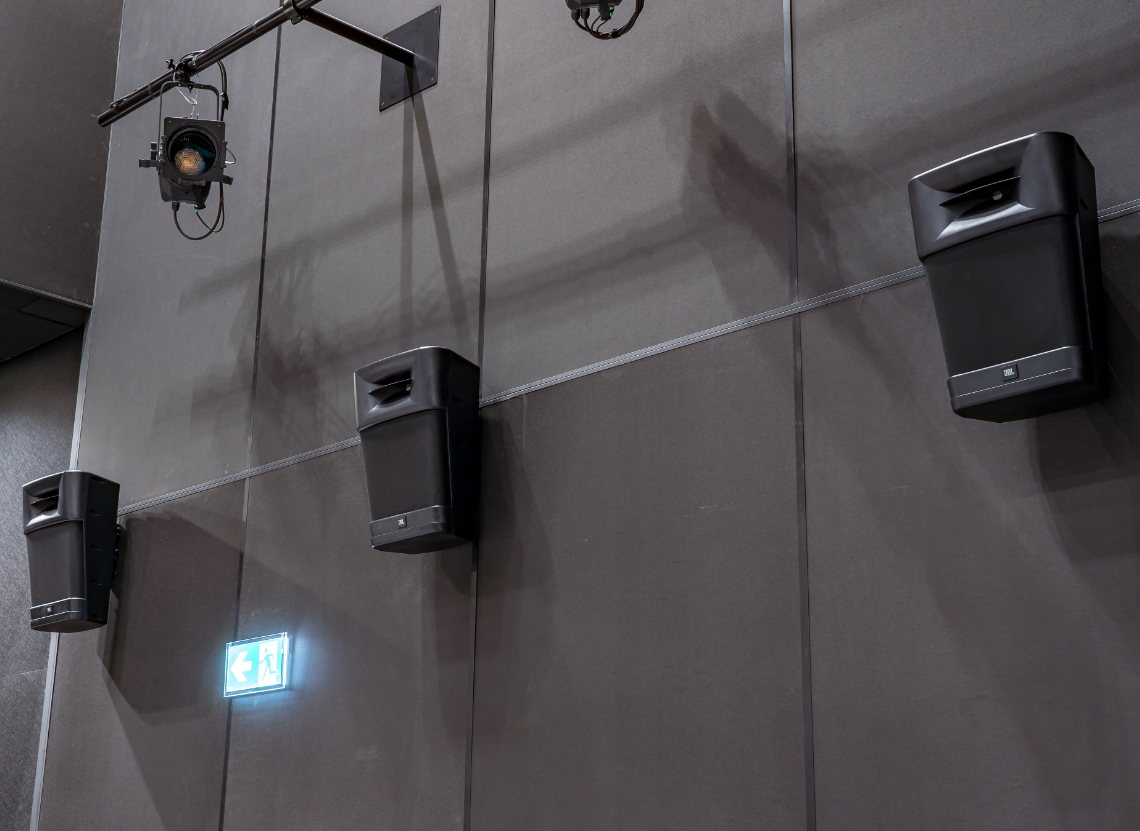
In the main exhibition hall, the system incorporates 14 JBL Control HST loudspeakers, six JBL CBT 70J-1 column speakers and four JBL Control SB2210 subwoofers, delivering consistent sound as part of a programmed audio experience that runs independently within the exhibition environment. Supplementary JBL Control Series models, including Control 25-1, Control 60PS/T and Control 67P/T loudspeakers, provide localized reinforcement for specific exhibits, while Crown DSi amplifiers ensure stable and consistent amplification across all zones. System routing, tuning and distribution are managed through BSS BLU-101 and BLU-160 processors with Dante integration, enabling reliable performance across multiple exhibition areas.
The installation also includes a multi-functional performance space equipped with a JBL SRX900 Series system, featuring 14 JBL SRX906 line arrays, and four JBL SRX915 subwoofers. Additional JBL 9300 Cinema Surround Series loudspeakers provide distributed coverage, supporting lectures, presentations and cultural programming. Si Series Soundcraft mixing consoles enable flexible live sound operation, while ten AKG microphones support speech and event use.
System control and distribution are managed through AMX solutions, including NMX encoders and decoders, VARIA touch panels and TPControl integration, enabling centralized management of presets, routing and system operation across both exhibition and performance spaces.
“In our exhibition, visitors can feel as if they are standing in the middle of a battlefield,” said Nawrocki. “This creates a much stronger emotional connection and helps them imagine the fear, tension, uncertainty, and determination that people experienced. Instead of simply observing the exhibition, they become part of it for a moment.”
With the installation complete, the 1920 Battle of Warsaw Museum now offers a sound-driven interpretive experience that enhances historical understanding while supporting education, commemoration and cultural engagement. By combining immersive spatial audio with flexible system design, the integrated HARMAN Professional solution positions the museum as a contemporary destination for both remembrance and public interaction.


