
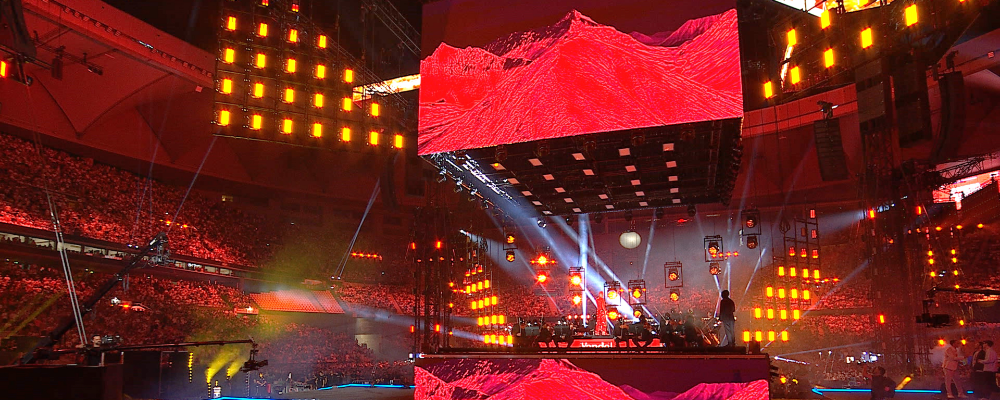
With a ring at the center of the stadium, around 80,000 spectators, nearly 30 cameras, and a broadcast lasting more than eight hours, the lighting design for La Velada del Año VI had to work simultaneously for the audience and the broadcast. Toni Llobet, lighting director and DOP of the event, incorporated 100 CHAUVET Professional Color STRIKE M fixtures into moving structures capable of changing position and orientation, multiplying the resources available within a production also constrained by weight, scale, and the specific requirements of each fight.
A show without a single front
Designing lighting for a stadium already means working with unusual distances and dimensions. At La Velada del Año VI, there was also a condition that completely changed the logic of the project: there was practically no front.
The ring occupied the center of the space and around 80,000 people surrounded it. The design had to work from every section of the stands and, at the same time, function for a multi-camera production that Toni Llobet, lighting director and DOP of La Velada del Año VI, estimates involved around 30 cameras.
“The big challenge we have with this design is that it has to work from every angle. It’s a 360° show, with a ring in the middle and 80,000 people around it,” he explains.
That immersive nature influenced many of his decisions. While on a conventional stage it is possible to establish a main direction and build the design around it, here every section of the stadium needed to receive visual stimuli.
Within that architecture, Toni specified 100 Color STRIKE M fixtures from CHAUVET Professional, incorporating them into a structure that had to provide impact and variety without compromising the system’s physical limitations.
A decision conditioned by weight
The large central structure had a specific load capacity, and the design already concentrated a considerable amount of equipment. The closer a fixture was positioned to the center, Toni explains, the greater the impact of that weight on the structure.
That ruled out a simple solution: installing independent fixtures aimed in every direction.
“I couldn’t place fixtures facing in every direction because I had to limit the amount of equipment. That’s why I looked for one with tilt movement, which would allow me to direct it from the console to one side or the other depending on what I needed at any given moment.”
The ability to modify the tilt of the Color STRIKE M thus became a tool that allowed the same physical position to respond to different directions. It was not simply about achieving a particular effect. The choice made it possible to solve a creative, structural, and economic issue simultaneously.
According to Toni, achieving similar coverage with fixed positions would have required considerably multiplying the number of fixtures.
“It’s a fixture that gives me flexibility in that sense. If I had to replace it, I would need four times as many fixtures to cover the entire stadium, and I couldn’t do that because of weight or budget.”
And this was within a production that, according to the designer’s own estimate, ultimately brought together nearly 1,500 fixtures in total.
100 Color STRIKE M fixtures distributed around the structure
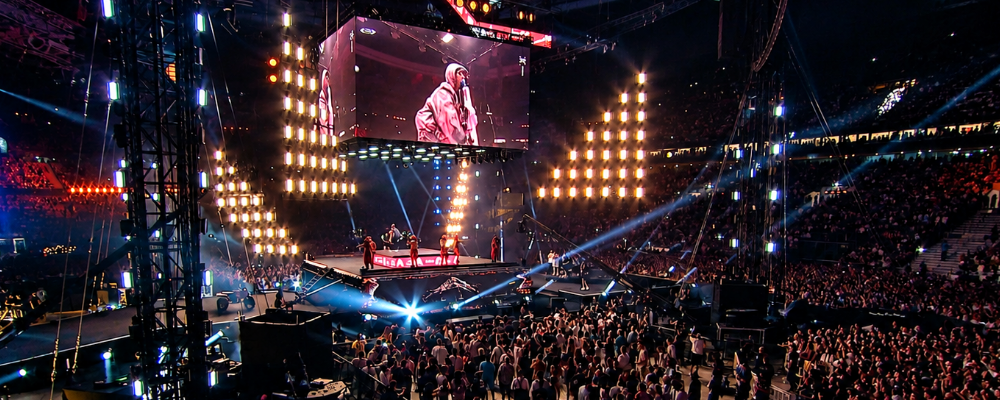
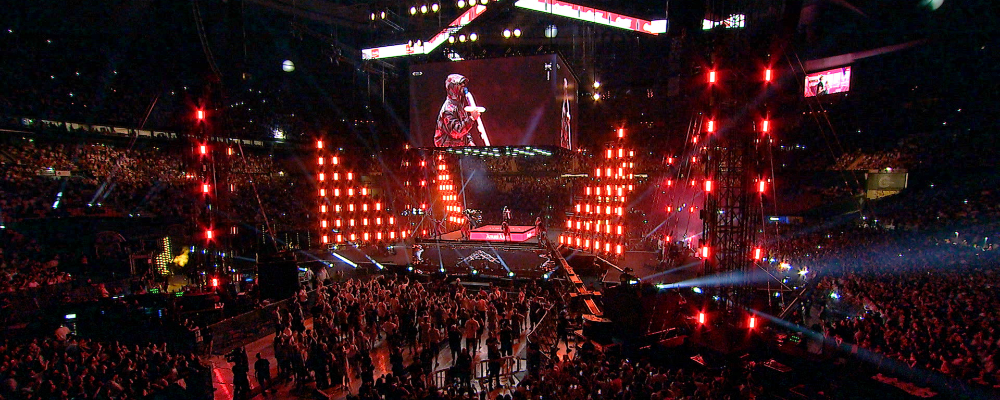
The Color STRIKE M fixtures were distributed across different grids connected to the four legs of the large central structure. Their arrangement made it possible to change their orientation depending on what was happening in the stadium. They could direct the light inward or outward, work toward specific sections, or combine positions to create different compositions.
One of the configurations developed together with the programmers was internally named “chess.”
The idea was to alternate the orientations so that, when visually moving around the structure, there would always be Color STRIKE M fixtures facing different directions.
“If you go all the way around the 360°, you always have strikes looking at you,” Toni recalls, laughing.
They could also move forward and backward, direct the units toward the tunnel, or concentrate them on a specific section. Tilt therefore ceased to be simply a feature of the fixture and became a fundamental tool in the 360° composition.
Movement, programming, and perspective
The visual construction went even one step further. The grids did not always remain at the same height. During the interview, Toni shows how he could keep some structures raised and others lowered depending on the point of view from which he wanted to build the image.
Programming completed the effect. Certain units could be turned off from the console to clean up the composition and make the different structures appear to fit together when viewed from a specific field.
The result, therefore, did not depend exclusively on the movement of the Color STRIKE M. The physical height of the grids, the tilt of the fixtures, whether they were on or off, and the viewing point were used together.
Perspective became another design tool within a space where the same structure could offer different images depending on the section of the stands or the camera from which it was viewed.
Disappearing during the fight
La Velada combines entertainment and sport, and those two worlds require practically opposite lighting behaviors.
During the fights, the sports team established strict conditions to avoid distractions. Although the participants are streamers and content creators, Toni emphasizes that the fights are treated according to professional boxing standards.
“During the fight, we can’t have lights that distract, we can’t have strobes. It has to be a fixed white light. The solution was to make much of the effects lighting disappear completely. That’s why the grids where the Color STRIKE M fixtures were installed were mounted on variable-speed motors. During the fights, they could remain raised and hidden within the structure, leaving the central area visually clean.”
The final bell completely changed that situation. “At the end of the fight came the awards ceremony, artists, or shows with performances as if it were a theater, beneath the panels. Only then did lighting effects appear everywhere.”
It was a physical transformation of the design: the rig did not only change through programming; it changed its own geometry in front of the audience.
The Color STRIKE M fixtures could also face the camera
Toni’s experience as a director of photography is particularly evident in the relationship he establishes between the fixtures and the cameras.
The objective was not only for the stadium to look good from the stands. Each shot needed to find enough visual information behind the protagonists, something particularly complex in a production where the cameras could look in practically any direction.
The Color STRIKE M fixtures were integrated directly into that strategy. The team programmed positions that allowed the fixtures to be concentrated within a specific camera field.
“I had a button on the console that, if I pressed it, all the strikes would point toward the field where the camera was.”
For a few seconds, Toni could deliberately sacrifice the perception of part of the audience to create a particularly powerful shot for the broadcast: “For these five seconds that I have the camera shot, all the strikes look at the camera. The people in the stadium don’t see them, it’s five seconds, and as soon as the camera goes to a close-up, I press it again and the strikes go back to facing everyone.”
It is a programming detail that helps explain much of his philosophy for La Velada: the in-person experience and the broadcast are designed together, but they do not necessarily have to receive exactly the same thing during every second of the show.
And it was the mobility of the Color STRIKE M that allowed him to temporarily give priority to the camera and immediately afterward restore the 360° operation.
When specifically asked what the Color STRIKE M’s features contributed to his creative design, Toni returns to the camera image. “It allows me to always keep the shot full of information.”
The broadcast of this edition lasted approximately eight and a half hours, and that also changes the criteria Toni uses when selecting a fixture. “I have eight hours to entertain people, so I need fixtures that give me more than one option per fixture.”
Flexibility ceased to be merely a creative possibility and also became a tool for adaptation.
A tool Toni would specify again
After explaining how he had integrated the different fixtures into La Velada, the question was inevitable: given the result, would he specify those models again to address similar needs? Toni’s answer was direct: “Without a doubt.”
Toni became interested in lighting at a very young age, later trained as a director of photography, and today combines both worlds in projects where camera and light are closely connected.
He also acknowledges a growing influence of architecture on the way he designs. Perspective, lines, scale, and perception appear repeatedly when he explains how he built La Velada.
The Color STRIKE M fixtures are a good example. They were not used merely as a light source or as an effect repeated one hundred times. Their position, movement, height, and direction were integrated into a composition that changed depending on where the spectator was located or where a camera was looking.
And that relationship between technical resources and visual intention connects with the way Toni defines his own work: “What I always say is that what I love is making art with technology. If you give me a piece of paper, a canvas, and a brush, everything is horrible. All my art comes through technology.”
At La Velada del Año VI, that technology had to handle an entire stadium.
And the 100 CHAUVET Professional Color STRIKE M fixtures became one of the tools Toni used to transform the same rig again and again: hiding it, making it appear, changing its direction, building patterns, filling camera shots with information, and then returning the lighting to the 80,000 people surrounding the ring.
Credits
Cover Photo: La Velada IV YouTube / La Marga
Inside Photos: La Velada IV YouTube / La Marga
The journalistic production, research, writing, editorial approach, and editing of this content are original works by LATAM STAGE and are protected by copyright.
No part of this content may be reproduced, copied, distributed, adapted, or published, in whole or in part, in any medium or format, without the prior written authorization of LATAM STAGE.


