
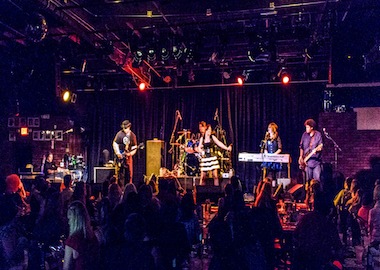
For more than 30 years, legendary venue The Coach
House Concert Theatre in San Juan Capistrano has hosted an ongoing roster of
regional and international artists. Until recently, the 480-seat hall has also
struggled with a notoriously poor sounding room. As ESP Management\’s Brian
English explains, the room\’s acoustical challenges have been legendary.
\”The room is very difficult,\” English begins.
\”It has a low ceiling, and the stage is asymmetrically placed, so there\’s
a larger seating area at house left than at house right. The areas near the bar
are underneath a very low ceiling because of VIP booths upstairs. So it\’s very
difficult to cover the place evenly. The house mix position is up in the
balcony, which was horrible with the original PA system because the engineer
was out of the coverage area and couldn\’t hear.\”
Addressing those challenges would require a new approach,
and English collaborated with Coach House management and Renkus-Heinz\’s Ralph
Heinz to design a new sound system based on the digitally steerable IC2 (IC
Squared) from Renkus-Heinz. English points to IC2 as the ideal solution to meet
the room\’s unique challenges.
\”A lot of acts specify a line array, and the Coach
House team wanted to be able to meet that need,\” he notes. \”But
because the ceiling is so low, you can\’t really do a conventional line
array.\” Together, English and system installers DJE Sound and Lighting of
Lake Forest, CA were able to meet the challenge. \”I flew four clusters of
two Renkus-Heinz IC2 steerable arrays per cluster, mounted close to the ceiling
so we didn\’t have sightline issues,\” English continues. \”We were able
to focus each array exactly where I wanted them to go. You can have up to four
steerable beams out of each enclosure, so we were able to take one tight beam
and shoot it right through the windows of the VIP area without it splashing all
over the wall around the window. We focused a beam at the face of the engineer
upstairs, so for the first time in 30 years, you can hear the PA from the mix
position.\”
The main left/right system on the downstage corners fires
straight out. The secondary left/right cluster is 10 feet upstage, toed out at
a 45-degree angle, focused as outfills. \”If you walk around the room past
the four clusters, you will hear left-right-left-right, so you\’re always
hearing the stereo image in the seated areas,\” English explains.
Six Renkus-Heinz IC212S-R subwoofers are positioned in
the center, under the stage, providing low frequency content for the main
left/right system. Under the stage at the outside corners are two aux-driven
IC118S-R powered subwoofers, each with a single 18-inch driver, extending the
bottom well below 30 Hz. \”The stage is a four-inch-thick concrete slab, so
low-frequency buildup and resonance weren\’t a problem,\” says English.
Onstage, ten Renkus-Heinz RH123 cabinets provide
crystal-clear stage monitoring. The RH123 is a self-powered, three-way
loudspeaker in an enclosure as compact as most two-way designs. Featuring a
dual-angle (30 or 45 degrees) cabinet, it makes an excellent low-profile,
unobtrusive floor monitor.
Both English and venue owner Gary Folgner are delighted
with the results. \”I was really impressed with how well we were able to
cover the entire place,\” says English. \”I can\’t name another system I
could have put in that would have done what the Renkus-Heinz system did. In
addition, its footprint is perfect; it didn\’t interfere with the sightlines,
which occur at several angles. And because of its powerful output, we were able
to hit SPL levels that they\’ve never heard in that room before.\”
In fact, the client\’s only complaint was that the system
was too loud. \”Fortunately,\” laughs English, \”That\’s easily
fixed with a fader.\”


