
For more than 25 years, the Red
Hot Chili Peppers have been closely linked with Dave Rat
who has manned the live concert mix for the Grammy Award-winning quartet since
1991. During that period, Rat has successfully grown his own tour sound company
(Rat Sound) and been awarded two patents for innovative live sound products. As
of February, however, the celebrated engineer has now passed the reins of
mixing the band to Sean “Sully” Sullivan, another industry veteran having most
recently manned front of house for Rihanna, Atoms For Peace and Beck.
Camarillo-based Rat Sound
is continuing to provide the FOH control and monitor package for the band’s
current Getaway World Tour, as well as the PA system for all of the band’s US
dates. For the current trek, Sullivan is mixing an all-L-Acoustics system that
he designed along with systems engineers Jim Locker and PA tech Radek Lesa. The
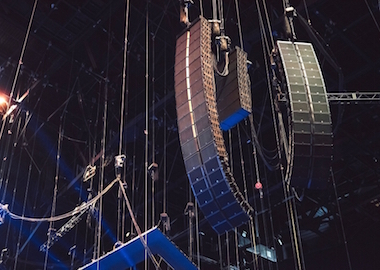
system consists of two main hangs of 16 K1 over
four K2 per side each flanked by eight K1-SB. An additional 16 K2 per side are
flown as side hangs, with 15 Kara per side delivering coverage to
the 270-degree wraparound seating areas.
The flown K1-SBs are complemented by
18 new KS28 subs arrayed in six ground-based
blocks of three, each deployed in cardioid mode, while six Kara situated across
the tops of the subs serve as front-fills. Each flown “Rat cage” per side
contains nine LA-RAK incorporating 24 LA8 amplified controllers, while on the
ground one LA-RAK and one LA-RAK II per side house three LA8 and
three of the new LA12X amplified controllers,
respectively.
As Sullivan stepped into the RHCP
FOH position, he quickly made it his own. “Dave and I have different approaches to the equipment—he was all analog
and I am all digital,” he says, quickly establishing what distinguishes
each mixer’s philosophy, with Rat’s Midas Heritage console and Sullivan’s Avid
S6L emblematic of their different approaches. “But my thinking is to always use what you’re comfortable with and what
makes you confident you can get the job done while also keeping the band
comfortable on stage.”
A major challenge that Sully has to
address each and every show is minimizing the LF energy on stage, while at the
same time keeping this energy—plus the definition of Flea’s bass—in the house.
This challenge is addressed by minimizing the number of KS28 subs on the ground
in front of the stage while at the same time reinforcing the LF energy in the
air by incorporating the K1-SB arrays next to the K1.
Deploying a cardioid configuration
on the ground minimizes the back wave substantially, which helps to address any
LF energy buildup around lead singer Anthony Kiedis’ voice. The interaction of
flying the K1-SB in the air next to the K1 allows for greater directivity in
the LF domain while creating an asymmetric LF coverage pattern steering energy
away from the onstage axis and concentrating it more in front and to the
offstage side of the audience.
“The fans
know the records by heart, and it’s my job to convey that to them,” says Sullivan, who first used K1
when he mixed Atoms For Peace back in 2010. “This PA does that every night without fail. And while the band is
using IEMs, they love the power that it puts out on stage. It’s not too loud,
but they can feel it. Like Flea’s signature Fender Jazz Bass, the L-Acoustics
PA is virtually another instrument—one the fans have come to know from shows
over the decades—and has become part of the band’s experience.”


