
Since opening its doors in 1996, Liverpool
Institute for Performing Arts (LIPA) has become one of the leading performing
arts schools in the UK, if not the world. Founded by Mark Featherstone-Witty
and Sir Paul McCartney, the school emphasizes a multifaceted and holistic
approach to training in the arts.
\”Our view is that every student should attain
some knowledge of all the individual disciplines that make a performance
possible,\” explains Jon Thornton, Director of LIPA\’s School of Sound
Technology. \”While they study their chosen major in depth, including
management, stage design, lighting, and sound engineering, they also have to
develop a working vocabulary in each of these areas.\”
This integrated approach does much to prepare LIPA
students for real-world situations, says Thornton. \”We create an
environment that\’s as professional as possible. It\’s all about
interdisciplinary collaboration; it\’s as important for a sound engineer to
understand what it\’s like to stand on stage as it is for an actor or musician
to understand what it is like to mix at front of house.\”
The school is well equipped with several tracking
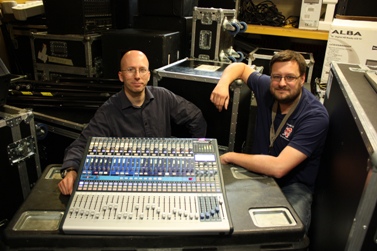
and mixdown rooms, and it recently added a StudioLive™ 24.4.2 digital console
to its arsenal. \”We\’ve got a fair amount of studio equipment, and a fair
amount of live sound equipment,\” Thornton says. \”But the StudioLive
filled a perfect niche for us. First, it gave us something with a small
footprint, which was great for lectures and events where a large desk is
overkill. But more importantly, it blows away the boundary between a live desk
and a recording console. The way you can quickly and easily plug in a laptop
and capture multitrack audio for all kinds of gigs is great for us.\”
The school has a number of high-end recording rooms
but Thornton says the StudioLive fills a different role. \”We\’ve got six
studios with consoles ranging from SSLs to Icons,\” he observes. \”But
if a musician or an engineer says \’we don\’t want to sit in a studio, we want to
track in, say, this vibe-y church we found somewhere,\’ it\’s really, really easy
to just take the StudioLive and a small laptop rig to do tracking almost
anywhere.\”
For live performance, the console is equally
useful. \”We do a lot of one-off shows: intimate cantina gigs for around
100 people. The StudioLive is perfect for those, and we\’re now able to record
every gig. And we\’ll be taking it along for a ten-day music festival we\’ve got
coming up as well.\”
\”The user interface on the StudioLive is
great,\” Thornton adds. \”It\’s a very intuitive, visual and tactile
approach, with hands-on faders and a simple workflow that\’s easy for students
to grasp. And the Capture application is clean and simple and doesn\’t get in
the way of the spontaneity of the live mixing process.\”
Thornton concludes, \”the StudioLive may not be
the solution for everything we do, but it\’s a great solution for a lot of
things we weren\’t able to do easily before.\”


