
In a building that has captured some of the most influential recordings in modern music, a brand approaching its centennial chose to listen to the future once again. Shure turned Village Studios into the starting point of a new chapter for professional recording, unveiling the new KSM Studio Mic line in an event filled with pure experience and rock ’n’ roll.

There are places where history is not told — it is heard. The Village Studios, in Los Angeles, is one of them. A building constructed in 1922 that transitioned from a Masonic temple to a recording sanctuary, where generations of artists shaped albums that defined eras. In that setting, charged with mystique, technique, and sonic memory, Shure — a brand with 100 years of history — decided to write a new chapter.
And it did not choose just any studio to present its new KSM microphone line. It chose a symbol.
For Brooke Giddens, Global Marketing at Shure, the decision was fully aligned with the essence of the product. “We chose Village Studios because it embodies the same values that shaped the KSM line: craftsmanship, quality, and an unwavering commitment to sound. It has been home to decades of iconic recordings, and its rooms have witnessed and refined the sound of generations of artists.”
Walking through Village means crossing decades of music production. Demonstrating a microphone in that environment means accepting a high standard. “This event allowed the microphones to be heard in a space trusted by some of the most important artists in the world. It is a studio that sets a very high level of expectation.”
The experience was deliberately immersive. During the event, attendees were able to listen to recordings made inside the studio itself using the new microphones. No isolated demonstrations or abstract comparisons. Brooke underscores a key point: “It wasn’t just about reviewing technical specifications, but about understanding how the microphones respond to the space, the performance, and the real dynamics of a recording room.”
A centennial brand inside a mythical studio, connecting legacy with the present. “Having Shure microphones in a studio like Village Studios connects two trusted names in the world of sound.”

Engineering, accessibility, and precision: the new KSM generation
If Village Studios contributed the mystique, the engineering behind the new KSM line provides the technical argument. Steve Marek, Product Manager at Shure, makes it clear that this series was developed with a very specific intention: to democratize high-end sound without sacrificing professional standards.
“The main goal was to make incredible-sounding microphones accessible to engineers and artists who are creating music,” he explains. In today’s market, many models are often prohibitively expensive. “Most microphones with handcrafted capsules and high-end components are very costly and out of reach for many working artists and engineers.” The KSM line was created to close that gap.
But it was not only about price. The goal was to preserve the Shure DNA intact. “We designed these microphones not only to deliver pristine audio quality, but also to look stunning in the studio and withstand the daily wear they experience in both studio and live environments — everything you would expect from a Shure microphone.” According to Marek, they are modern microphones, transparent in sound and with an aesthetic that reinforces their professional identity.
From a purely technical perspective, the heart of the development lies in the capsule. “In the new KSM line, these capsules are proprietary designs focused on smoothness and detail, achieved through the precise relationship between the diaphragm and the backplate.”
One of the most delicate engineering challenges was controlling the modal behavior of the diaphragm. “This is key to reducing resonance, peaks, and dips in the frequency response. The result is a microphone that avoids harshness while maintaining the air and clarity expected from a premium condenser.”
Within the series, the KSM44MP positions itself as the most versatile model. It incorporates a dual 1-inch capsule offering three polar patterns, reduces proximity effect to expand the sweet spot, and increases sensitivity, achieving extremely low noise levels.
The KSM40, meanwhile, shares the same capsule architecture but in a single-diaphragm configuration. It is cardioid and features a more pronounced proximity effect, which can be used creatively to add character and depth to certain sources.
The KSM32 features a ¾-inch capsule with embossed technology — thousands of small indentations that reduce the resonance frequency — allowing low-frequency extension comparable to a 1-inch capsule, but with excellent off-axis response similar to that of a small-diaphragm condenser.

Beyond sound, the physical design was treated with the same level of detail. “We wanted the microphones to showcase their capsules and impress studio clients.” The housings are made of anodized aluminum, extremely lightweight and durable. The reduced weight improves shock mount performance and makes them easier to use on arms not designed to support heavy microphones.
The shock mounts are fully metal, designed for long service life, and incorporate shorter bands engineered to prevent sagging or stretching over time — a common frustration among engineers who work with microphones constantly. Added to this are a magnetic pop filter for easy installation, a robust rigid mount, a premium windscreen, and cases that allow the microphone to be stored without removing it from the shock mount.
Marek even hints at the profile of the team behind the development: “By now, you’ve probably realized that many recording engineers were involved in this project.” And that statement does not sound like a closing remark, but a declaration of principles.
The evolution of the line was not conceived only for large studios. Shure understood that the recording landscape has changed radically in recent years. Traditional studios, home studios, and hybrid workflows now coexist within the same project.
Steve explains it clearly: “KSM microphones are designed specifically to reflect the workflow engineers and artists are working in today.” Many current productions combine a few days in a large studio with overdubs, editing, and collaborations recorded in personal or home studios.
That is where, according to Marek, the KSM microphones find their ideal place. “They shine because they are quite accessible for the performance they deliver, and they are very flexible and flattering on almost any source.” For the engineer who needs a portable and reliable microphone, or for the artist who wants to record vocals and instruments at home with professional standards, the series positions itself in a very clear sweet spot within the market.
During the sessions held at Village Studios, there were aspects of performance that Shure wanted professionals to notice immediately. “Smoothness is the first thing most people notice,” Steve says. That characteristic reduces common issues such as harsh cymbals, sibilant vocals, or brittle guitars. “That means less surgical EQ and more usable tones right from the start.”

Beyond sonic character, the KSM line connects directly with Shure’s historical studio legacy. “The accessibility of these tools at this price range is probably what creators value most.”
Looking ahead, Marek places this series within a broader strategy for the professional market. “The new KSM large-diaphragm condensers complement our small-diaphragm condensers, our ribbons, and the Nexadyne dynamics, offering a microphone for virtually any studio task.” Shure has historically been associated with extreme durability in the live sound world — models like the SM57, SM58, or SM7B are everywhere for a reason — but its studio microphones, although perhaps less visible, have long been key tools for those who know them.
Now, according to Steve, they are ready to take a more prominent place. And this moment is not accidental. It is the result of an industry that changed — and a brand that decided to evolve with it.
An ecosystem evolving in parallel
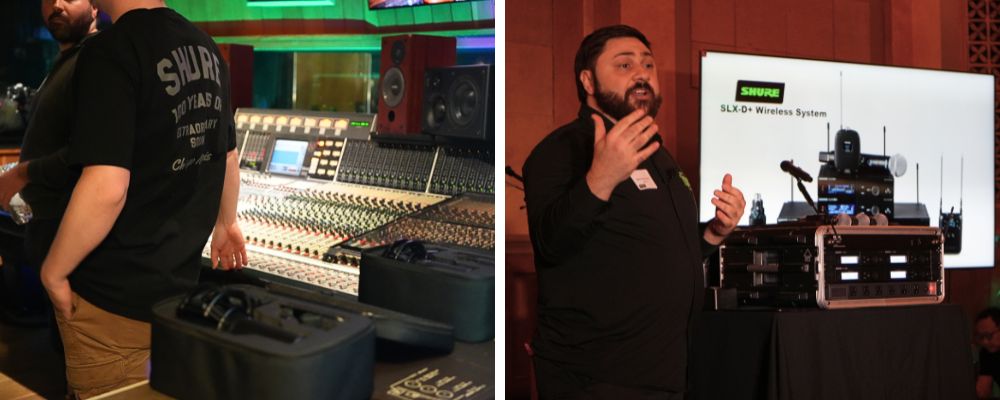
While the new KSM generation reaffirms Shure’s commitment to the professional studio, the brand also made it clear that its strategy is not limited to a single segment. During the event, Mike Petruccelli led the presentation of the SLX-D+, showing how digital evolution in wireless transmission upholds the same standard of quality and reliability that defines the microphone line.
“At Shure, we don’t develop products in isolation. We think in terms of an integrated ecosystem where the studio, the stage, and digital transmission interact with one another. If the KSM represents precision and character in capture, SLX-D+ represents stability and performance in transmission. They are two different fronts, but they respond to the same engineering philosophy,” says Mike, one of the engineers involved in the system’s development.

Shure: legacy and future
At Village Studios, Shure did not simply introduce a new line of microphones. A brand approaching its centennial understands that legacy is not sustained by nostalgia, but by constant evolution.
From a mythical studio in Los Angeles to the creators who are building their own spaces in the region today, the message is clear: professional sound is not a distant privilege — it is an accessible tool for those defining the next generation of productions.
And at the intersection of history and precision, the new KSM line found its perfect stage.