
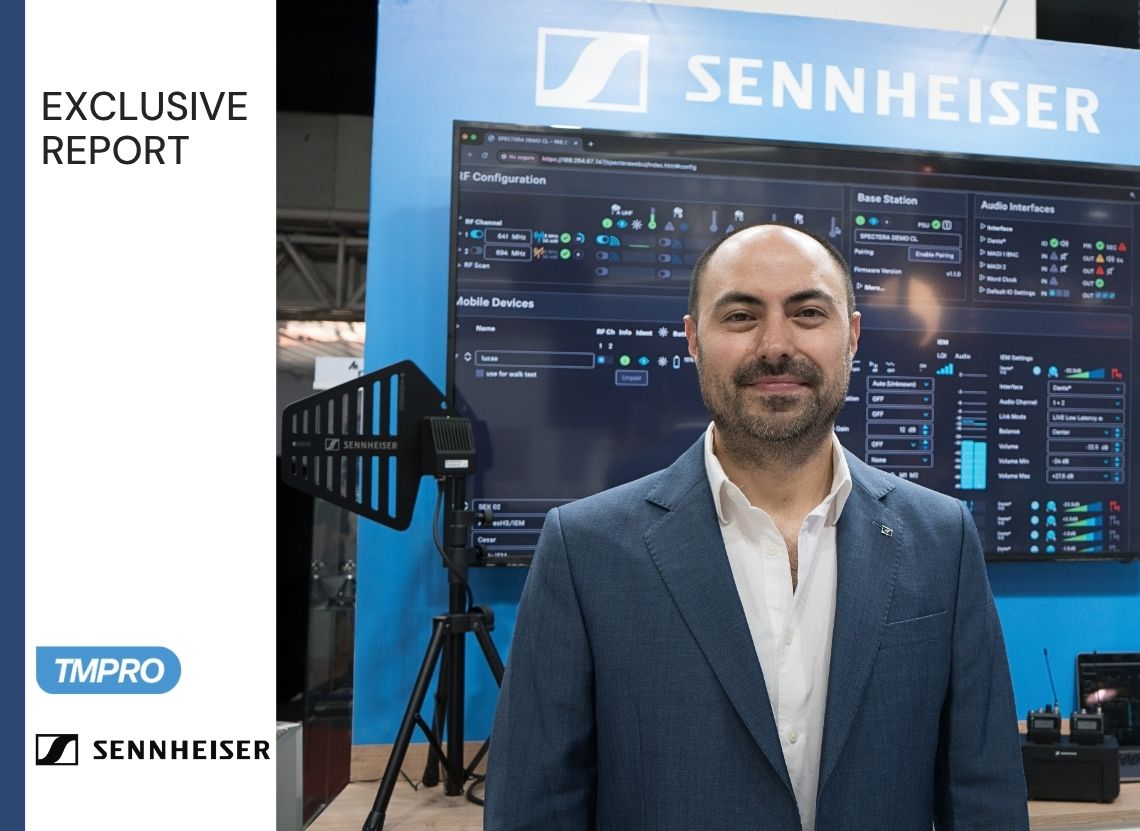
With the official presentation of Sennheiser in the TMPro catalog, the professional division of Todo Música S.A., Argentina adds a new chapter to its development within the professional audio industry. Spectera, the advanced wireless monitoring solution from the German brand, was introduced at CAPER as a symbol of this new stage—one defined by innovation, training, and a shared vision toward the future of sound.
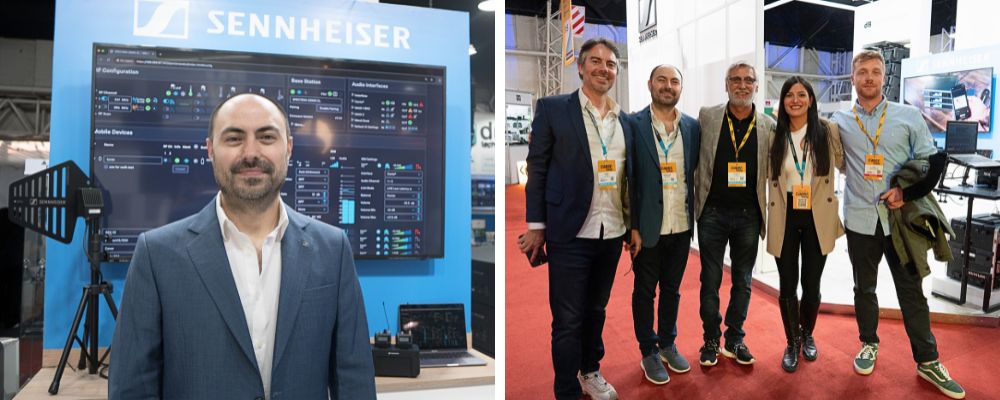
Within the framework of CAPER 2025, TMPro—the professional audio division of Todo Música S.A.—officially presented Sennheiser as a new brand in its catalog. The alliance represents a key step in the company’s strategy, continuing to strengthen its portfolio with high-end solutions for the rental, broadcast, integration, and retail markets.
“Taking on the representation of a brand like Sennheiser puts us in a position of great satisfaction,” says Eliseo Cuciniello, Sales Director of Todo Música. “Sennheiser’s philosophy is to look toward the future of audio, to generate new solutions, and to support both the professional and amateur segments.”
The challenge, he explains, goes beyond distribution: “Our goal is to position Sennheiser within the Argentine professional audio market, and to do so through a direct relationship between the brand, the distributor, and the end user. We want technicians, operators, and artists to feel that they have real access to the best audio tools.”
The presentation included a comprehensive product showcase, with a special focus on Spectera—the system that is revolutionizing professional wireless monitoring—reflecting the innovative spirit that drives this new stage.
According to Sebastián Álvarez, Product Specialist for Sennheiser Latin America, Spectera represents “the future of wireless microphone technology” and redefines the standards of efficiency, scalability, and control: “We’re not talking about an evolution—we’re talking about a completely new way of thinking about the system.”
From idea to result
“Spectera is a digital RF system with IP connectivity, which means it doesn’t require coaxial cables to operate. It’s designed for highly demanding environments where many simultaneous channels are required—all within a compact 1U rack format that allows up to 32 simultaneous channels,” explains Sebastián.
In addition to completely eliminating the need for multiple antennas and traditional cabling, Spectera operates with separate radio modules that can be placed in different areas of the venue and connected via network to the main system. “It’s not just about physical efficiency—it’s a new way of working, where flexibility, remote control, and scalability are at the center.”
The concept of distributed modules redefines how RF coverage is conceived. “Spectera doesn’t use a traditional system with antennas connected directly to the receiver. The radio modules are connected through an IP network and can be positioned in different parts of the venue, allowing specific zones to be covered without signal loss and with greater efficiency,” details Álvarez. “This decentralization not only improves coverage but also reduces noise, interference, and installation complexity.”
With a software-based architecture, all system control is managed through a web application accessible from any browser, with no need for additional programs. This not only optimizes setup time but also allows for live adjustments, remote monitoring, and module-specific configuration depending on the environment. “From the web interface you can see everything—it’s a complete monitoring and control platform.”
Beyond audio: an integrated proposal for the present and future
Spectera not only revolutionizes wireless transmission—it also redefines the concept of integration within modern spaces.
According to Sebastián Álvarez, the system was conceived from the beginning as a total solution. “We’re no longer just talking about an RF system. Spectera is a platform that allows multiple signals, formats, and configurations to be managed in a single environment, with minimal latency and impeccable stability.”
This holistic vision positions it as a versatile tool, designed for both large-scale stages and fixed installations where quality, agility, and centralized control are key.
But the real difference lies not only in the technical side but also in the philosophy behind its development. “What Spectera proposes is a new way of organizing show infrastructure: fewer devices, more control, more freedom. And all of this without compromising quality or robustness, because we’re working with the highest standards in every system component,” asserts Álvarez.
In times when every channel, every space, and every resource matters, this simplified and powerful logic truly marks a turning point.
Control network and efficient spectrum management
One of Spectera’s most powerful features is its ability to monitor and control, representing a qualitative leap in efficiency and reliability for complex productions.
As Sebastián explains, “Having the receivers, transmitters, and access points in a single control center allows the operator to receive detailed information from each channel, each device, and each transmission.”
This not only optimizes workflow but also significantly reduces technical risks in high-demand events.
“One of Spectera’s most remarkable advantages is its constant spectrum scanning,” says Sebastián, adding: “The system immediately alerts us if it detects a change in the RF environment, allowing us to react before a real problem occurs.”
In addition, Spectera enables dynamic channel changes without interrupting operation. “We can reassign channels instantly, either automatically or manually, without turning off the transmitter or losing signal. This is especially useful in contexts where the spectrum is saturated or where multiple systems are operating simultaneously.”
Sebastián highlights the precision level of the system: “We don’t just see the signal level or audio quality—we can also monitor the transmitter’s location, battery life, temperature, and many other parameters that allow us to anticipate any issue. It’s a tool designed to give the technician full control, even under maximum pressure.”
A cross-functional solution for the present of live audio
Although Spectera was designed as a versatile platform adaptable to various scenarios such as broadcast, theater, or fixed installations, its true potential unfolds in the live sound environment. “Concerts are the main users who can truly benefit from this. Not only because of its size, which is fantastic, but also because it offers a level of reliability that no other system can match.”
Thanks to its bidirectional architecture, Spectera allows a musician to use both the transmitter for their instrument and the in-ear monitoring system from the same bodypack. “For example, a trumpet player can use their instrument and their in-ear monitor from the same pack. This dual functionality is also valuable in broadcast environments, where instructions can be sent to the artist’s ear along with the lavalier mic, all through one bodypack,” explains Sebastián.
The system also provides an exceptional level of configuration and customization, making it a key tool for any demanding production. “I believe the system’s main focus is to serve any market that requires a wireless system, but especially live audio, where we’re seeing the greatest impact of all our technology.”
As part of its regional rollout plan, Sennheiser is promoting multiple training initiatives, webinars, and in-person sessions. “We’ve already held sessions in Mexico and Colombia. Chile is next, and Argentina very soon,” anticipates Sebastián. “We want to educate all our users about the advantages and major differences this system has compared to conventional setups.”
With technology that allows users to visualize, equalize, customize, and share data in real time, Spectera doesn’t just redefine monitoring—it redefines the stage experience and technical operation.

Sennheiser and TMPro: technology, learning, and a shared vision
For Cuciniello, this alliance not only strengthens Todo Música’s catalog but also reinforces its commitment to technical training and user proximity. “One of the most important points is investing in education. These are new products, built with advanced technology, and we want to support professionals throughout the learning process,” he highlights.
With a focus on live sound, broadcast, and integration solutions, Todo Música and Sennheiser are beginning a joint path aimed at expanding knowledge and access to state-of-the-art technologies.
“Spectera is an innovative product, with dual transmission and reception paths—ideal for large installations and events. It has enormous potential and is already generating great interest in the market,” adds Cuciniello.
According to him, this new stage is one of consolidation and growth. “We’re developing activities, trainings, and demonstrations both in Buenos Aires and across the country. The goal is clear: to support the market with knowledge and solutions that meet the new demands of professional audio.”
With Spectera as a symbol of innovation and TMPro as a driving force for local expansion, Sennheiser officially begins a new chapter in Argentina—one that unites experience, technology, and a shared vision toward the future of sound.
http://www.tmpro.com.ar
http://www.sennheiser.com
Ph: LATAM STAGE / IG @tmpro.oficial


