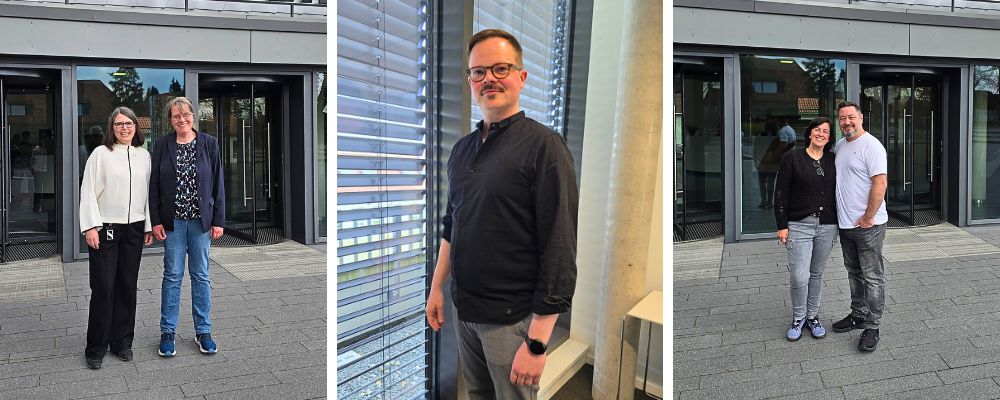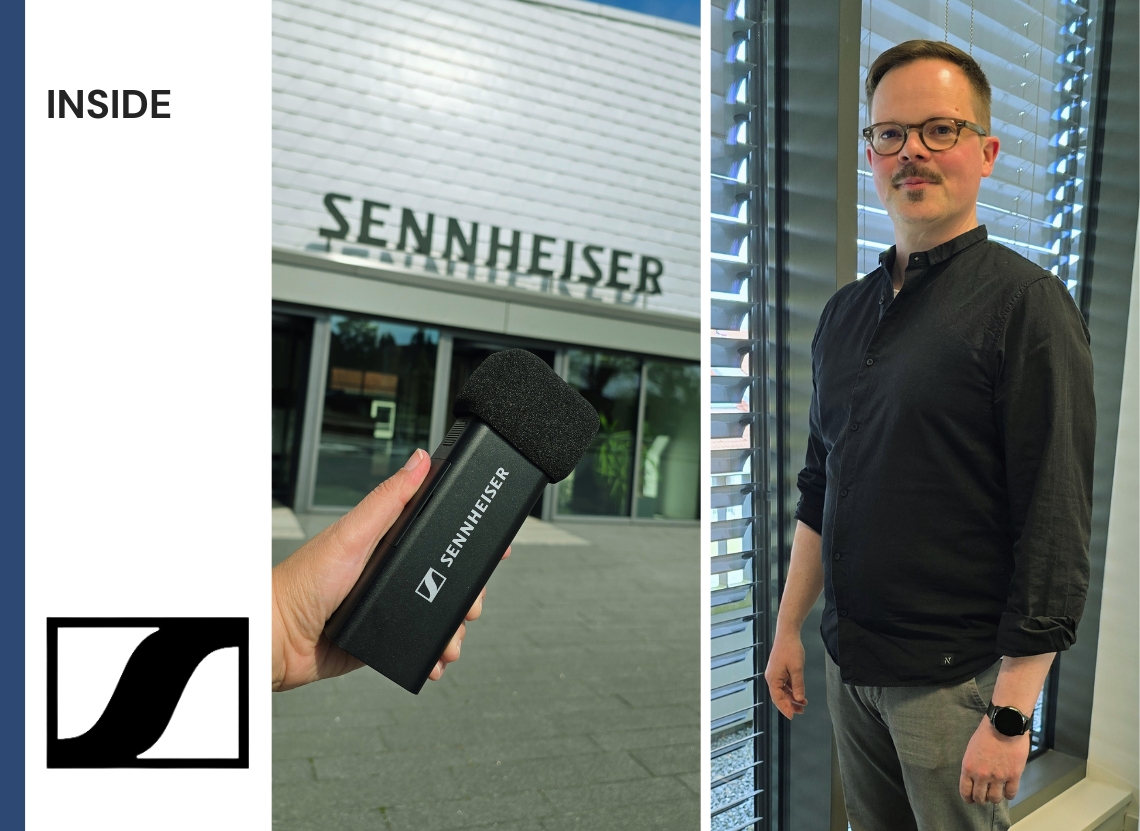
There are places where technology is palpable. This is one of those factories. A visit to the heart of production where sound is experienced and every detail reveals a story of precision, vision, and purpose.
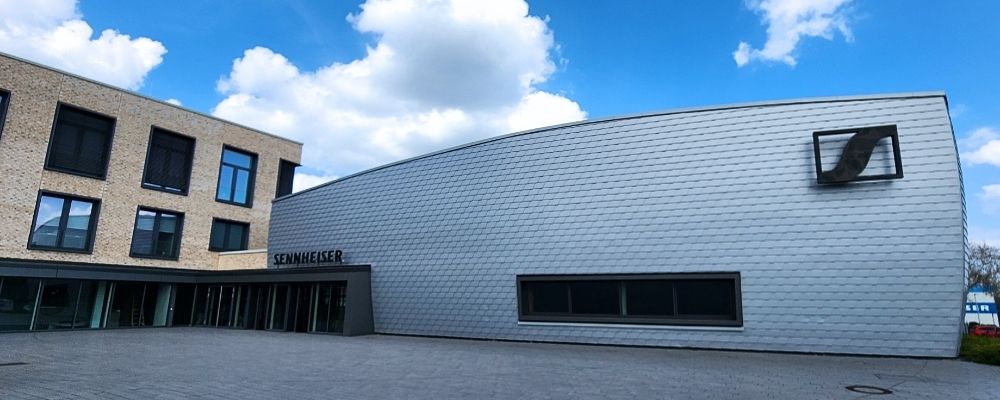
In Wedemark, a few kilometers from Hanover, there is a place where sound is not only produced: it is understood, designed, and breathed.
There you’ll find the headquarters of Sennheiser, a company that has been setting the pace of innovation in professional audio for 80 years, without losing sight of its roots.
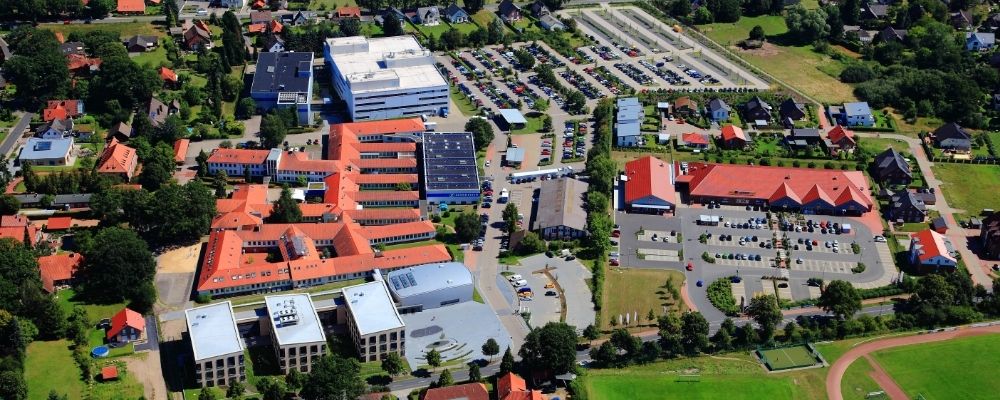
What was once a family farm is now a campus that brings together development, production, and a vision for the future. Each building—from the historic Labor W to the modern Innovation Campus—tells a part of the story, while inside, the meticulous work of engineering and manufacturing follows a single objective: to make sound feel as real as possible.
Visiting this headquarters is like stepping into the heart of a brand that doesn’t just manufacture technology: it cultivates a culture of detail, precision, and commitment. Because here, audio is lived as an experience. And so is every person who is part of it.
Heritage, vision, and a shared compass
Sennheiser’s story began in 1945, when Dr. Fritz Sennheiser founded the Wennebostel Laboratory in Wedemark, with a clear conviction: to unleash the potential of audio through engineering. What began in a half-timbered house—now preserved as an emblem—transformed into a global benchmark, marking milestones: the first directional microphone, pioneering wireless systems, and the legendary open-back headphones.
Today, 80 years after that beginning, the third generation of the family is at the helm. Andreas and Daniel Sennheiser lead the company from complementary perspectives: one with a solid foundation in engineering, the other with a designer’s sensibility and a focus on user experience. “We think differently, and that’s why we make better decisions together,” they say.
Under his leadership, Sennheiser is focusing entirely on professional audio, expanding its key divisions: live sound, business communications, and higher education.
The heritage remains, but the future is built by listening, quite literally, to the user.

From metal to millimeter: Precision takes shape
The visit began where it all starts: in the mechanical production area, also known as pre-production. There, among high-precision CNC lathes, the Sennheiser and Neumann microphone bodies are born. Solid brass rods are machined and cut with surgical accuracy, and every millimeter of excess material is collected and recycled, reaffirming the brand’s commitment to responsible production.
The tour continued in the Technikum, the technical center where ideas from the laboratory evolve into real production processes. “The Technikum is a bridge between engineering and manufacturing,” explained Gritta Gramm, Project Manager. “It’s where we transform an idea into a reliable, efficient, and precise production line.” And it’s not just the machines that impress, but the team spirit: young talents sharing space and experience with technicians who have been with the company for decades, in a balance that feels both natural and powerful.
From there, the tour leads to a special display case dedicated to Neumann, where the internal components of a condenser microphone capsule are exhibited piece by piece. In this area, each workstation is optimized to manufacture a specific model, and although each team member has their assigned workstations, everyone is trained to assemble any microphone in the line. The level of specialization is such that each step of the process is detailed on a screen at each workstation.
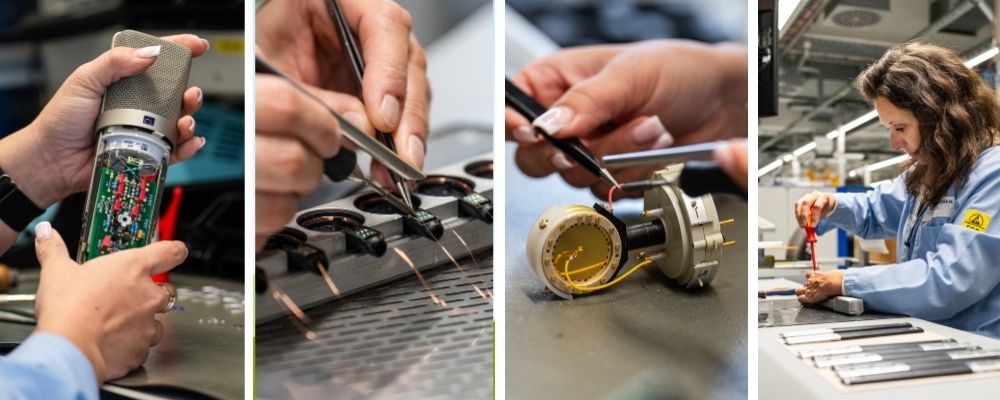
Invisible precision: where capsules that make history are born. On the way to the windows of the “clean room,” one of the technicians is assembling and testing an MKH 416 by hand, the legendary shotgun microphone that celebrates its 50th anniversary this year. The scene was revealing: a model that originated in 1974 continues to be manufactured and tested with meticulous craftsmanship. “That’s the kind of longevity you only achieve when design, engineering, and experience come together,” says Gritta, with a mixture of technical pride and historical affection.
In front of the windows of the “cleanroom,” classified as Class 100 / ISO-5, one of the most delicate processes in the entire factory takes place: the production of condenser microphone capsules for the Sennheiser and Neumann lines. In this almost sterile environment, every step is controlled down to the millimeter. “Even a single speck of dust can introduce noise into the signal,” Gritta explained. “That’s why each station has specific tools, precision lighting, and magnifying glasses placed everywhere. There’s no room for error, and no space for rushing.”
On a nearby screen, a display shows… The complete manufacturing process of the KE10 capsules, used in ceiling microphones and cameras, is on display. Gritta explains that each group of capsules is manufactured and tested together to ensure identical performance. “Everything is calibrated to function as a system, not as individual parts,” he says.
But the most striking detail was almost poetic: each machine in that room has its own name. “Without a doubt, they are already part of the team,” Gritta says with a smile. “At Sennheiser, knowledge is not only about accumulated experience, but also about integration and evolution.”
Further on, in another room, the MD 441 is assembled, a dynamic microphone with condenser capabilities that still defies standards today. Launched in 1971, it continues to be hand-built by a small group of technicians. “Not just anyone can build a 441. Its internals are as complex as its history,” Gritta points out.
Touring this factory is also a glimpse into the future: like the production line for the new Spectera, a bidirectional in-ear system, which is already making its way around the world. Although it must be viewed from a distance, it’s enough to grasp the logic of its unified flow: board testing, assembly, final inspection, and packaging, all at a single workstation. “It’s a highly anticipated product and a key piece in our new generation of wireless solutions,” affirms Stephanie Schmidt, PR Manager. “Seeing it being launched into the world from here is a source of immense pride.”
The order, precision, and steady rhythm of each station reveal a flexible architecture, capable of adapting to new products or redistributing assembly spaces according to demand. “The plant is designed to change with us,” confesses Gritta, “There’s no rigidity: only precision with a forward-looking vision.”
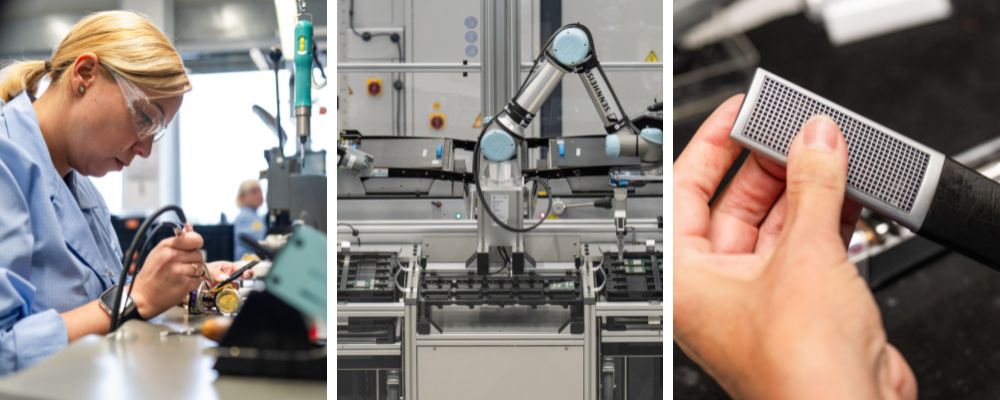
Along the same route, there’s a scene that seems to come from another time, or perhaps from the future: automated testing robots with artificial intelligence. “They handle the most repetitive tasks, the ones no human would enjoy doing,” Gritta says with a laugh. They do it with tireless efficiency, freeing up the technical team to focus on tasks where sensitivity and judgment remain irreplaceable.
The last leg of the tour leads to one of the oldest buildings in the complex. There you’ll find the evolution line, an automated production line that has been manufacturing the brand’s most popular stage microphones since 1998. “Happily producing, as we say,” Gritta jokes. “This line never stops, and although we’ve added new machines over the years, the heart remains the same.”
And it is there, amidst intelligent automation and functional heritage, that the microphone you might be holding in your hands right now is produced.
Echoes of the past, awards of the present, and architecture that resonates.
The incredible journey through this plant has a few more points that deserve a pause, a slower look, and a gesture of admiration.
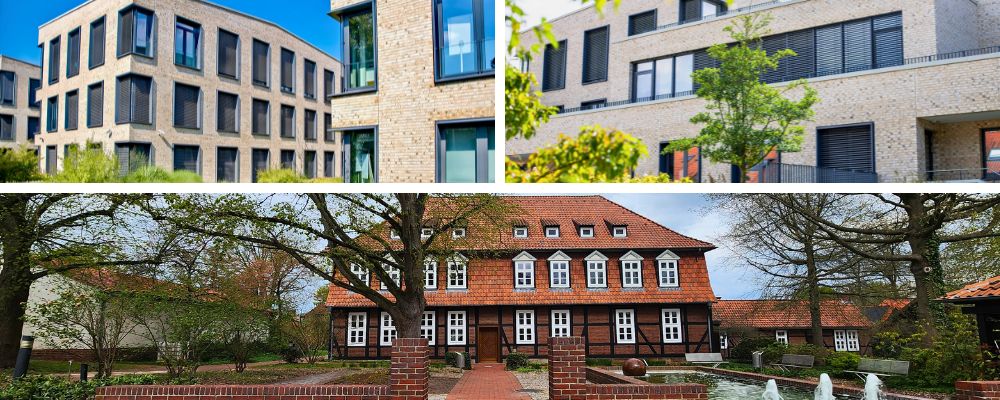
The first is almost a journey back in time: the half-timbered Baroque house where, in 1945, Dr. Fritz Sennheiser founded Laboratorium Wennebostel—or “Labor W,” as it was known then. Built in 1771 and restored by the Sennheiser family in 1984, it still stands today as a symbol of their origins. The rose garden, the old woodworking workshops, and even a daycare center for employees’ children complete a scene that exudes history and a sense of belonging. “It’s not just the place where it all began; it’s the point where the family legacy merges with the commitment to future generations,” Stephanie remarks.
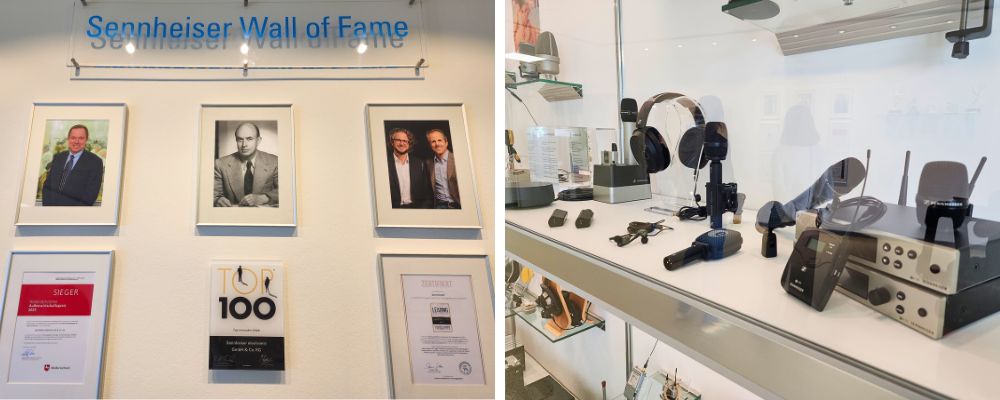
The next is the Wall of Fame. There you’ll find the technical Grammy awarded to Neumann, an Emmy, a Philo T. Farnsworth Award, and other accolades celebrating decades of innovation. Photos of Fritz, Jörg, Daniel, and Andreas Sennheiser line up next to display cases exhibiting milestones such as the first shotgun microphone, an early wireless microphone, the first open-back headphones, and a vocoder. In front of them, a Duesenberg guitar commemorates the company’s 75th anniversary.
It’s not a museum: it’s a shrine to the evolution of sound.
Further on, the large anechoic chamber, where silence is absolute and every microphone in development undergoes rigorous testing. And from the top floor of the Innovation Campus, with its project areas and laboratories, we got a panoramic view of the entire site.
From there, the architecture reveals its hidden message: the flowerbeds and pathways replicate the shape of a sound wave, as if the campus itself were designed to resonate.
Bertram’s Words: How the Future is Designed Through Experience
In the midst of a factory that balances automation and craftsmanship, there is a clear conviction: innovation is not just about launching new products, but about making technology work for people.
Among the key voices that are defining the product direction at Sennheiser today is that of Bertram Zimmermann. “I am a product management manager at SennheiserAnd I’m in charge of several existing lines, such as the EW Digital series, the D6K series, the evolution microphones, the classic MD series, and also the professional headphones.”
Bertram is also one of the direct links between precision engineering and the real user experience: “The challenge is no longer to achieve the best audio quality—because we’ve already achieved that—but to make it accessible, intuitive, and flexible,” he states. In other words, technology shouldn’t be a barrier, but a platform for freedom. “Today, the mission is to make the user feel like they’re just replacing a cable, but with all the advantages of the digital world.”
In recent years, Bertram has focused his work on wireless projects and new generations of microphones. One of the most notable was the development of the MD421 Compact, a modern reinterpretation of an absolute classic. “It was one of my most important projects with the acoustics team, and I’m really happy with the result. It was released last October and the reception has been excellent.”
Their other major focus was consolidating the EW-DX ecosystem, particularly with the launch of the EM4 Dante.
Spectera: Simplicity in High Definition
And the horizon continues to expand. This year, Sennheiser launched Spectera, a bidirectional in-ear system that represents a technical and logistical leap. “Now we can include many channels in a single rack unit, and that’s a huge advantage in the face of rising transportation and operating costs,” he explains.
But Spectera is just the beginning. “It’s the first step in a complete ecosystem that will continue to add features, software, and hardware. What you see today is just the foundation of what’s to come. It’s the starting point of a broader ecosystem that will combine hardware, software, and true scalability. We’re going to add new features and components. The idea is that you can transport a large-scale wireless system in an ultra-compact format. And that, in these times, is a huge benefit,” Bertram reveals.
For decades, audio quality was the ultimate goal. Today, Sennheiser is moving in a different direction: “We can already deliver extremely high-quality audio across all our systems thanks to digital connections. The challenge isn’t to take another step up in quality, but to make that quality accessible, to make it easy to use,” he reaffirms. “We need simpler workflows than we have now.”
The picture is clear: “What we do with our wireless systems is replace a cable. That’s all. But in doing so, multiple layers of configuration emerge: racks, frequencies, monitoring.”
This principle of simplicity guides what Bertram defines as a “technological trinity”: an input link (microphone, whether handheld or beltpack), an IEM return link (for monitoring), and software that adapts to the user’s needs.
With Spectera, the idea is to complete this trinity as well, just like in the EW Digital family. “Because if all three links work well—microphone, monitoring, and software—the whole system flows smoothly,” Bertram concludes.
Listening first: when the user becomes a designer
In an industry where innovation is often associated with technology, Sennheiser is also betting on another source of evolution: the real user experience.
For Bertram Zimmermann, incorporating that voice from the beginning is as important as any algorithm or industrial design. “User feedback is playing an increasingly important role in our development process. It’s a constantly evolving area,” he emphasizes.
Today, the first prototypes are already being tested with external users. “Even with the initial samples, we want them to try them out and give us their feedback. The sooner we get that feedback, the better the overall development,” he mentions. The argument isn’t just technical; it’s also economic. “Modifying a product close to launch is much more expensive. That’s why we need to know what works and what doesn’t, from the very beginning.”
For him, innovation isn’t limited to disruptive technologies; it also involves how and when feedback is received. “We see how other industries—like smartphones or tablets—have replaced specific hardware with accessible solutions. And that’s starting to happen in professional audio as well,” he acknowledges.
This transition also forces us to rethink what we understand by innovation. It’s no longer just about new technologies, but about how existing technologies are beginning to converge with the real needs of the market. Wi-Fi or Bluetooth don’t evolve as quickly as others, but their integration into professional audio is now inevitable.
“Audio quality is no longer the goal: it’s a starting point,” he argues. “What matters now is how to make that quality more usable, more accessible, and faster to deploy. It’s not a battle between new and old: I don’t think it’s about old school versus new school. These transformations begin in the amateur market, but…”But little by little, they reach the professional market.”
The challenge, then, is not technical, but strategic: “As a manufacturer, the question is how to exist and remain relevant in an ecosystem of standard technologies that are already available to everyone.”
Uncompromising accessibility: Designing for all scenarios
One of the challenges Sennheiser faces, and which Bertram acknowledges quite frankly, is how to balance accessibility and excellence.
What does it really mean for a product to be accessible? Is it just a matter of price? “No, it’s not just about the price. It’s the technology that exists between the two,” he clarifies. The key is adapting solutions to different levels of experience, without compromising the quality standard that defines the brand.
“We have different equipment for different types of users and contexts,” he admits. “Those who design for high-profile professional musicians don’t necessarily understand the needs of someone in a garage band or just starting out. They just want everything to work without having to think so much about the technical aspects. And that’s fine: we have to design for that too.”
With the progressive migration from hardware to software, Bertram envisions a more flexible and customizable future: “We’ll have user interfaces that are better suited to each environment. If you’re in a place where everything is simpler, you don’t need to monitor every minute. And you’ll be able to adapt the interface to that.” The important thing, he concludes, is that this improvement won’t be exclusive to any one region: it will be a global advantage for all users.
Microphones, monitors, and more than just technology: the experience is also designed.
When asked to choose a project that has made a lasting impression on him, Bertram Zimmermann pauses. It’s not easy to choose just one, but there’s one project he highlights with particular enthusiasm: “I loved working on the development of the MD421 Compact, because the MD421 is an iconic product with a very strong legacy in the market.” The challenge was to update it without betraying its essence: “We wanted to remove everything that’s no longer necessary—like the physical bass filter—because every console already has it built in. This allowed us to achieve something lighter, more usable, and more accessible for live performance.” The sound remained the same. What changed was everything that was unnecessary. “We knew people liked the way this mic sounded. We just had to make it better.”
But Bertram’s pride isn’t solely in product design: it also lies in his career as a mixing engineer. With 15 years of experience in FOH and monitors, his technical vision is infused with empathy for the musicians.
When talking about in-ear systems, his advice is clear: “Using them doesn’t feel natural at first. Don’t get frustrated if it sounds strange or closed off at the beginning. It’s a process. Like learning to play a scale: you have to practice, try, fail, come back, and find the ideal setting.” His advice is almost pedagogical: experiment with ambient sound, try different settings, and above all, communicate. “If you have a mixing engineer, talk to them. Saying ‘this sounded bad’ at the end of the show is useless. It’s a contact sport: speak up, explain what you feel, and the result will improve.”
At that point, Bertram offers one of his most powerful reflections: “Beyond technology, you have to trust human skills.” Because even if the system is well-calibrated, if the artist feels something is wrong, they’re right. “It doesn’t matter if it’s a technical problem, or if they slept poorly, or ate something that didn’t agree with them. If they feel it, it’s wrong. And telling them they’re wrong doesn’t help.” Technology can be precise, but hearing and emotion remain the true point of contact.
Beyond technology: the future lies in how everything connects.
For Bertram Zimmermann, the dilemma isn’t what technology is coming, but how to use the right one to solve a real problem. “It’s not a question of specific technologies. “If you can imagine something that works, you can probably build it today,” he says. Although he acknowledges the impact that artificial intelligence and advanced DSPs will have, he warns that they are often unnecessary or disproportionate. “In a live performance, what comes in through the microphone goes through the mixing console and has to sound good. And that, in many cases, can already be automated without AI.”
He believes the future of the industry lies not in inventing new technologies, but in better connecting existing ones. The key is aligning systems, simplifying workflows, and enabling communication between platforms—such as mixing consoles, wireless systems, and show control—through open protocols and accessible APIs. “Imagine a musical where you can adjust the audio quality in real time from the console, depending on who is on stage,” he suggests.
More than innovating for the sake of innovation, it’s about ensuring that the technical aspects don’t interfere with the creative ones, automating tedious tasks—like changing batteries—so that the focus returns to where it really matters: the sonic experience.
Because Yes: the future will be more connected, more flexible, more automated… but always with humans in charge.
Thinking 5 or 10 years ahead in an industry like professional audio might seem like an exercise in futurology. “We are exploring integrations with other platforms and digital ecosystems. We know we need partnerships, to talk to other manufacturers, to connect with mixing consoles, show control systems. Anything that facilitates the workflows of the future,” he says.
The direction is clear: fewer hardware versions, more modular solutions through firmware, remote software, and interface customization. The goal is not only to be pioneers, but also to accompany users in this evolution, but he also recognizes a unique characteristic of the sector: the speed of adoption is not as rapid as in other industries. “I see bands that are still touring with 10-year-old systems and they are happy. That doesn’t mean the industry is asleep, but rather that it values stability.”
“Our job is to show that there are benefits you haven’t even imagined yet. And that those benefits are within reach, if we develop them purposefully,” he concludes.
A realistic, ambitious vision, and above all, one deeply connected to the user.
Where trust resonates strongly
A visit to Sennheiser’s headquarters in Wedemark is not just entering a factory: it’s entering a work culture.
From the first screw to the last audio test, every process, every decision, every conversation conveys the same thing: precision, pride, and a constant pursuit of doing things right. And it’s not just about products, but about the people behind them.
Technicians, engineers, designers, product managers, each with a story and a conviction. “What we have with Sennheiser is a reliable, high-quality brand and company. In a world of accelerated consumption, we remain stable. And you can count on us in the coming years,” Bertram summarizes.
That is perhaps Sennheiser’s greatest strength: a brand that adapts, innovates, automates, and projects… but without losing its soul.
Because behind every technological advancement are teams that speak with passion, deep knowledge, and responsibility. And in that balance between heritage and innovation, between German precision and a global vision, sound finds not only its form, but also its purpose.