
The ‘Queen of Taiwanese Music’ Jody Chiang said
farewell to fans after a long and stellar 34 year singing career which has produced
no less than 60 albums and seen her win eight Golden Melody Awards!
Twenty-six epic concerts were staged by the superstar
at the Taipei Arena in the Songshan District of Taipei and
the Kaohsiung Arena in Zuoying District, Kaohsiung, Taiwan. Ticket sales for
the original 16 dates were so over-subscribed that an additional 9 shows were
added, enabling over 250,000 people to see her perform live for the final time.
Jody Chiang’s regular lighting designer since 2013, Tokyo
based Mitsumasa Hayashi, was asked to create high-impact lighting for the
occasion. One of Japan’s leading LD’s, Hayashi worked closely with set designer
Fion Cheng and a team of producers from the Young Hope Corporation in Taiwan to make the shows exciting, elegant and
memorable – a fitting tribute to a successful superstar.
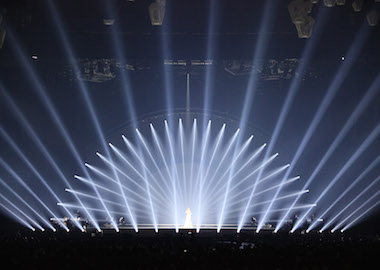
Hayashi’s main effects lights were 46 x Robe Pointes.
The set started as a ‘bare stage’ and had a curved
theme that included a long runway snaking out into the audience, staircases and
various hydraulic platforms which rose out of the stage throughout the show.
The lighting was designed with full adaptability to
the fore – able to transform from full-on Broadway style razzamatazz one moment
to the bare elemental shreds of experimental theatre the next. At any time, the
show presentation could be stripped back to the base elements, which were the
carefully and precisely positioned lighting instruments.
A large arched upstage truss dominated the general stage
architecture, complemented by a large arched HD LED screen upstage, which was
supported by two side LED screens for IMAG.
Alongside all these big, high-impact dramatic ‘gags’
and scenic pieces, the general look and feel of the performance area was clean
and uncomplicated, allowing Jody Chiang
to be the centre of attention.
Out above the audience, 368 paper lanterns were suspended
in the celling as part of the set dressing.
Twenty four fixtures were rigged on the arch with
another 22 on the floor upstage,
allowing him to frame Jody Chiang
in their powerful beams when stage-centre or when working the catwalk,
utilising multiple effects like gobos, colour and prisms to accentuate her
presence.
Hayashi chose Pointes as the best beam fixtures
available, and specifically to make up these framing effects. He especially likes
the frost and prism features and the half-colours, all which were used
extensively for creating unique effects for this show. Pointes were also ideal
because they could look fast, poppy and contemporary for the up-tempo numbers,
or slow and moody for the ballads. “They are truly a multi-purpose fixture!” he
declares.
Hayashi first invested in ROBE
in 2014 with the purchase of 40 units by his own rental company, The Mula
Corporation. He has compared and contrasted many beam and ‘multi-purpose’ fixtures
lately and Pointes have so far proved to be the best choice for his design
style.
Robe’s Pointe has been a big
success in Japan, with over 1000 sold since the launch in 2013, resulting in
record sales for Robe’s distributor LTG.
He first used Robe’s best-selling multi-purpose
fixture in 2014 on Japanese singer Mariko Takahashi’s ‘Adultica’ tour and they
have appeared regularly on his work ever since.
Other lights on the rig included Vari*Lite VL3500 Wash
and VL3000 Spot, a number of other moving lights, 9-lite blinders and Xenon Pin spots from Ushio lighting.
All the lighting was controlled via a Compulite Vector
console, supplied by rental company Engineering Impact Taiwan Corp., together with the rest of the lighting
equipment.
Working alongside Hayashi in Taiwan were his FOH team
from Mula : lighting director Yoshinori Yamamoto, lighting programmer Takeshi
Nakanishi, moving light operator Lee Kyungmin, operator Toshiyuki Nakamura and lighting
systems engineer Kazuyoshi Kondo.
The biggest challenge was to
balance the ambient brightness from the video screen with the lighting. The
lighting has to be powerful as the video, but not overwhelming and balancing
this dichotomy was the key.
Mitsumasa Hayashi’s professional lighting industry career
started in 1975 when he was involved in the foundation of the Shikoku Stage & Television Lighting Corporation.
In 1986 he moved to Tokyo
and established his own office and lighting design practice, developing his
penchant for imaginative lighting and expanding the international scope of his
design work. In 2007 he founded STUFISH Japan (now called Live Art) to work
more creatively and closely with the late set designer / stage architect, Mark
Fisher. He is now busy lighting a plethora of projects including music shows,
tours and live events.
Photos : TOSHIHIRO
NAKAIGAWA


