
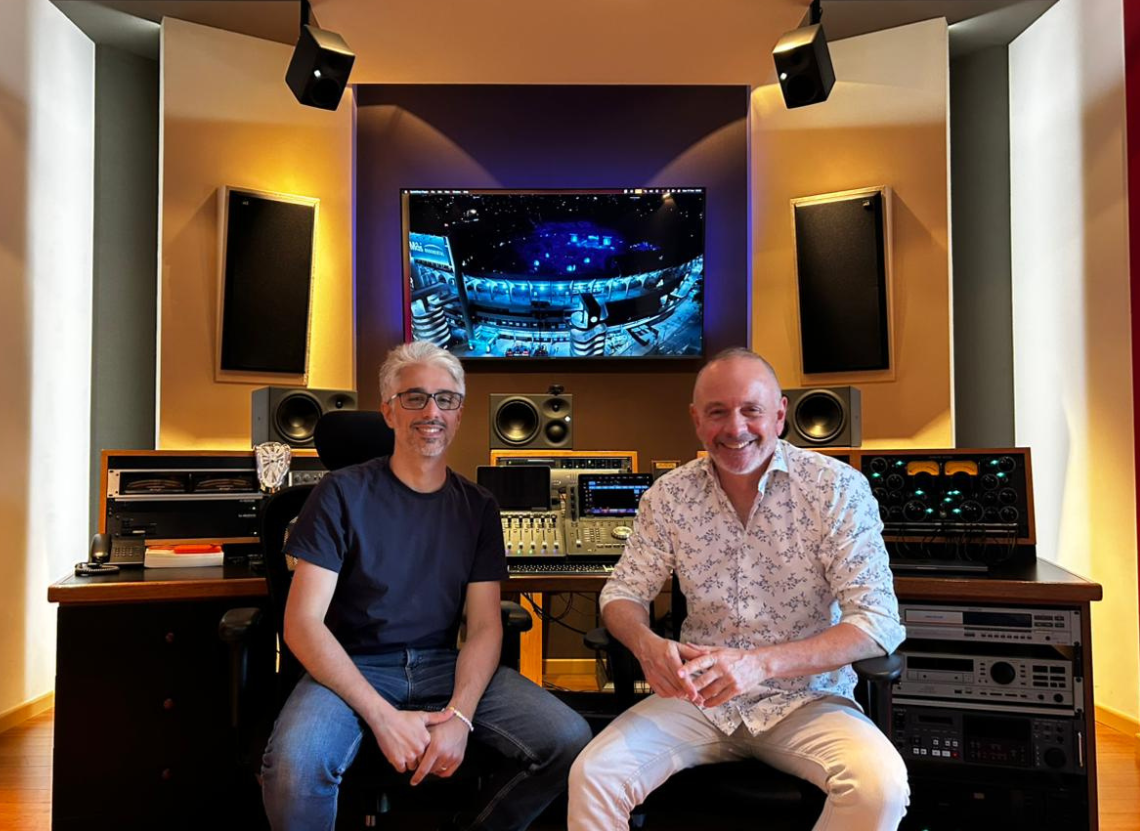
Argentina – Sometimes revolutions begin without making a sound. A duo of men seated behind a console, a monitoring system they trust blindly, and the immense body of work of Piazzolla being reinterpreted, reimagined in three dimensions. With that mix — a little magical, a little technical, and deeply visceral — Andrés Mayo and Martín Muscatello have just reached a place no other Latin American professional had achieved before: a Grammy nomination in the category Best Immersive Audio Album for An Immersive Tribute to Astor Piazzolla. And yes, it is absolutely historic and unprecedented.
The global Grammy nomination (not to be confused with the Latin Grammy) comes after eight years of trial and error, exploring immersive audio when it was still a strange, science-fiction-like, almost futuristic concept. Mayo recalls it while looking back with a mix of nostalgia and amusement: “In 2016, the term didn’t even exist. What we were doing seemed strange every time we explained it.”
However, that vision of pushing forward a format that didn’t yet have a defined name is now beginning to take center stage not only in niche circles but also in the mainstream: global platforms massively adopting Dolby Atmos, artists like DUKI and Bizarrap calling Mayo and Muscatello to mix their albums, car brands incorporating multidimensional systems, and an audience that is slowly starting to understand that music is no longer just left and right, but has a depth with fewer and fewer limits.
In that transformation — and this is something Mayo repeats without needing to be asked — Neumann was more than a supplier: it was the technical turning point. Andrés and Martín rely on KH310, KH120, and KH80 systems to work with confidence and solidity.
“You pressed play and it sounded perfect. There was nothing to adjust. We never had to call technical support or ask for calibrations. Most importantly: we never had mixes come back with complaints from our clients,” says Mayo.
For an engineer who knows that every minimal detail will be judged in demanding rooms with massive, ultra-high-resolution monitoring systems, that reliability is practically life insurance. “We don’t know if we could have made this record this way with another brand,” he admits.
Mayo knows the difference between trusting and crossing your fingers. His career is marked by a necessary obsession to reach places like the Grammys: ensuring that what leaves the studio is as faithful as possible to what his imagination conceived and envisioned. With more than 20 albums produced, 2 Latin Grammys, 7 Gardel Awards, and decades spent in studios ranging from his first apartment (no more than 40 square meters, where he moved the living room table to improvise a studio) to professional, top-tier facilities like the one he has today in Vicente López, Buenos Aires, his craft was sharpened through records of all genres, remote sessions long before they became common, and complex projects in the 1990s that would now be nearly impossible to replicate. He has worked with artists ranging from Jaime Roos, Luis Alberto Spinetta, Los Piojos, Soda Stereo, and Kevin Johansen, to Latin American bands and international projects now circulating in Asia and Europe. Andrés’ résumé is truly endless and outstanding.
Listening to how he speaks about An Immersive Tribute to Astor Piazzolla, it becomes clear that this nomination is not the result of luck or chance: it is a consequence. The album was a creative challenge where the original work demands a new and fresh perspective. There was an intention to recreate spaces, moments, and places that never existed, yet feel real. The work was elegant, refined, and bold: preserving the human texture of the recordings, respecting breaths, minimal noises, and organic intentions.
The contribution of the German brand appears once again: if immersive mixing is a matter of extreme precision, the monitoring system defines how much of the map you can see and how much you are guessing.
“In our immersive mix, any detail is magnified. The Grammy committee listens on huge systems where nothing is forgiven. To get there, you have to have heard the same — or more — from your studio. And that’s the difference Neumann gave us: zero lies, zero deception, zero blind spots.”
And then the conversation inevitably turns to the future. Mayo does not speak like a technician following trends; he speaks like someone who lived with the future before the rest even knew it existed, as if he had a crystal ball. He says that in a couple of years this conversation will sound old and irrelevant, that audiences will understand immersive audio as something given, that artists will incorporate the format simultaneously for their albums as well as for remixes of popular music classics. And his plan is to push the boundaries of that path: adding Argentine projects conceived for immersive audio, alternative versions, and new ways of opening sound to narrative possibilities.
Meanwhile, the 68th Grammy Awards already have an Argentine name in a historically inaccessible category. And although no one says it out loud, the nomination not only positions an album: it positions a region that has always known how to invent on the fly, with minimal resources and maximum creativity.
The project was born in Buenos Aires, mixed on Neumann monitors, driven by two engineers who chose to look ahead even when no one else was looking. Now it travels to Los Angeles. And it sounds — literally — like something from another world.


