
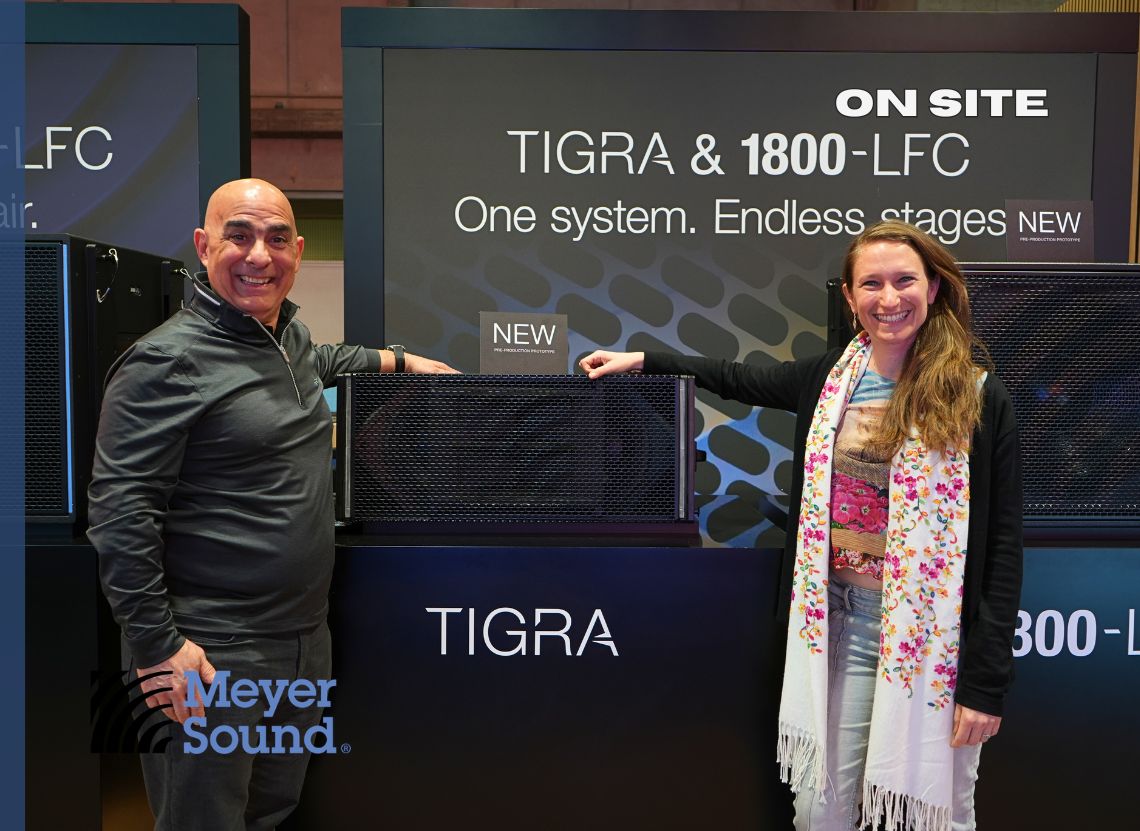
ISE 2026 became the ideal stage for Meyer Sound to use its presence in Barcelona to showcase the direction of its technological development and present, for the first time in Europe, preproduction prototypes of two of its new systems: the TIGRA line array and the 1800-LFC subwoofer.
The company led by Helen and John Meyer gathered representatives, distributors, and users from different parts of the world at its space to share first-hand updates about its professional audio ecosystem and the evolution of its portfolio.
Andy Davies, Director of Product Management at Meyer Sound, explained the brand’s approach during the show. “We’re here at ISE 2026, and we’re very happy to be alongside all our colleagues, distributors, and friends from the industry. We have a large portion of the Meyer Sound product portfolio here, but most importantly, we have people from around the world representing us and speaking with our sales teams, our distributors, and our users about the evolution of Meyer Sound and how it has impacted their projects.”
The exhibition included a wide selection of the company’s systems. “From Ultra-X to PANTHER and 2100, there is a lot to see here,” Davies said, before highlighting one of the key moments at the stand: “And really, really exciting for us, we have the preproduction prototypes of both TIGRA and 1800-LFC. They are in Europe for the first time, and we have the opportunity to show them.”
TIGRA and 1800-LFC: a new stage within the Meyer Sound ecosystem
One of the central points of the presentation was the introduction of the TIGRA system, accompanied by the 1800-LFC subwoofer, both designed as an evolution within the brand’s existing product families.
Katie Murphy Khulusi, Senior Director of Engineering at Meyer Sound, highlighted the strategic importance of these launches. “We’re very excited to be here at ISE 2026 presenting some of our new loudspeakers, the TIGRA line array and the 1800-LFC low-frequency control element.”
According to her explanation, both products expand the reach of the Meyer Sound ecosystem. “TIGRA and 1800-LFC are an evolution in our product families.”
These systems were conceived to operate within the brand’s platform alongside larger-scale solutions such as PANTHER and the 2100-LFC subwoofer. “We’re very excited to have them accompanied by PANTHER and the 2100-LFC,” she said.
While PANTHER represents the highest expression of power within the catalog, TIGRA was designed to expand application possibilities. “While PANTHER and 2100-LFC offer the highest performance and power, TIGRA and 1800-LFC can be used in a wide range of applications for a wide range of users.”
The goal, Katie explained, was to bring Meyer Sound technology to more scenarios. “We wanted to make sure we were launching new loudspeakers that could be used within the Meyer Sound ecosystem and, hopefully, reach new customers.”
This includes a wide variety of applications. “We want them to be used in houses of worship, permanent installations, and even outdoors.”
The new systems were also designed to adapt to demanding environments. “With a temporary IP55 rating for outdoor use, they are ready to go outside.”
The philosophy behind these developments focuses on operational simplicity and technical predictability. “We want to make sure our products are flexible, easy to rig and use, and that they don’t have surprises. We want to make sure that if you can rig them there, you can use them well,” said Katie Murphy Khulusi.
Uniform coverage, integrated processing, and optimized power
From a technical perspective, TIGRA introduces several innovations that reinforce Meyer Sound’s engineering philosophy.
Ianina Canalis, a representative of the company, explained some of the most notable aspects of the new system.
“I’m going to tell you my three favorite things about TIGRA. The first: coverage,” Canalis said.
According to her description, off-axis behavior is one of the key elements of the design. “This cabinet has incredible coverage. TIGRA is the younger sibling of PANTHER, and it has a fundamental characteristic: as the listener moves off the axis of the cabinet, the coverage remains exactly the same.”
This feature delivers a particularly valuable result in terms of sonic uniformity. “It provides an impressive level of uniformity in coverage for the audience.”
Another central element of the system is the inclusion of the GEN-1 card, which integrates processing directly into the loudspeaker. “The second: the GEN-1 card. This card contains all the processing inside the loudspeaker.”
Thanks to this technology, the system allows multiple connectivity options. “This loudspeaker allows us to connect via AVB Milan with primary and secondary networks, but it also includes an analog input,” Canalis explained.
The integration of internal processing also simplifies system architecture. “All the processing that previously required an output channel in our Galileo Galaxy processor is now inside this cabinet. It’s remarkable.”
The third highlighted point was the relationship between size, weight, and performance. “For a cabinet of this size, the weight and the decibels that TIGRA can deliver are truly impressive.”
1800-LFC: the new subwoofer designed to accompany TIGRA
The 1800-LFC subwoofer was developed as the natural complement to the TIGRA system within the Meyer Sound ecosystem.
Ianina Canalis explained the concept behind this new model. “This new subwoofer we’re presenting today comes alongside TIGRA, the new Meyer Sound line array.”
The system incorporates an 18-inch transducer and shares the new processing architecture. “It’s an 18-inch loudspeaker, and the novelty is that it features the new GEN-1 card, just like TIGRA.”
This allows functions traditionally managed by external processors to be handled directly within the system. “You can now perform all the processing that you previously did with the Galileo Galaxy.”
The difference now is that this capability is integrated directly into the loudspeaker itself. “Now you’ll be able to do it directly with the loudspeaker because this card has everything included inside the cabinet.”
The result is a fully self-powered system with complete internal processing. In other words, the user has everything needed: a loudspeaker that is amplified and contains all the processing.
Operation is also significantly simplified. “All you need is a computer, a network cable, and you’re ready to go,” Canalis said.
An ecosystem that continues to evolve
Beyond the new systems, Meyer Sound also showcased other developments that are part of the evolution of its technological platform.
Katie Murphy Khulusi also highlighted the presence of the Ultra-X family, which includes the X20, X40, and X80 models, accompanied by new rigging accessories designed to expand installation flexibility.
“We’re also excited to show our Ultra family of products, the X20, X40, and Ultra-X80, and we will introduce some new rigging accessories because we want, once again, to increase the flexibility of how our products can be used,” Katie said.
The exhibition also included other recent developments within the catalog, such as the compact USW-121P subwoofer, designed for spaces where traditional system designs are difficult to implement.
The tour of the stand allowed integrators, system designers, and rental companies to see up close how Meyer Sound continues to expand its technological ecosystem, combining power, integrated processing, and tools designed to simplify field operation. ISE 2026 once again proved to be the ideal stage for this evolution. In Barcelona, Meyer Sound did not simply showcase new products: it presented a clear vision for the future of its professional audio platform.


