
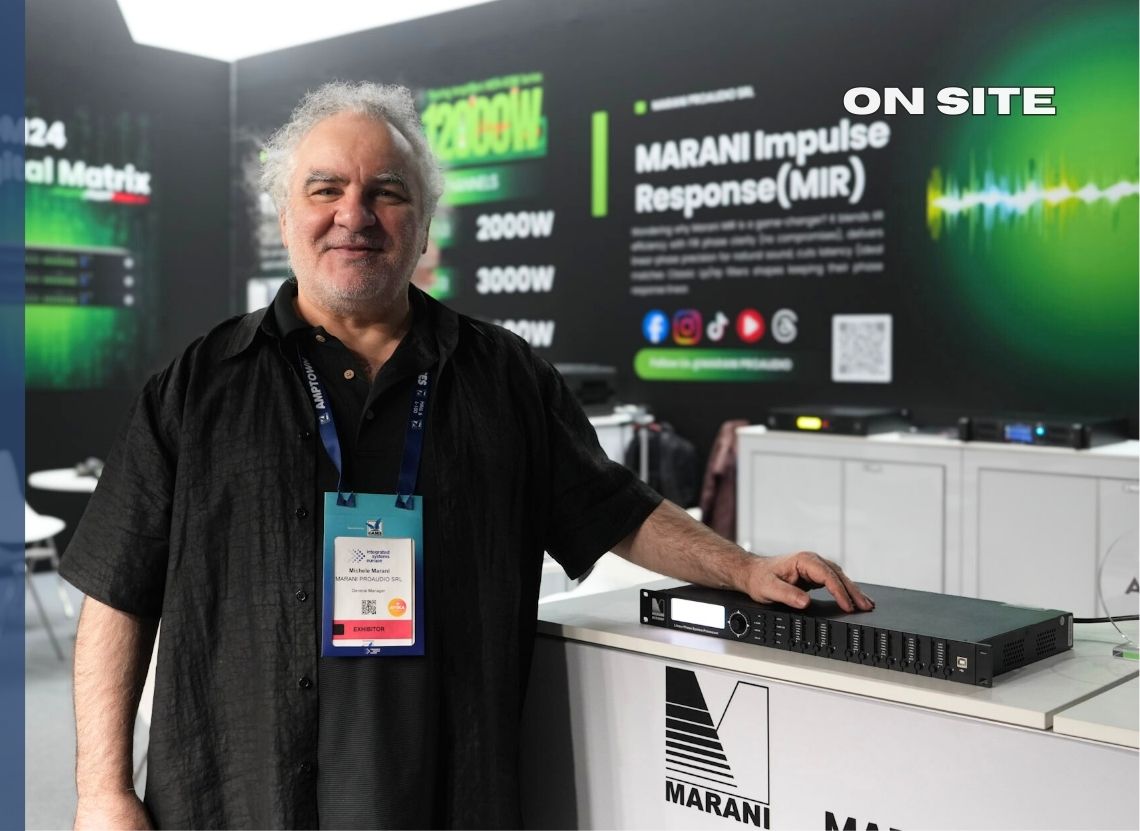
At ISE 2026 in Barcelona, MARANI did not simply present products. It presented an architecture — a different way of thinking about professional audio at a time when integration, networking and system intelligence have become as critical as raw power.
For Michele Marani, founder of the company, the presence at the show carried strategic significance that went far beyond commercial exhibition. “ISE has undoubtedly become the most important professional AV trade show in Europe — and since its move to Barcelona, it has consolidated its position as a truly global platform,” he stated.
From his perspective, MARANI’s participation was driven by three core objectives: positioning, expansion and technological validation. In a landscape where audio increasingly converges with IT, video and systems integration, ISE served as the stage where that convergence became tangible. “We are not just an audio company. We are part of the integrated solutions chain,” he emphasized.
Barcelona also functioned as a key meeting point to strengthen the international distribution network. Europe, the Middle East, Africa, Asia-Pacific and especially Latin America were strongly represented throughout the exhibition halls. “The Latin American market is particularly important for us,” Marani noted, highlighting that expansion in LATAM was one of the concrete strategic goals of this edition.
But beyond commercial positioning, ISE 2026 was the platform chosen to demonstrate where the brand’s engineering is heading.
The evolution of the ecosystem: from kDM to kTM
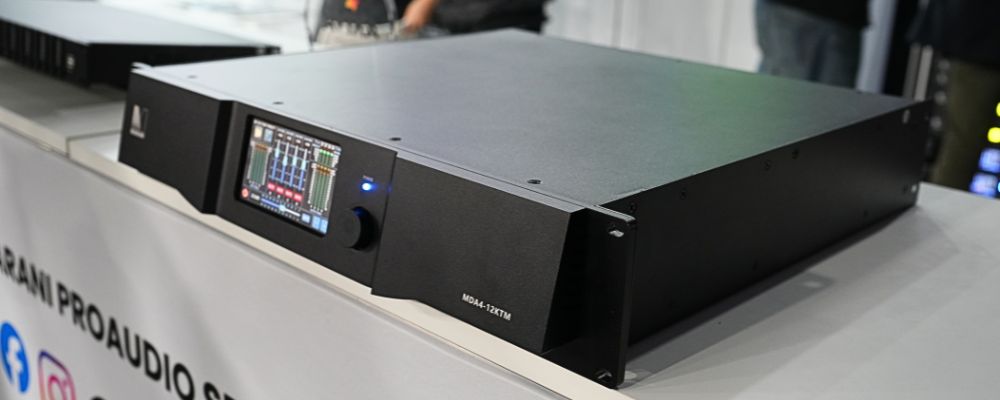
One of the central highlights at the booth was the new kTM series, the direct evolution of the well-known kDM line. However, Marani was clear in defining the distinction: “When I say evolution, I do not mean an aesthetic refresh. We fundamentally rethought what a rack amplifier should be doing in 2026.”
The integration of voltage and current sensors directly within the power modules made it possible to measure real load impedance in real time. The amplifier no longer operates on estimations — it works with actual data. This information not only enhances monitoring, but also feeds intelligent power management decisions while the system is running.
Processing capabilities also advanced significantly. The new architecture doubles DSP capacity, enabling 1,000-tap FIR filters per channel while maintaining the ability to combine FIR correction with traditional IIR filters — Butterworth, Bessel and Linkwitz-Riley — within the same amplifier. “Previously, you needed separate outboard units. Now it is all inside the amplifier,” he explained.
The new Profiler process represented another major step forward. Designed to operate within a 64 dB dynamic window, it allows the system’s tonal response to adapt in real time according to signal level. “Loudspeakers do not sound the same at every SPL. This addresses that directly,” he noted.
Distributed processing and intelligence across the entire chain
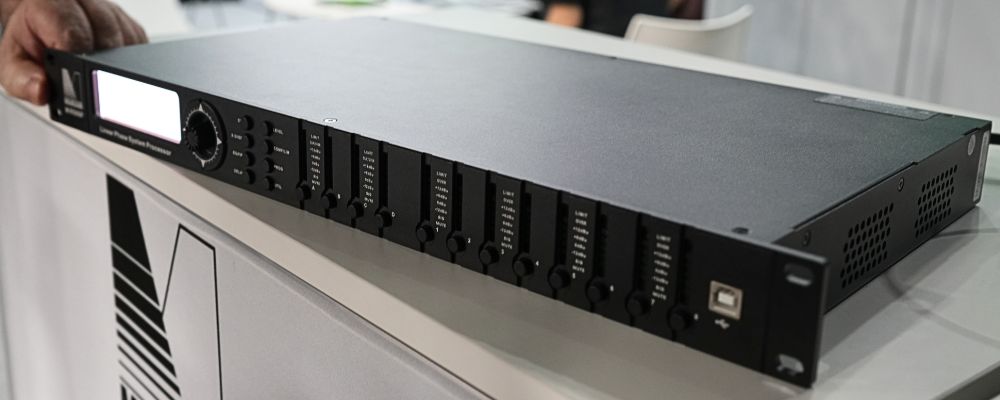
MARANI did not showcase standalone products, but rather an integrated ecosystem composed of the MDAM24 matrix, the MIR488I and MIR888F processors — now featuring AES3 digital outputs — and the new kTM amplifiers.
The philosophy was clear: distributed processing where it makes sense, a fully digital signal path when required, and real-time awareness of what is happening at the loudspeaker level.
“Every stage carries intelligence,” Marani stated. From any-to-any routing and automatic priority-based backup in the MDAM24, to FIR integration with dynamic processes in the MIR units, and impedance monitoring in the amplifiers, the system was conceived as a cohesive architecture.
In large-format applications — touring and concerts — the impact is direct. The ability to measure, load FIR filters and then allow processes such as Dynamic EQ or Profiler to compensate for venue changes during the show provides a level of adaptability that previously required multiple external devices.
In festivals and multi-stage events, the MDAM24 assumes the role of central brain, managing multiple formats — analog, AES3 and Dante — with automatic signal-failure backup.
In corporate environments, houses of worship and theaters, the combination of FIR correction and dynamic processing enables deeply aligned systems that can later operate autonomously, even with non-specialized operators.
“The system does not simply reproduce audio. It observes, measures and adapts,” he summarized.
Networks, modularity and investment protection
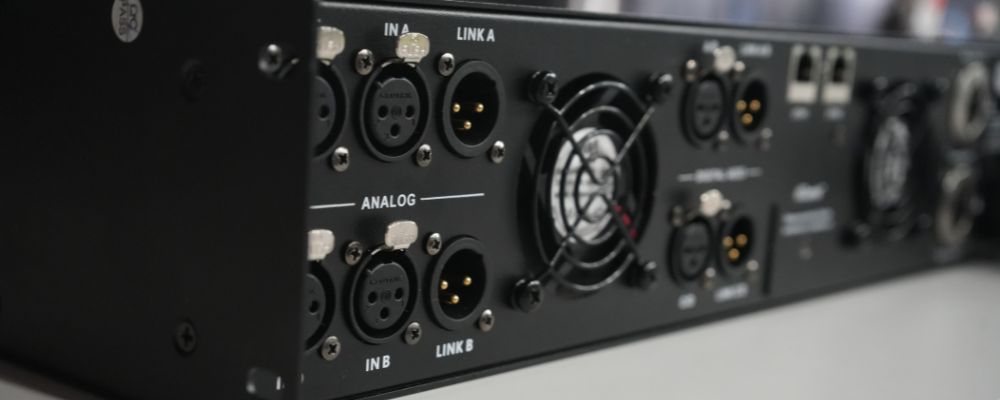
At a time when Dante, AVB, AES67 and Milan compete for adoption, MARANI made a structural decision: no single protocol permanently embedded on the motherboard. All units feature sockets for interchangeable network cards.
“Protocols evolve, and the market does not settle on just one,” Marani explained. If a client requires Dante, the appropriate card is installed. If the system migrates to AVB in the future, the card can simply be replaced without changing the hardware.
The company is already developing an AVB card and a dual AVB/Dante version selectable via software, particularly aimed at rental companies and integrators working across multiple standards.
The vision is clear: protect the client’s investment while anticipating the industry’s evolution.
Software, modeling and the step toward AI
One of the most ambitious announcements was the development of a comprehensive System Management Software platform structured in three layers: management, modeling and measurement.
The objective is to bridge the gap between design and deployment — enabling users to model an installation before connecting a single cable, perform measurements within the same environment and deploy fully integrated configurations.
The next step is even more forward-looking: the exploration of AI applied to system configuration.
“This is not about replacing the engineer, but assisting them,” Marani clarified. The concept is to build a knowledge base grounded in real-world configurations used in theaters, festivals and corporate auditoriums, allowing the system to suggest informed starting points.
“A young engineer can benefit from the accumulated experience of thousands of previous implementations. An experienced engineer can save time under pressure,” he explained.
GaN: the next leap in amplification
In parallel, the company is advancing a new generation of amplifiers based on gallium nitride (GaN) transistors. Faster, more efficient and thermally superior to traditional MOSFETs, they promise higher power density within reduced size and weight.
“GaN is a truly transformative technology,” he stated. The goal is not simply to replace a component, but to redesign the power platform around its advantages.
Deepening, not diversifying
When addressing the mid-term vision, Marani was unequivocal. The company does not plan to expand into new categories such as consoles or microphones.
“We are deepening, not broadening,” he affirmed. The focus will remain on amplification, processing, routing and intelligent software.
“It is not about building louder boxes or adding features for marketing purposes. It is about solving the real problems professionals face when standing in front of a system hours before doors open.”
A coherent narrative
MARANI’s presence at ISE 2026 delivered a clear narrative: build the most intelligent signal chain in professional audio — from matrix to amplifier — integrated by software that manages, models, measures and learns.
In a market where raw power is no longer enough and differentiation increasingly depends on system intelligence, MARANI has chosen to invest in technical depth, vertical integration and sustained evolution.
“The days of treating the amplifier as a brainless power block are over,” Marani concluded. “Sound professionals want — and their clients demand — intelligent end-to-end systems. That is exactly what we are building.”


