
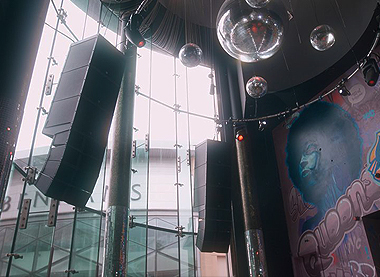
Located in the heart of Newcastle’s buzzing city centre, The Lofts, which opened in August last year, has already earned a reputation for being a new ‘super club,’ welcoming high-profile artists and delivering some of the liveliest nights out in the city. The 1,500-capacity venue was co-founded by directors Rob Seaman, John Dance, and Marty Smith, whose extensive nightlife experiences in the Balearics and beyond drive the ethic at The Lofts. And that ethic extends to the L-Acoustics K3, which is a key part of the overall experience, designed and installed by Adlib to deliver excellent coverage and crystal-clear audio throughout the venue.
“The club’s owners approached Adlib after we’d been recommended to them by a mutual acquaintance,” recalls Nick Whitehead, Adlib’s Project Manager and project lead on The Lofts. “They came to us with an ambitious but very clear brief. They wanted the best club in the Northeast and knew they wanted to use L-Acoustics because of their previous experience with the brand and, as a company, are always at the cutting-edge of audio technology. We were thrilled to support them on this journey and implement an L-Acoustics system, tailor-made for the venue.”
The first conversations and initial site visits all took place at the start of last summer, but with the official opening planned for the August bank holiday weekend and with BBC Radio 1 legend Pete Tong set to perform on The Lofts’ opening night, the Adlib team had just four weeks on-site to complete the installation.
“There was a lot of hype and excitement around the opening, with TV advertising, banners up around Newcastle, tickets sold out, and Pete’s private jet booked. In short, there was absolutely no room for error. Everything had to be just perfect!” says Whitehead.
Whitehead worked alongside Project Designer Tim Robinson to design the perfect system for each of the venue’s three main spaces: The Plant Room, Harlem, and The Hustle.
Set across three floors, the upper floor of The Lofts consists of three large rooms, the main Plant Room, the more laid-back Harlem, and the cabaret-style Speakeasy, all of which have large dance floor areas and bars, with a corridor connecting them.
The Plant Room system comprises two hangs of five K3 with two hangs of three KS28 subs immediately behind, all end-fired and time-aligned. Delays are two A10, with X12 as out-fill. In the bar area, there are six ceiling-mounted X8 cabinets and two KS21 subs.
“When the brief is to do a nightclub, there’s a temptation to put a bunch of point source boxes in each corner and call it a day,” says Robinson. “We were fortunate that the owners were great at engaging with us during the design stage. Using L-Acoustics Soundvision 3D files, we shared our ideas to demonstrate the effects of putting different cabinets in different positions, ho”w they would interact, and what the audience experience would be.”
A key design principle was to have a focal point in each club area, generally at the DJ booth, to focus on the live-performance feel. We wanted the sound always emanating from that focal point, with subsequent cabinets delayed where appropriate. The result is a remarkably coherent experience.
According to Robinson, with one defined point and the K3 in the Plant Room in particular, “it absolutely thumps. If you’re at the back of the DJ booth, whatever way you face, you can’t see another loudspeaker. Everything points the same way, is time-aligned, and works coherently.”
The same approach follows through in Harlem, an acoustically tricky space. The room is divided into two distinct areas: a dance floor with a DJ booth and a bar area. The dance floor with the DJ booth is a large, almost circular room with a glass tower and a huge floor-to-ceiling window that is almost 20m high at one end. The bar area adjoins the dance floor/DJ space through a low archway.
The 120-capacity Speakeasy features three clusters of A10i Focus and an A10i Wide, along with three KS21i.
“We tried to design the systems so that the three spaces would interact coherently, rather than destructively. Everything starts at Harlem in front of the window with two flown arrays comprising four Kara II and three SB18. As you progress into the Harlem bar, we treated it almost entirely as a separate acoustic space because there is a dividing wall above the separating arch. We used two arrays of A10i—two Focus and a Wide—with four central KS21. At the far end of the bar, there is a single X15 mounted on the back of a pillar for delay,” explains Robinson.
The mezzanine level is a more private venue, The Electric: an artists’ green room with its own DJ booth and a space where artists, staff, and management can relax away from the public—it also houses the management offices. In the bar area of The Electric, four X8 are mounted above the bar following its curve to cover the audience side, with a further two X8 as dedicated stereo DJ monitors.
“One of the reasons we liked this setup is to give uniform coverage to the audience area but not have it firing in the faces of the bar staff. It’s better for their health and safety, and also, when you stand at the bar to order a drink, you dip out of the coverage, and you can hear yourself think and get your order right,” adds Robinson. The low-frequency extension is via two Syva Subs mounted in the bar area ceiling, alongside the X8.
On the ground floor, The Hustle is a New York-style bar/club comprising a long thin room that runs the length of the building, with a central dividing door. “One end is clearly the bar and is the feeder bar for upstairs. So, it required a system that could go from background music to reasonably high foreground music in keeping with the level of the system upstairs. The other end is the club which has booths for seating and a DJ booth, which needed a bit more of a dance floor system,” adds Robinson.
The Hustle’s main system comprises two A15 on each side, with KS28 delivering low frequency, with further A10 deployed for delays as you move down the room. Coaxial X12 cabinets are yoke-mounted above the bar. These are all in the same plane and reinforced by ceiling-mounted KS21 subs. “In the area where the ceiling becomes a little low, we have placed compact X8 cabinets. The Snug, a small room off the bar, is served by two 5XT and its own Syva sub,” shares Robinson.
The backbone of the audio system is a cloud-manageable Q-Sys control platform, which means audio is moved around the venue over an AES67 network, allowing any signal to be routed anywhere. “At the beginning of the project, there wasn’t any indication that audio would need to be moved from one room into another. As each room has its own DJ booth installed, why would it? But as that requirement inevitably surfaced, we were able to implement it very easily. Likewise, we can route between floors. The Hustle can take audio from any of the bigger rooms upstairs, as can The Electric. Given that The Electric is the green room, they can treat it like a radio station, listening to their friends who happen to be on stage,” explains Robinson.
During the installation process in The Hustle, one of the contractors was asked to install a TV system to broadcast sports matches. The original intention was that the sound should come out of the TVs. But because the Adlib team worked so closely with the contractors on-site, they suggested using a Blustream IP-based matrix allowing audio to be routed into the Q-Sys system and then to the L-Acoustics cabinets, giving much more satisfactory results.
Robinson notes that Adlib’s relationship with L-Acoustics adds value to complex installations with tight deadlines. “Our relationship with manufacturers is really important,” he says. “As an L-Acoustics Certified Systems Integrator, we could draw on all the resources they offer to help get an installation across the line as quickly as this.”
Good sound is critical for a nightclub such as The Lofts since its entertainment value is almost entirely based upon sound. “It needs to be an immersive and enveloping experience. It doesn’t have to be blisteringly loud, although it can be, as it has plenty of headroom,” Robinson concludes. “We’ve had a lot of comments about the sound in The Lofts being loud but very clear and not painful or uncomfortable. It definitely achieves what it needs to without hurting our ears. One of The Loft’s owners, Rob Seaman, visited with the venue’s resident DJ, Jonny Burn, shortly after The Hustle’s system installation. As they walked into the room, Rob froze with his hands behind his back and just stood there listening. Finally, he exclaimed, ‘John [Dance, co-founder], has to hear this!’ ”
“The ultimate design is the result of a great collaborative effort, and from a technical point of view, this is the best nightclub in the Northeast, if not the country. We feel honored to have been entrusted with the opportunity to work on this amazing project and to bring the L-Acoustics sonic signature to this remarkable venue.”


