
A
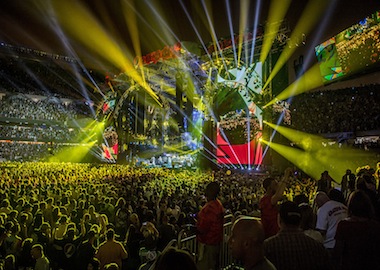
milestone in music history took place at Soldier Field in Chicago as legendary
US ‘jam’ band The Grateful Dead celebrated their 50th anniversary with the three
final ‘Fare Thee Well’ shows, produced by Paul Shapiro over the 4th
of July holiday weekend, playing to record crowds of 70,000 each night. This
followed two gigs the previous weekend, each pulling capacity audiences of
65,000, at Levi’s Stadium in Santa Clara, California.
Lighting
was designed and directed by the band’s long term LD Candace Brightman, who started with them in
1972. Paul Hoffman of Pulse Lighting LLC
provided programming, equipment selection and moral support. The pair have
collaborated on the Grateful Dead since 2004. Central to the large lighting rig
were 50 x Robe BMFL Spots and 32 x Pointes supplied by lighting vendors Felix
Lighting in Santa Clara and Bandit Lites in Chicago respectively.
Candace
and Paul started work on the design in January. The band wanted an industrial
look to the stage and Candace was keen that the design follow-on from her
‘organic’ work of the past while incorporating some of the newest technologies.
The stage was defined by a series of gently curved trusses wrapping the central
performance space and topping off the PA / side screen wings. Upstage center was
a 30ft diameter circular truss covered with a stretched scrim.
Assisted
by Bandit account handler Dizzy Gosnell on the CAD elements, the lighting design
and system evolved and morphed several times in the run-up period as new
elements – like a live YouTube internet stream at Soldier Fields – came
into play.
The BMFL
fixtures were “the spectacle of the show – outshining anything else” stated
Paul, who explained that they were hung on the curved trusses. The BMFLs
emphasized the general outline of the trusses, allowing them to shoot right to the
back corners of the stadium … and also to be focused in onto the circular
scrim where their gobos could produce incredibly detailed and vivid
projections.
They were
also impressed with the speed of the movement. “They can move super-fast
between positions compared to more sluggish, older luminaires,” observed Paul.
Robe
Pointes were used around the central circle to project onto the circular scrim,
giving some different patterns from the BMFLs, and also out on the wing curved
trusses and floor for some long-throw beams.
As with
all Grateful Dead or ‘jam’ band shows, the challenge was the fact that the same
song is never played twice in the same way, so instead of being able to prepare
and execute a tightly pre-cued show, Candace operated the grandMA 2 console very
similar to a musical instrument, playing along with the band as the set unfolded.
Her 40
years of experience lighting the band, however, did give a reasonable insight
into the next musical directions they might take.
Paul
suggested the BMFL Spots having used them himself, and seeing them in action at
various other shows since their launch last September. He has been incorporating
Robe into much of his work for the last year, starting with Pointes.
Joining
Candace and Paul on the creative team for these seminal shows were video
operator Aaron Stinebrink and video content producers Tim Zgragen and Obsura
Inc.
The
lighting crew chief was Chris Coyle and the account handler for Felix was Roger
Pullis.
The
webcast from Soldier Field was the first ever live webcast by YouTube and it’s
estimated that a record 175,000 pay-per-view audience tuned in to catch the
action.
Additional
resonance touched the Soldier Field event as it was also the site of the last Grateful
Dead concert 20 years previously … to feature the late great Jerry Garcia on
lead vocals & guitar.


