
With hundreds of
thousands of fans in the stadiums, not to mention the billions who tune in from
across the globe, making sure the sound is perfect for the 2014 FIFA World Cup
is no small undertaking. When faced with challenge of delivering the most
sophisticated, world-class audio experience possible, from the Amazon basin in
the north to the banks of the River Guaiba in the south, eight of the major
stadium venues in Brazil’s 12 host cities featured HARMAN’s wide range of audio
solutions. In addition, a wide variety of Studer Vista
consoles were used for television broadcast of the games.
“From inception
through delivery, each component in our family of brands is designed to provide
a sophisticated, integrated and affordable audio solution,” said Robert
Klesser, National Sales Manager, Install & Cinema, HARMAN Brazil. “As
soccer transcends sport and becomes an expression of culture, we are honored to
be the brand of choice for so many of the venues hosting matches during the 2014
FIFA World Cup.”
While the
components installed vary by venue, popular products include HARMAN’s IDX
communication systems, AKG microphones, BSS signal processing, Crown
amplifiers, Soundcraft digital consoles and JBL loudspeakers. The range of
stadiums equipped with HARMAN audio solutions is diverse in terms of size,
location and age.
Beginning on a
plateau in southeastern Brazil, on the Atlantic Coast, Arena de Sao Paulo
hosted the opening match between Croatia and Brazil. Built specifically for the
World Cup, the facility seats 68,807 and will serve as the new home for Sport
Club Corinthians Paulista. Systems integrator Johnson Controls and audio integrator
Soundvision outfitted the facility with the IDX communication system, AKG
microphones, BSS BLU-800 networked signal processors, Crown CTs amplifiers, JBL
Control Contractor ceiling loudspeakers and Soundcraft Si Expression digital
consoles.
Surrounded by
mountains in Belo Horizonte, Brazil, which is inland from Sao Paulo and Rio,
Estadio Mineirao is a national monument that will host not only World Cup
matches but also numerous matches during the 2016 Summer Olympics as well.
Built in 1965, the venue seats 57,400 and recently underwent an extensive renovation
that took three years. Johnson Controls systems integrator and Soundvision audio
integrator equipped the landmark stadium with an IDX communication system, AKG
microphones, BSS BLU-800 networked signal processors, Crown I-Tech HD
amplifiers, JBL ceiling loudspeakers and Soundcraft Si Compact digital
consoles.
Estadio Nacional,
in Brazil’s capital city, Brasilia, opened in 1974, was renovated in 2013 and
seats 68,009. Systems integrator Siemens and audio integrator Loudness equipped
the massive facility with an IDX communication system, AKG microphones, BSS
BLU-800 networked signal processors, JBL ceiling loudspeakers and Soundcraft Si
Compact digital consoles.
Estadio Castelao is
located in Fortaleza, Brazil, considered a “fortress” port on the country’s
northeast coast, more than 1,500 miles from Rio. The facility, which opened in
1973 and reopened in 2013, seats 58,000. For sound, systems integrator TODO and
audio integrator Telem equipped the stadium with an IDX communication system,
BSS BLU-800 networked signal processors, Crown CTs amplifiers, JBL PD5000
Series loudspeakers and Soundcraft Si Compact digital consoles.
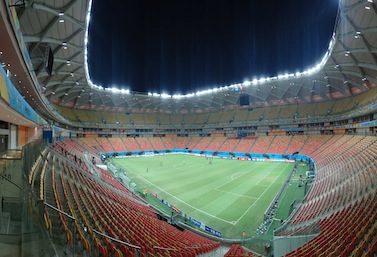
Arena da Amazonia
is in Manaus, Brazil, the capital of the state of Amazonas and, at 2,659 miles
from Rio, the furthest north of the host cities. The stadium, which opened in
March 2014, seats 42,374. Systems integrator Johnson Controls and audio integrator
Soundvision equipped the facility with AKG microphones, BSS BLU-800 networked
signal processors, Crown I-Tech HD amplifiers and JBL Control Contractor Series
ceiling speakers.
Arena Pantanal,
which opened just two months before the World Cup, is 1,200 miles from Rio,
near the Bolivian border and close to the center of South America, in Cuiaba,
Brazil. It seats 42,968. Systems integrator Canal Livre and audio integrator
Soundvision equipped the facility with an IDX communication system, AKG
microphones, BSS BLU-800 networked signal processors, Crown I-Tech HD
amplifiers, Crown DCi amplifiers, JBL PD5000 Series loudspeakers and Soundcraft
Si Expression digital consoles.
Arena Pernambuco is
in an economically deprived area on the outskirts of Recife, Brazil, more than
1,400 miles from Rio. With a seating capacity of 42,800, the stadium was opened
in 2013 with the hope that it will act as a catalyst for local regeneration long
after the World Cup. Systems integrator NEC and audio integrator Telem
installed an IDX communication system, AKG microphones, BSS BLU-800 networked
signal processors, JBL ceiling loudspeakers and Soundcraft Si Compact digital
consoles.
Finally, the oldest
of the World Cup venues, Arena de Baixada is in Curitba, Brazil, south of Sao
Paulo and about 500 miles from Rio. Originally built in 1914, the stadium was
completely rebuilt in 1999 and then renovated again for the World Cup. It seats
41,456. Systems integrator NEC and audio integrator Telem equipped the facility
with a HARMAN lineup that includes IDX communications systems, AKG microphones,
BSS BLU-800 networked signal processors, Crown CTs amplifiers, JBL AWC
weatherized compact loudspeakers, JBL PD5000 Series loudspeakers, JBL Control
Contractor loudspeakers and Soundcraft Si Expression 3 digital consoles.
HARMAN Professional also had a strong presence in
the broadcast elements of the World Cup, with multiple Studer Vista consoles in
use for television broadcast of the games. In Rio de Janeiro, a Studer Vista 9
digital console was used to broadcast all 64 games via the TV Globo Network to
the Jardim Botanico area. In addition, TV Globo’s OB Van HD3 used a Vista 9 to
specifically feed games from Maracana Stadium for live transmission to Jardim
Botanico. Projac, the main center of television production for TV Globo, also
used a Vista 9 in its OB Van HD8 for live shows related to World Cup events. TV
Globo also utilized a pair of Vista 8 digital consoles for television broadcast
of live performances centered on the World Cup.
In Sao Paulo and Brasilia, TV Globo’s OB Van HD1 was
equipped with a Vista 8 console for the games that were hold in those two
cities. A Vista 8 and a Vista 9 were also used in Sao Paolo for live
performances related to the World Cup.
Lastly, RCN in Colombia used its OB Van, equipped
with a Studer Vista 5 digital console, to broadcast the entirety of the
Colombian National Team’s games in the World Cup.
Photo Caption:
Arena da Amazonia in Manaus, Brazil (Photo Credit: Gabriel Smith)


