
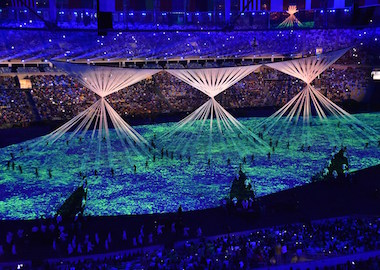
Just home from Rio, where he designed the lighting for the 2016
Olympic opening and closing ceremonies, Durham Marenghi shared with us his reflections about the project, for
which he brought a massive lineup of SGM lighting fixtures including P-2, P-5,
Q-7 and G-1 Beams, supplied by Italian rental
company Agorá.
Marenghi
is no stranger to lighting design in an Olympic context. He has been involved
with the Turin Winter Olympics in 2006, the London 2012 handover at the Beijing
Olympics closing ceremony in 2008, and the Sochi Winter Paralympic opening and
closing ceremonies in 2014.
The Olympic design challenge
Marenghi and his team were hired by Cerimonias
Cariocas 2016 and were only involved
about ten months before the forthcoming opening ceremony, which may be
considered relatively late considering the fact that Marenghi worked on the
Turin Winter Olympics for four years. As the theme and the content for the Rio
opening and closing ceremonies had already been determined, Marenghi’s brief
was to enhance the projected environments of both ceremonies in a more subtle
manner than the beam and flash effects commonly used on many Olympic events in
the past.
To reflect the direction given, Marenghi grouped the fixtures
together, rather than spreading them out along the trusses, in order to create
a more defined key lighting as well as a more minimalistic and theatrical feel.
The opening ceremony was delicate and theatrical, whereas the closing ceremony
was all about partying Brazilian style. Each section of the opening ceremony
had an associated artist and style, so Marenghi created designs that followed
their palettes. The closing ceremony was themed with carnival and samba, so
here the theme also guided Marenghi’s design.
To Marenghi and the team the challenges included hitting the
right balance between ‘kissing’ the projections with lights to illuminate the
performers, while not washing out the projected images in the performance
arena. So compared to a regular stadium show the light levels were extremely
low. This made it all the more important to deploy lights that were easy to
control from a distance, which the SGM fixtures according to Marenghi: “fitted that bill perfectly”.
Another challenge was the fact that all artistic segments ran to
a time-coded show, so even minor edits had a significant impact on the
lighting.
Speccing suitable lights for tricky Brazilian weather
Marenghi has been a regular user of SGM products for some time.
As the Brazilian weather can be rather unpredictable, which was to be proven on
the stormy night of the closing ceremony, it was crucial to spec fixtures which
would do the job in any weather conditions. Another requirement of Marenghi’s
was low power consumption and good optical control from a distance. And so he
decided to use a truckload of SGM fixtures to realize his designs.
Marenghi used the Q-7s to backlight the audience and to create
stadium-wide effects and chases. Also during the Athlete Parade, they reflected
the individual colors of the athletes’ various national flags. He said about
the Q-7: “It is a particular favorite of mine due to it’s bright washes and
dynamic effects which are great for highlighting points in the soundtrack.”
The P-2s were placed as footlights around Maracanã Stadium’s
field of play and equally as footlights for the more than 50 “box city” stages
during the opening ceremony.
The
P-5s lit the box city cyclorama for the opening ceremony, and then re-rigged
with a lens change to light the athletes seating blocks for the closing
ceremony. Further, they were used to light the mirror section of the sculpture
part of the cauldron sequence of the closing ceremony.
Marenghi said about the P-5s and P-2s: “They are great wash lights; bright, compact, efficient and weatherproof.
Because of the optional barndoors they were also completely controllable, which
was key to stay off the projections.”
Finally, G-1 Beams were deployed in the opening ceremony just
below the cauldron and placed on the floor around the stadium to provide beam
effects after smoky sequences, such as fireworks. Marenghi is particularly fond
of the little wireless beam fixture because of its high suitability for events
requiring quick deployment. He explained: “The G-1 is just unique and allowed us to quickly deploy them where
cabled units would not have been possible in time for certain events, such as
the all-important torch-lighting sequence. And because they are waterproof,
they were ideal to use under the rain effect for the beautiful cauldron
extinguishing sequence in the closing ceremony.”
In the wake of the Rio 2016 Olympics, Marenghi and his team can
now look back upon two successfully conducted ceremonies. Reflecting on his
cooperation with SGM, Marenghi concludes: “SGM were very supportive of the project and were able to facilitate
some last minute lens changes as the athletes seating got moved. SGM managed to
overcome the hurdles of Brazilian import procedures, and we had the right
lights and accessories in due time before the show.”
SGM equipment
P-2, 200 pcs.
P-5, 168 pcs.
Q-7, 180 pcs.
G-1 Beam, 112 pcs.
Credits
Lighting team
Durham Marenghi: Lighting Designer
Joyce Drummond: Associate LD
Nick Collier: TV Lighting Director
Andy Voller: Lead Lighting Programmer
Ross Williams: Lighting Programmer
Paulinho Lebrão: Lighting Programmer
Chris Henry: Followspot Coordinator
Jennie Marenghi: Lighting Team Manager
Lighting supplier_ Agorá
Production Electrician: Nicola-Manuel Tallino
Lighting Manager: Giulio Rovelli
Photography
Dave Crump CT


